
Texts
India’s textual history is less a bookshelf than a long argument. The Vedas claim the authority of revelation; Buddhist and Jain canons reject that claim and rebuild the path to liberation on different foundations. The Upanishads ask what the self is. The epics put duty into stories where every clean rule is broken. Sanskrit treatises turn to grammar, government, law, theater, desire, and literary beauty, while ancient Tamil poems make landscape carry love, war, and public life.
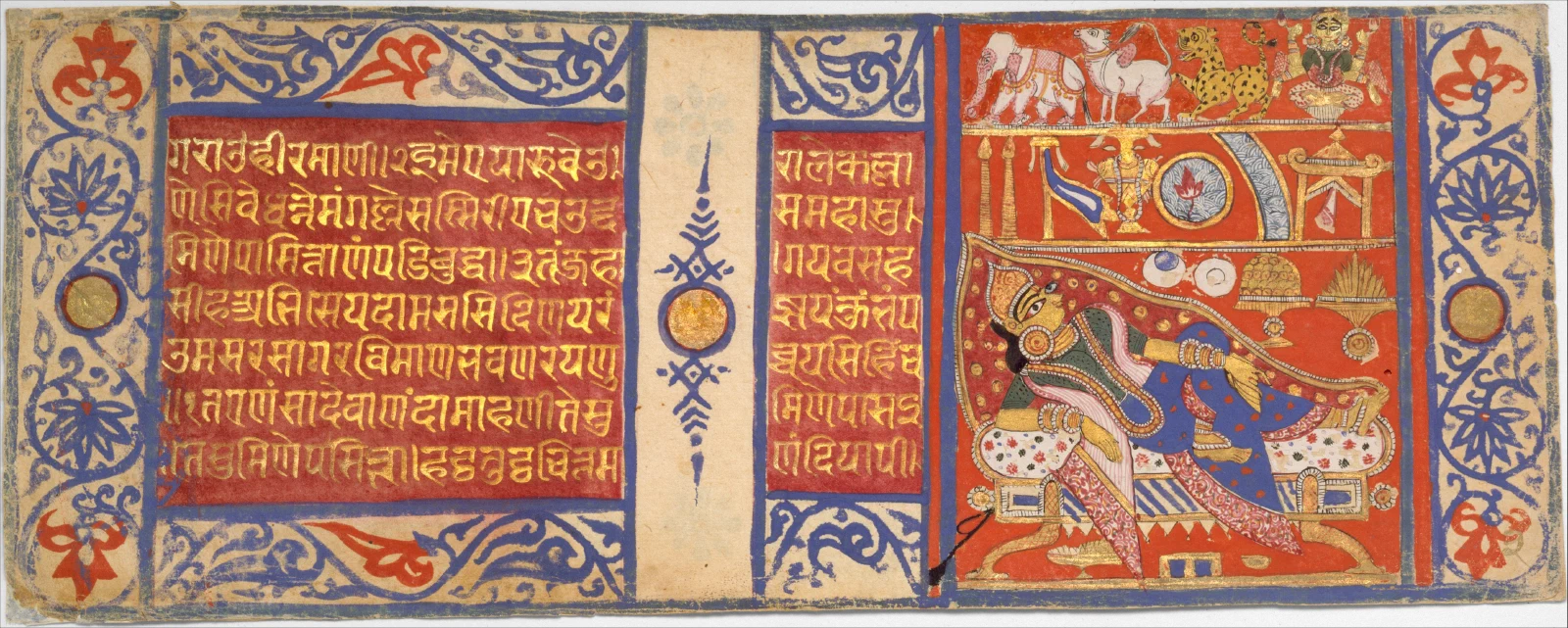
Later corpora move from story into practice: the Puranas organize gods, pilgrimage, and cosmic time; the Agamas and Tantras explain how to build temples, install images, transmit mantras, and use the body in ritual. Bhakti, Sufi, and Sikh poets move authority into songs people can carry without a manuscript. Modern writers inherit all of this along with print, empire, Partition, caste politics, feminism, translation, and the unequal power of English.
The pages below follow the earliest recoverable layers in rough order, not rank. Most of these works grew over centuries, crossed languages, and survive because oral performers, scribes, monks, courts, temples, shrines, printers, and translators kept remaking them. There is no single Indian canon here. There are the texts through which different Indias have explained themselves and argued with one another.
-
Vedas
Hymns, formulas, and ritual texts from the oldest surviving Sanskrit tradition, preserved by an oral system engineered to protect every word and accent.
-
Upanishads
Vedic sages turn toward the self, death, rebirth, and ultimate reality, leaving later schools the same passages to interpret in incompatible ways.
-
Ramayana
Hundreds of tellings make Rama, Sita, and Ravana answer different questions about duty, kingship, gender, and political belonging.
-
Buddhist & Jain Canons
Two textual worlds reject Vedic authority and rebuild ethics, knowledge, selfhood, karma, and liberation from radically different premises.
-
Mahabharata
A family destroys itself while every rule of dharma bends or conflicts; the epic asks what righteousness means when no choice stays clean.
-
Law, Statecraft & Classical Sanskrit
Panini, Manu, Kautilya, Vatsyayana, and Kalidasa show classical Sanskrit thinking beyond scripture: language, power, law, desire, theater, and beauty.
-
Bhagavad Gita
Krishna’s answer to Arjuna’s refusal to fight, how Shankara, Gandhi, and Ambedkar read it differently, and all 701 verses in Sanskrit and translation.
-
Sangam & the Tirukkural
The oldest substantial Tamil poetry makes landscape carry love and war; the Tirukkural compresses virtue, politics, wealth, and desire into 1,330 couplets.
-
Puranas
The layered story-world that connected gods, pilgrimage places, festivals, cosmic time, and local temple myths to everyday Hindu practice.
-
Agamas & Tantras
The operating manuals of temple religion: how to build sacred space, install an image, transmit a mantra, initiate a practitioner, and ritualize the body.
-
Bhakti, Sufi & Sikh Poetry
Poet-saints move authority into vernacular song, from the Alvars and Kabir to Sufi shrines and the Guru Granth Sahib.
-
Modern Literature
Many literatures become connected unevenly by print, empire, Partition, caste, gender, translation, and the disproportionate reach of English.