
Vedas
What they are. Four Vedic collections: Rig, Sama, Yajur, and Atharva. Their oldest Samhita material was composed in Vedic Sanskrit during the second millennium BCE, with the Rigveda the earliest and the Sama and Yajur collections drawing extensively on it. The Samhitas contain hymns, chants, sacrificial formulas, and incantations; later Brahmanas explain ritual; Aranyakas develop more speculative interpretations of it. “Forest texts” is the traditional designation for the Aranyakas, but their precise setting and audience remain debated. The Upanishads grow from these ritual and speculative traditions without forming a neat final layer attached to every Veda in the same way. Brahmanical traditions classify the corpus as shruti, “that which is heard”: revealed rather than authored.
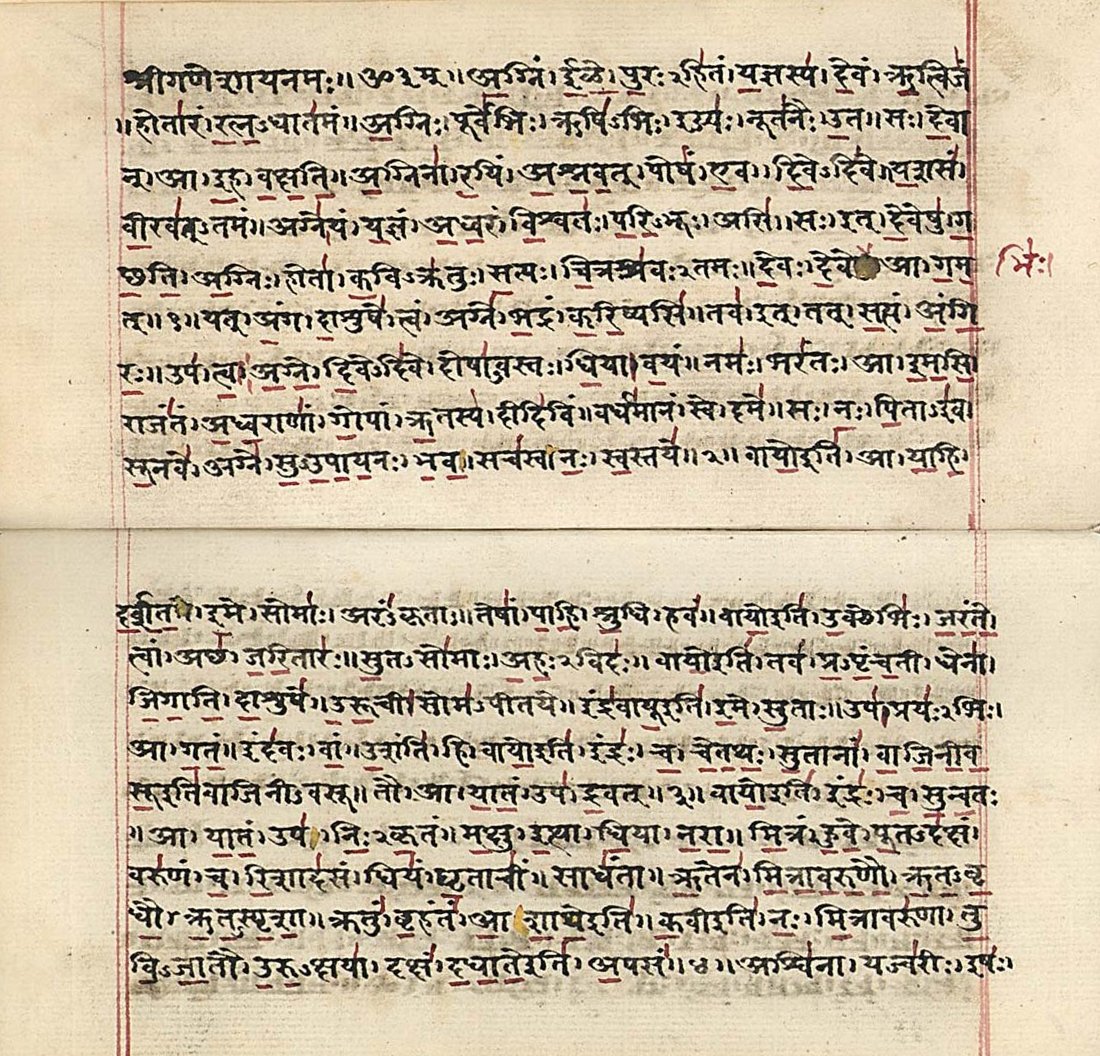
The transmission is the surprising part. The Vedas were composed and transmitted primarily through oral lineages, which remained authoritative even after the use of manuscripts. Reciters preserved words, pronunciation, and tonal accent through several redundant schemes, including pada, krama, jata, and ghana, that rearrange words in prescribed patterns and make many errors easier to detect. The result is an unusually stable oral tradition, though it existed in multiple branches, and many of those branches have been lost. Whatever you think about the content, the mnemonic engineering is remarkable.
What’s in the Rigveda? 1,028 hymns to Agni, Indra, Varuna, Soma, Ushas, and others: praise, petition, and ritual speech, largely addressed to a world of cattle, chariots, rivers, and fire. It is not a book of doctrine and does not read like one. But it also contains the Nasadiya Sukta (10.129), a creation hymn that ends by asking whether anyone knows how creation happened and whether even its highest overseer knows. Its refusal to force a final answer makes it an unusually skeptical work of early cosmological speculation. The Rigveda also contains the Purusha Sukta (10.90), generally treated as a late hymn, whose cosmic body supplies an influential origin story for the fourfold social order. See Caste.