
Bhagavad Gita
What it is. A dialogue in eighteen chapters, embedded in the sixth book of the Mahabharata. It is traditionally counted as 700 verses. The edition displayed here also includes a verse conventionally numbered 13.1, which some editions omit, bringing this page’s total to 701. Arjuna, looking across the field at cousins, teachers, and grandfathers he is about to kill, puts down his bow and says he won’t do it. Krishna, his charioteer and God, spends the rest of the text explaining why he must do so.
When. Roughly 2nd century BCE to 2nd century CE, later than the epic’s oldest strata.
What it argues. It is a synthesis, and unusually explicit about its status as one. It takes Samkhya metaphysics, Upanishadic non-dualism, Vedic ritual duty, and emergent devotionalism and braids them into three routes to the same destination: karma yoga, action performed without attachment to its results; jnana yoga, liberating knowledge; and bhakti yoga, devotion to a personal god. The central move, act but surrender the fruits of action, is what lets the text answer Arjuna without either denying that killing is terrible or excusing him from it. Chapter 11, where Krishna shows his universal form and Arjuna asks him to stop, is the passage everyone remembers.
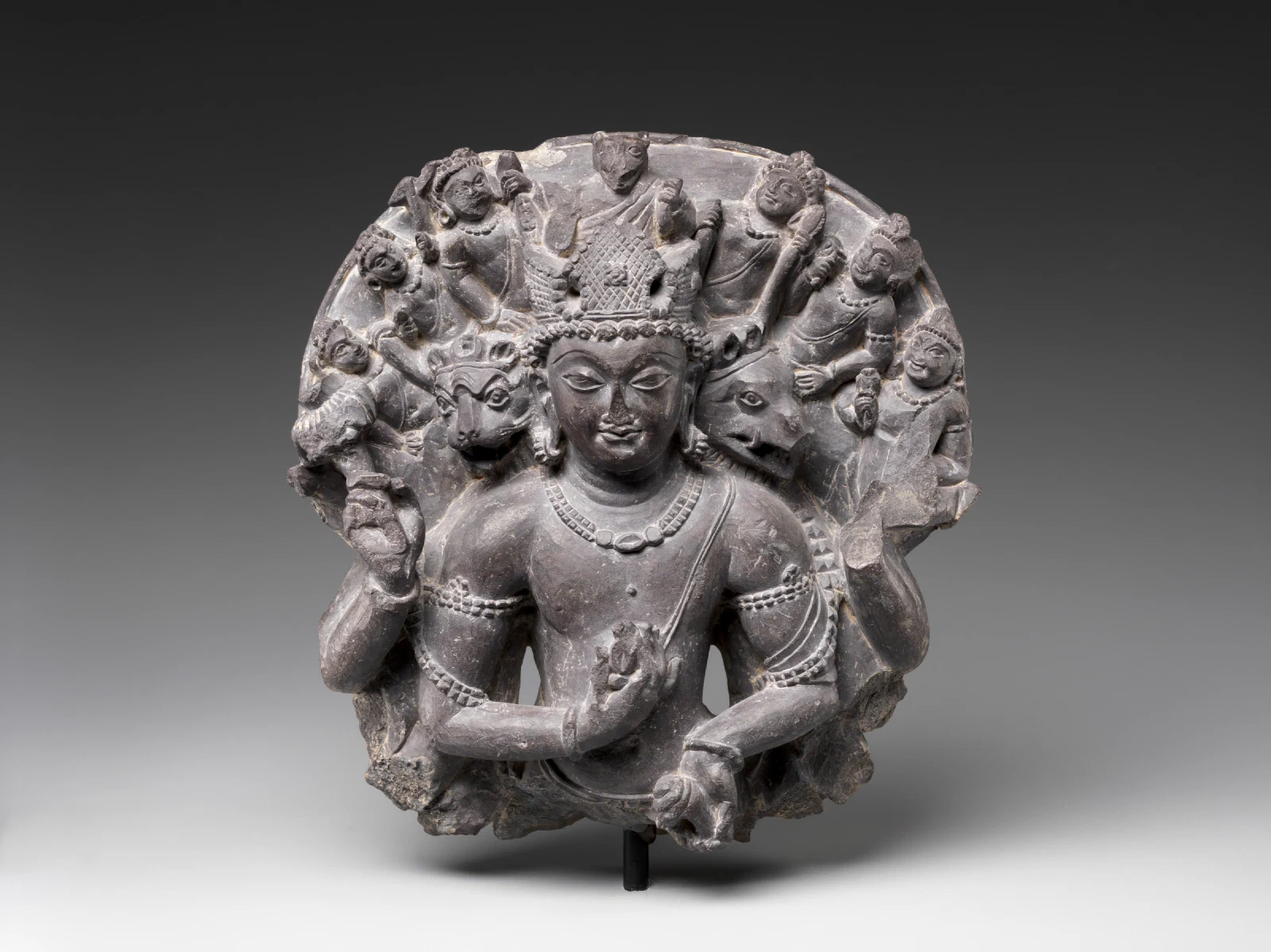
What I found surprising. The Gita already held unusual authority within the Mahabharata, stood alongside the Upanishads and Brahma Sutra as one of Vedanta’s three foundational texts, and attracted major Sanskrit and vernacular commentaries for centuries. What changed after 1785 was its scale and kind of prominence. Colonial translators, European and American readers, Indian reformers, and nationalists increasingly treated this compact dialogue as a portable summary of Hinduism as a whole. Its career as the representative Hindu scripture is modern; its prestige is not. That modern reception history is one of the strangest attached to any book:
- 1785. Charles Wilkins translates it, sponsored by Warren Hastings: the first Sanskrit book rendered directly into English. Emerson and Thoreau read it. It becomes, in the West, the Indian book.
- 1885. Edwin Arnold’s verse translation, The Song Celestial. This is the version Gandhi first read, in London, in English, introduced by Theosophists. He came to his own tradition’s central text through Victorian England.
- 1910–11. Tilak writes Gita Rahasya in a Mandalay prison, reading the text as a mandate for action and, by clear implication, for armed resistance to British rule. It was published in 1915, after his release.
- 1929. Gandhi’s Anasaktiyoga reads the same text as pure allegory: the battlefield is the self, the war is internal, and the Gita is a document of non-violence. He and Tilak are reading identical verses.
- 1930s–40s. Ambedkar attacks it, arguing that it defends both varna and killing, and that its philosophical sophistication serves an indefensible social order. He wrote his essays on the Gita in this period, and they were published only after his death.
- 1945. Oppenheimer, watching Trinity, later says he thought of chapter 11, verse 32. He had learned Sanskrit to read it. Whether the thought occurred at the moment or in the retelling twenty years afterward is not settled, and the retelling is arguably the more interesting artifact.
Four incompatible readings by serious people within fifty years, plus a physicist at the birth of the nuclear age. Richard Davis’s The Bhagavad Gita: A Biography (2015) tells this story properly and is the best entry point to the text’s afterlife.
Translations. Barbara Stoler Miller for literary quality; Laurie Patton’s Penguin for accessibility; Winthrop Sargeant’s interlinear edition if you want to work with the Sanskrit; Radhakrishnan for traditional commentary. Arnold’s Song Celestial is Victorian, lovely, and unfaithful, and it is the one that changed history.
The full text
All eighteen chapters follow, on this page, with the Sanskrit, a transliteration, the translation, and the word-by-word glosses. Every verse has its own anchor, so any of them can be linked directly: /india/texts/gita/#2-47.
From chapter 2 onward, Śaṅkara’s commentary is given as a concise modern-English paraphrase of his explanation. Śaṅkara gives no separate exposition of chapter 1 in this edition. The paraphrases were prepared from Alladi Mahadeva Sastri’s public-domain 1901 translation; they are summaries, not quotations or a complete translation.
1. Arjuna Vishada Yoga
अर्जुनविषादयोग · Arjuna's Despair · 35 verses
धर्मक्षेत्रे कुरुक्षेत्रे समवेता युयुत्सवः ।
मामकाः पाण्डवाश्चैव किमकुर्वत सञ्जय ॥ १ ॥
dharmakṣetre kurukṣetre samavetā yuyutsavaḥ |
māmakāḥ pāṇḍavāścaiva kimakurvata sañjaya || 1 ||
Dhritarashtra said: Sanjaya, after my sons and the sons of Pandu gathered on the sacred field of Kurukshetra, ready to fight, what did they do?
दृष्ट्वा तु पाण्डवानीकं व्यूढं दुर्योधनस्तदा ।
आचार्यमुपसङ्गम्य राजा वचनमब्रवीत् ॥ २ ॥
dṛṣṭvā tu pāṇḍavānīkaṃ vyūḍhaṃ duryodhanastadā |
ācāryamupasaṅgamya rājā vacanamabravīt || 2 ||
Sanjaya said: When King Duryodhana saw the Pandava army formed for battle, he approached his teacher Drona and said:
व्यूढां द्रुपदपुत्रेण तव शिष्येण धीमता ॥ ३ ॥
vyūḍhāṃ drupadaputreṇa tava śiṣyeṇa dhīmatā || 3 ||
Teacher, look at this powerful army of Pandu’s sons, arranged by your gifted student, Drupada’s son.
युयुधानो विराटश्च द्रुपदश्च महारथ: ॥ ४ ॥
धृष्टकेतुश्चेकितान: काशिराजश्च वीर्यवान् ।
पुरुजित्कुन्तिभोजश्च शैब्यश्च नरपुङ्गव: ॥ ५ ॥
युधामन्युश्च विक्रान्त उत्तमौजाश्च वीर्यवान् ।
सौभद्रो द्रौपदेयाश्च सर्व एव महारथा: ॥ ६ ॥
yuyudhāno virāṭaśca drupadaśca mahārathaḥ || 4 ||
dhṛṣṭaketuścekitānaḥ kāśirājaśca vīryavān |
purujitkuntibhojaśca śaibyaśca narapuṅgavaḥ || 5 ||
yudhāmanyuśca vikrānta uttamaujāśca vīryavān |
saubhadro draupadeyāśca sarva eva mahārathāḥ || 6 ||
Here are heroic archers equal to Bhima and Arjuna in battle: Yuyudhana, Virata, and the great chariot warrior Drupada; Dhrishtaketu, Chekitana, the brave king of Kashi, Purujit, Kuntibhoja, and Shaivya, an outstanding leader; the strong Yudhamanyu, the courageous Uttamaujas, Subhadra’s son, and Draupadi’s sons, all great chariot warriors.
नायका मम सैन्यस्य संज्ञार्थं तान्ब्रवीमि ते ॥ ७ ॥
nāyakā mama sainyasya saṃjñārthaṃ tānbravīmi te || 7 ||
Now, best of Brahmins, let me name the leading commanders of our own army so that you know them.
अश्वत्थामा विकर्णश्च सौमदत्तिस्तथैव च ॥ ८ ॥
aśvatthāmā vikarṇaśca saumadattistathaiva ca || 8 ||
There are you, Bhishma, Karna, and Kripa, all victorious in battle, as well as Ashvatthama, Vikarna, and Somadatta’s son.
नानाशस्त्रप्रहरणा: सर्वे युद्धविशारदा: ॥ ९ ॥
nānāśastrapraharaṇāḥ sarve yuddhaviśāradāḥ || 9 ||
Many other heroes are also prepared to give their lives for me. They carry many kinds of weapons and are skilled in war.
पर्याप्तं त्विदमेतेषां बलं भीमाभिरक्षितम् ॥ १० ॥
paryāptaṃ tvidameteṣāṃ balaṃ bhīmābhirakṣitam || 10 ||
Our forces, though commanded by Bhishma, seem insufficient, while their forces, commanded by Bhima, seem sufficient.
भीष्ममेवाभिरक्षन्तु भवन्त: सर्व एव हि ॥ ११ ॥
bhīṣmamevābhirakṣantu bhavantaḥ sarva eva hi || 11 ||
All of you must therefore hold your assigned positions and protect Bhishma from every side.
सिंहनादं विनद्योच्चै: शङ्खं दध्मौ प्रतापवान् ॥ १२ ॥
siṃhanādaṃ vinadyoccaiḥ śaṅkhaṃ dadhmau pratāpavān || 12 ||
To encourage Duryodhana, the glorious Bhishma, elder of the Kurus, roared like a lion and blew his conch.
सहसैवाभ्यहन्यन्त स शब्दस्तुमुलोऽभवत् ॥ १३ ॥
sahasaivābhyahanyanta sa śabdastumulo’bhavat || 13 ||
Conches, kettledrums, drums, trumpets, and horns suddenly sounded together, creating a tremendous noise.
माधव: पाण्डवश्चैव दिव्यौ शङ्खौ प्रदध्मतु: ॥ १४ ॥
mādhavaḥ pāṇḍavaścaiva divyau śaṅkhau pradadhmatuḥ || 14 ||
Then Krishna and Arjuna, seated in their magnificent chariot drawn by white horses, blew their divine conches.
पौण्ड्रं दध्मौ महाशङ्खं भीमकर्मा वृकोदर: ॥ १५ ॥
pauṇḍraṃ dadhmau mahāśaṅkhaṃ bhīmakarmā vṛkodaraḥ || 15 ||
Krishna blew Panchajanya, Arjuna blew Devadatta, and mighty Bhima, known for his terrible deeds, blew his great conch Paundra.
नकुल: सहदेवश्च सुघोषमणिपुष्पकौ ॥ १६ ॥
काश्यश्च परमेष्वास: शिखण्डी च महारथ: ।
धृष्टद्युम्नो विराटश्च सात्यकिश्चापराजित: ॥ १७ ॥
द्रुपदो द्रौपदेयाश्च सर्वश: पृथिवीपते ।
सौभद्रश्च महाबाहु: शङ्खान्दध्मु: पृथक् पृथक् ॥ १८ ॥
nakulaḥ sahadevaśca sughoṣamaṇipuṣpakau || 16 ||
kāśyaśca parameṣvāsaḥ śikhaṇḍī ca mahārathaḥ |
dhṛṣṭadyumno virāṭaśca sātyakiścāparājitaḥ || 17 ||
drupado draupadeyāśca sarvaśaḥ pṛthivīpate |
saubhadraśca mahābāhuḥ śaṅkhāndadhmuḥ pṛthak pṛthak || 18 ||
King Yudhishthira, son of Kunti, blew Anantavijaya. Nakula and Sahadeva blew Sughosha and Manipushpaka. The master archer and king of Kashi, the great warrior Shikhandi, Dhrishtadyumna, Virata, and the undefeated Satyaki also blew their conches. King, Drupada, Draupadi’s sons, and mighty-armed Subhadra’s son each sounded their conch.
नभश्च पृथिवीं चैव तुमुलोऽभ्यनुनादयन् ॥ १९ ॥
nabhaśca pṛthivīṃ caiva tumulo’bhyanunādayan || 19 ||
The thunderous noise echoed through earth and sky and struck fear into the hearts of Dhritarashtra’s sons.
प्रवृत्ते शस्त्रसम्पाते धनुरुद्यम्य पाण्डव: ॥ २० ॥
हृषीकेशं तदा वाक्यमिदमाह महीपते ।
pravṛtte śastrasampāte dhanurudyamya pāṇḍavaḥ || 20 ||
hṛṣīkeśaṃ tadā vākyamidamāha mahīpate |
As the fighting was about to begin, Arjuna, the son of Pandu whose banner bore a monkey, saw Dhritarashtra’s sons in formation, raised his bow, and addressed Krishna, King.
सेनयोरुभयोर्मध्ये रथं स्थापय मेऽच्युत ॥ २१ ॥
यावदेतान्निरीक्षेऽहं योद्धुकामानवस्थितान् ।
कैर्मया सह योद्धव्यमस्मिन् रणसमुद्यमे ॥ २२ ॥
senayorubhayormadhye rathaṃ sthāpaya me’cyuta || 21 ||
yāvadetānnirīkṣe’haṃ yoddhukāmānavasthitān |
kairmayā saha yoddhavyamasmin raṇasamudyame || 22 ||
Arjuna said: Achyuta, place my chariot between the two armies so I can see those standing here ready for battle and know whom I must fight in this war.
धार्तराष्ट्रस्य दुर्बुद्धेर्युद्धे प्रियचिकीर्षव: ॥ २३ ॥
dhārtarāṣṭrasya durbuddheryuddhe priyacikīrṣavaḥ || 23 ||
I want to see those who have gathered to fight in hopes of pleasing the evil-minded son of Dhritarashtra.
एवमुक्तो हृषीकेशो गुडाकेशेन भारत ।
सेनयोरुभयोर्मध्ये स्थापयित्वा रथोत्तमम् ॥ २४ ॥
evamukto hṛṣīkeśo guḍākeśena bhārata |
senayorubhayormadhye sthāpayitvā rathottamam || 24 ||
Sanjaya said: Bharata, when Arjuna asked him this, Krishna placed the magnificent chariot between the two armies.
उवाच पार्थ पश्यैतान्समवेतान्कुरूनिति ॥ २५ ॥
uvāca pārtha paśyaitānsamavetānkurūniti || 25 ||
Facing Bhishma, Drona, and all the rulers, Krishna said: Partha, look at these assembled Kurus.
आचार्यान्मातुलान्भ्रातृ न्पुत्रान्पौत्रान्सखींस्तथा ॥ २६ ॥
श्वशुरान्सुहृदश्चैव सेनयोरुभयोरपि ।
ācāryānmātulānbhrātṛ nputrānpautrānsakhīṃstathā || 26 ||
śvaśurānsuhṛdaścaiva senayorubhayorapi |
Arjuna saw fathers, grandfathers, teachers, maternal uncles, brothers, sons, grandsons, friends, fathers-in-law, and well-wishers standing in both armies.
कृपया परयाविष्टो विषीदन्निदमब्रवीत् ।
kṛpayā parayāviṣṭo viṣīdannidamabravīt |
Seeing all his relatives ready for battle, Kunti’s son was overcome with compassion and spoke in sorrow.
दृष्ट्वेमं स्वजनं कृष्ण युयुत्सुं समुपस्थितम् ॥ २८ ॥
सीदन्ति मम गात्राणि मुखं च परिशुष्यति ।
dṛṣṭvemaṃ svajanaṃ kṛṣṇa yuyutsuṃ samupasthitam || 28 ||
sīdanti mama gātrāṇi mukhaṃ ca pariśuṣyati |
Arjuna said: Krishna, when I see my own relatives here eager to fight, my limbs grow weak and my mouth goes dry.
गाण्डीवं स्रंसते हस्तात्त्वक्चै व परिदह्यते ।
न च शक्नोम्यवस्थातुं भ्रमतीव च मे मन: ॥ ३० ॥
निमित्तानि च पश्यामि विपरीतानि केशव ।
न च श्रेयोऽनुपश्यामि हत्वा स्वजनमाहवे ॥ ३१ ॥
gāṇḍīvaṃ sraṃsate hastāttvakcai va paridahyate |
na ca śaknomyavasthātuṃ bhramatīva ca me manaḥ || 30 ||
nimittāni ca paśyāmi viparītāni keśava |
na ca śreyo’nupaśyāmi hatvā svajanamāhave || 31 ||
My body trembles, and my hair stands on end. Gandiva slips from my hand, my skin burns, I cannot remain standing, and my mind is spinning. I see only bad signs, Keshava. I cannot see how any good could come from killing my relatives in battle.
किं नो राज्येन गोविन्द किं भोगैर्जीवितेन वा ॥ ३२ ॥
येषामर्थे काङ्क्षितं नो राज्यं भोगा: सुखानि च ।
त इमेऽवस्थिता युद्धे प्राणांस्त्यक्त्वा धनानि च ॥ ३३ ॥
kiṃ no rājyena govinda kiṃ bhogairjīvitena vā || 32 ||
yeṣāmarthe kāṅkṣitaṃ no rājyaṃ bhogāḥ sukhāni ca |
ta ime’vasthitā yuddhe prāṇāṃstyaktvā dhanāni ca || 33 ||
Krishna, I want neither victory, nor a kingdom, nor its pleasures. Govinda, what use are a kingdom, enjoyment, or even life when those for whose sake we desire them stand here in battle, prepared to give up their lives and wealth?
मातुला: श्वशुरा: पौत्रा: श्याला: सम्बन्धिनस्तथा ॥ ३४ ॥
एतान्न हन्तुमिच्छामि घ्नतोऽपि मधुसूदन ।
अपि त्रैलोक्यराज्यस्य हेतो: किं नु महीकृते ॥ ३५ ॥
mātulāḥ śvaśurāḥ pautrāḥ śyālāḥ sambandhinastathā || 34 ||
etānna hantumicchāmi ghnato’pi madhusūdana |
api trailokyarājyasya hetoḥ kiṃ nu mahīkṛte || 35 ||
They are our teachers, fathers, sons, grandfathers, maternal uncles, fathers-in-law, grandsons, brothers-in-law, and other relatives. Madhusudana, I do not want to kill them even if they kill me, not even for rule over the three worlds, much less for the earth.
पापमेवाश्रयेदस्मान्हत्वैतानाततायिन: ॥ ३६ ॥
तस्मान्नार्हा वयं हन्तुं धार्तराष्ट्रान्स्वबान्धवान् ।
स्वजनं हि कथं हत्वा सुखिन: स्याम माधव ॥ ३७ ॥
pāpamevāśrayedasmānhatvaitānātatāyinaḥ || 36 ||
tasmānnārhā vayaṃ hantuṃ dhārtarāṣṭrānsvabāndhavān |
svajanaṃ hi kathaṃ hatvā sukhinaḥ syāma mādhava || 37 ||
Janardana, what joy could we gain by killing Dhritarashtra’s sons? Even if they are aggressors, killing them would make us guilty. We should not kill Dhritarashtra’s sons, our own relatives. Madhava, how could we be happy after killing our family?
कुलक्षयकृतं दोषं मित्रद्रोहे च पातकम् ॥ ३८ ॥
कथं न ज्ञेयमस्माभि: पापादस्मान्निवर्तितुम् ।
कुलक्षयकृतं दोषं प्रपश्यद्भिर्जनार्दन ॥ ३९ ॥
kulakṣayakṛtaṃ doṣaṃ mitradrohe ca pātakam || 38 ||
kathaṃ na jñeyamasmābhiḥ pāpādasmānnivartitum |
kulakṣayakṛtaṃ doṣaṃ prapaśyadbhirjanārdana || 39 ||
Their judgment is clouded by greed, so they see no wrong in destroying a family or betraying friends. But Janardana, we can see the evil in destroying a family. Why should we not turn away from this wrong?
धर्मे नष्टे कुलं कृत्स्नमधर्मोऽभिभवत्युत ॥ ४० ॥
dharme naṣṭe kulaṃ kṛtsnamadharmo’bhibhavatyuta || 40 ||
When a family is destroyed, its long-standing traditions disappear. When those traditions are lost, lawlessness overwhelms the whole family.
स्त्रीषु दुष्टासु वार्ष्णेय जायते वर्णसङ्कर: ॥ ४१ ॥
strīṣu duṣṭāsu vārṣṇeya jāyate varṇasaṅkaraḥ || 41 ||
When lawlessness prevails, Krishna, the women of the family are corrupted; and when that happens, Varshneya, social order breaks down.
पतन्ति पितरो ह्येषां लुप्तपिण्डोदकक्रिया: ॥ ४२ ॥
patanti pitaro hyeṣāṃ luptapiṇḍodakakriyāḥ || 42 ||
This disorder drags both the family’s destroyers and the family itself toward hell. Their ancestors also fall, deprived of the traditional offerings of food and water.
उत्साद्यन्ते जातिधर्मा: कुलधर्माश्च शाश्वता: ॥ ४३ ॥
utsādyante jātidharmāḥ kuladharmāśca śāśvatāḥ || 43 ||
Through the wrongdoing of those who destroy a family and bring social disorder, its lasting social and family customs are abolished.
नरकेऽनियतं वासो भवतीत्यनुशुश्रुम ॥ ४४ ॥
narake’niyataṃ vāso bhavatītyanuśuśruma || 44 ||
Janardana, we have heard that people whose family traditions are destroyed remain in hell.
यद्राज्यसुखलोभेन हन्तुं स्वजनमुद्यता: ॥ ४५ ॥
यदि मामप्रतीकारमशस्त्रं शस्त्रपाणय: ।
धार्तराष्ट्रा रणे हन्युस्तन्मे क्षेमतरं भवेत् ॥ ४६ ॥
yadrājyasukhalobhena hantuṃ svajanamudyatāḥ || 45 ||
yadi māmapratīkāramaśastraṃ śastrapāṇayaḥ |
dhārtarāṣṭrā raṇe hanyustanme kṣemataraṃ bhavet || 46 ||
How terrible that greed for royal pleasures has made us ready to commit the great wrong of killing our own relatives. It would be better for me if Dhritarashtra’s armed sons killed me in battle while I remained unarmed and did not resist.
एवमुक्त्वार्जुन: सङ्ख्ये रथोपस्थ उपाविशत् ।
विसृज्य सशरं चापं शोकसंविग्नमानस: ॥ ४७ ॥
evamuktvārjunaḥ saṅkhye rathopastha upāviśat |
visṛjya saśaraṃ cāpaṃ śokasaṃvignamānasaḥ || 47 ||
Sanjaya said: After speaking on the battlefield, Arjuna dropped his bow and arrows and sank onto the chariot seat, overwhelmed by grief.
2. Sankhya Yoga
सांख्ययोग · The Yoga of Analysis · 71 verses
तं तथा कृपयाविष्टमश्रुपूर्णाकुलेक्षणम् ।
विषीदन्तमिदं वाक्यमुवाच मधुसूदन: ॥ १ ॥
taṃ tathā kṛpayāviṣṭamaśrupūrṇākulekṣaṇam |
viṣīdantamidaṃ vākyamuvāca madhusūdanaḥ || 1 ||
Sanjaya said: Arjuna was overcome with compassion and despair, his burning eyes filled with tears. Krishna then spoke to him.
कुतस्त्वा कश्मलमिदं विषमे समुपस्थितम् ।
अनार्यजुष्टमस्वर्ग्यमकीर्तिकरमर्जुन ॥ २ ॥
kutastvā kaśmalamidaṃ viṣame samupasthitam |
anāryajuṣṭamasvargyamakīrtikaramarjuna || 2 ||
Krishna said: Arjuna, why have you given in to despair at this moment of crisis? It is unworthy of you, closes the way to heaven, and brings disgrace.
Krishna first condemns Arjuna's collapse as unworthy of an honorable person. For Śaṅkara, this rebuke is preliminary; the direct teaching about the Self begins at 2.11.
क्षुद्रं हृदयदौर्बल्यं त्यक्त्वोत्तिष्ठ परन्तप ॥ ३ ॥
kṣudraṃ hṛdayadaurbalyaṃ tyaktvottiṣṭha parantapa || 3 ||
Do not surrender to weakness, Partha; it does not suit you. Shake off this cowardice and stand up, conqueror of enemies.
Arjuna has mistaken grief for compassion and withdrawal for virtue. Krishna tells him to abandon this weakness before explaining why his reasoning is mistaken.
कथं भीष्ममहं सङ्ख्ये द्रोणं च मधुसूदन ।
इषुभि: प्रतियोत्स्यामि पूजार्हावरिसूदन ॥ ४ ॥
kathaṃ bhīṣmamahaṃ saṅkhye droṇaṃ ca madhusūdana |
iṣubhiḥ pratiyotsyāmi pūjārhāvarisūdana || 4 ||
Arjuna said: Madhusudana, how can I shoot arrows at Bhishma and Drona in battle when they deserve my reverence?
Arjuna's conflict is real at the level of social duty: warriors deserve resistance, while teachers deserve reverence. Śaṅkara uses the dilemma to show that Arjuna cannot escape confusion merely by choosing a different action.
श्रेयो भोक्तुं भैक्ष्यमपीह लोके ।
हत्वार्थकामांस्तु गुरूनिहैव
भुञ्जीय भोगान् रुधिरप्रदिग्धान् ॥ ५ ॥
śreyo bhoktuṃ bhaikṣyamapīha loke |
hatvārthakāmāṃstu gurūnihaiva
bhuñjīya bhogān rudhirapradigdhān || 5 ||
It would be better to live on alms than to kill these honored teachers. If I killed my teachers and well-wishers, every pleasure I enjoyed would be stained with their blood.
Arjuna proposes a mendicant's life, but Śaṅkara says this is renunciation born from grief and delusion, not from knowledge of the Self. Changing one's outward role does not by itself remove ignorance.
यद्वा जयेम यदि वा नो जयेयु: ।
यानेव हत्वा न जिजीविषाम
स्तेऽवस्थिता: प्रमुखे धार्तराष्ट्रा: ॥ ६ ॥
yadvā jayema yadi vā no jayeyuḥ |
yāneva hatvā na jijīviṣāma
ste’vasthitāḥ pramukhe dhārtarāṣṭrāḥ || 6 ||
I do not know which outcome would be better: defeating them or being defeated by them. If we killed Dhritarashtra’s sons standing against us, we would no longer want to live.
Arjuna cannot determine either the proper action or the outcome worth desiring. His uncertainty shows why he needs knowledge rather than another calculation of advantage.
पृच्छामि त्वां धर्मसम्मूढचेता: ।
यच्छ्रेय: स्यान्निश्चितं ब्रूहि तन्मे
शिष्यस्तेऽहं शाधि मां त्वां प्रपन्नम् ॥ ७ ॥
pṛcchāmi tvāṃ dharmasammūḍhacetāḥ |
yacchreyaḥ syānniścitaṃ brūhi tanme
śiṣyaste’haṃ śādhi māṃ tvāṃ prapannam || 7 ||
My heart is overcome by weakness, and I am confused about my duty. Tell me clearly what is best. I am your student; I take refuge in you. Teach me.
By becoming Krishna's student, Arjuna stops treating his private judgment as sufficient. Śaṅkara emphasizes that his confusion concerns dharma, and that he now asks for the good that leads beyond grief.
यच्छोकमुच्छोषणमिन्द्रियाणाम् ।
अवाप्य भूमावसपत्नमृद्धं
राज्यं सुराणामपि चाधिपत्यम् ॥ ८ ॥
yacchokamucchoṣaṇamindriyāṇām |
avāpya bhūmāvasapatnamṛddhaṃ
rājyaṃ surāṇāmapi cādhipatyam || 8 ||
I see nothing that could remove this grief that is drying up my senses, not even an unrivaled kingdom on earth or rule over the gods.
No external achievement can cure a grief rooted in ignorance of the Self. Even universal sovereignty would leave its cause untouched.
एवमुक्त्वा हृषीकेशं गुडाकेश: परन्तप ।
न योत्स्य इति गोविन्दमुक्त्वा तूष्णीं बभूव ह ॥ ९ ॥
evamuktvā hṛṣīkeśaṃ guḍākeśaḥ parantapa |
na yotsya iti govindamuktvā tūṣṇīṃ babhūva ha || 9 ||
Sanjaya said: After telling Krishna, ‘I will not fight,’ Arjuna, conqueror of enemies, fell silent.
Arjuna's refusal closes his argument but does not settle what is right. His silence makes room for Krishna's teaching.
सेनयोरुभयोर्मध्ये विषीदन्तमिदं वच: ॥ १० ॥
senayorubhayormadhye viṣīdantamidaṃ vacaḥ || 10 ||
Then Krishna smiled and addressed the despairing Arjuna between the two armies.
Śaṅkara reads Krishna's smile as the composure of one who sees that Arjuna grieves through delusion while speaking in the language of wisdom.
अशोच्यानन्वशोचस्त्वं प्रज्ञावादांश्च भाषसे ।
गतासूनगतासूंश्च नानुशोचन्ति पण्डिता: ॥ ११ ॥
aśocyānanvaśocastvaṃ prajñāvādāṃśca bhāṣase |
gatāsūnagatāsūṃśca nānuśocanti paṇḍitāḥ || 11 ||
Krishna said: You grieve for those who should not be grieved for, yet you speak as if you were wise. The wise grieve for neither the living nor the dead.
The wise do not mourn because the Self is never lost, while bodies are necessarily perishable. Arjuna's learned arguments therefore rest on a failure to distinguish the Self from the body.
न चैव न भविष्याम: सर्वे वयमत: परम् ॥ १२ ॥
na caiva na bhaviṣyāmaḥ sarve vayamataḥ param || 12 ||
There was never a time when I did not exist, nor you, nor these kings; and none of us will cease to exist in the future.
The Self present as 'I' has never been absent and will never cease to be. The verse does not make the eternal Self one changing individual among many bodies.
तथा देहान्तरप्राप्तिर्धीरस्तत्र न मुह्यति ॥ १३ ॥
tathā dehāntaraprāptirdhīrastatra na muhyati || 13 ||
Just as the embodied self passes through childhood, youth, and old age within this body, it passes into another body. A steady person is not confused by this.
Childhood, youth, old age, and the taking of another body are changes presented to the same conscious Self. One who recognizes that continuity is not confused by bodily change.
आगमापायिनोऽनित्यास्तांस्तितिक्षस्व भारत ॥ १४ ॥
āgamāpāyino’nityāstāṃstitikṣasva bhārata || 14 ||
Son of Kunti, contact with matter produces heat and cold, pleasure and pain. These experiences come and go; they do not last. Endure them patiently, Bharata.
Heat, cold, pleasure, and pain arise when the senses meet their objects. Because these experiences begin and end, an aspirant should endure them without letting them govern judgment.
समदु:खसुखं धीरं सोऽमृतत्वाय कल्पते ॥ १५ ॥
samaduḥkhasukhaṃ dhīraṃ so’mṛtatvāya kalpate || 15 ||
Greatest of people, one who remains steady and is disturbed by neither pain nor pleasure becomes ready for immortality.
Steadiness amid pleasure and pain makes a person fit for liberating knowledge. Immortality is recognition of the deathless Self, not a reward newly produced by endurance.
उभयोरपि दृष्टोऽन्तस्त्वनयोस्तत्त्वदर्शिभि: ॥ १६ ॥
ubhayorapi dṛṣṭo’ntastvanayostattvadarśibhiḥ || 16 ||
The unreal has no lasting existence, and the real never ceases to exist. Those who see the truth understand the nature of both.
What changes and disappears has no independent reality; what is real never passes out of being. Those who discern truth see the body and its conditions as changing appearances, and the Self as the constant reality.
विनाशमव्ययस्यास्य न कश्चित्कर्तुमर्हति ॥ १७ ॥
vināśamavyayasyāsya na kaścitkartumarhati || 17 ||
Know that the reality pervading everything is indestructible. Nothing can destroy it.
The indestructible reality is the Self that pervades every experience and body. Nothing can destroy it because destruction is itself an event known in consciousness.
अनाशिनोऽप्रमेयस्य तस्माद्युध्यस्व भारत ॥ १८ ॥
anāśino’prameyasya tasmādyudhyasva bhārata || 18 ||
The eternal, indestructible, immeasurable self lives in bodies that will die. Therefore fight, Bharata.
Bodies are finite, but the embodied Self is eternal and cannot be measured as an object. Krishna's command to fight addresses Arjuna in his present role, after distinguishing bodily death from destruction of the Self.
उभौ तौ न विजानीतो नायं हन्ति न हन्यते ॥ १९ ॥
ubhau tau na vijānīto nāyaṃ hanti na hanyate || 19 ||
Anyone who thinks the self kills or can be killed does not understand. The self neither kills nor is killed.
Killing and being killed belong to bodies and actions, not to the actionless Self. Anyone who assigns either role to the Self has confused it with the body.
नायं भूत्वा भविता वा न भूय: ।
अजो नित्य: शाश्वतोऽयं पुराणो
न हन्यते हन्यमाने शरीरे ॥ २० ॥
nāyaṃ bhūtvā bhavitā vā na bhūyaḥ |
ajo nityaḥ śāśvato’yaṃ purāṇo
na hanyate hanyamāne śarīre || 20 ||
The self is never born and never dies. It did not come into being, and it will never cease to be. Unborn, eternal, enduring, and ancient, it is not killed when the body is killed.
The Self undergoes none of the six bodily changes, including birth, growth, decline, and death. It is not a product, so the body's destruction cannot destroy it.
कथं स पुरुष: पार्थ कं घातयति हन्ति कम् ॥ २१ ॥
kathaṃ sa puruṣaḥ pārtha kaṃ ghātayati hanti kam || 21 ||
Partha, when someone knows the self to be indestructible, eternal, unborn, and unchanging, how could that person kill or cause anyone to be killed?
One who directly knows the Self as changeless cannot regard it as an agent who kills. Śaṅkara takes this as support for the renunciation proper to knowledge, not as a claim that bodily actions never occur.
नवानि गृह्णाति नरोऽपराणि ।
तथा शरीराणि विहाय जीर्णा
न्यन्यानि संयाति नवानि देही ॥ २२ ॥
navāni gṛhṇāti naro’parāṇi |
tathā śarīrāṇi vihāya jīrṇā
nyanyāni saṃyāti navāni dehī || 22 ||
As a person discards worn-out clothes and puts on new ones, the embodied self leaves worn-out bodies and enters new ones.
Changing bodies do not alter the Self, just as changing clothes does not alter their wearer. The analogy explains continuity through death without making the Self a material traveler.
न चैनं क्लेदयन्त्यापो न शोषयति मारुत: ॥ २३ ॥
na cainaṃ kledayantyāpo na śoṣayati mārutaḥ || 23 ||
Weapons cannot cut the self, fire cannot burn it, water cannot wet it, and wind cannot dry it.
Cutting, burning, wetting, and drying affect material things composed of parts. The partless Self is beyond the reach of every physical process.
नित्य: सर्वगत: स्थाणुरचलोऽयं सनातन: ॥ २४ ॥
nityaḥ sarvagataḥ sthāṇuracalo’yaṃ sanātanaḥ || 24 ||
It cannot be cut, burned, wetted, or dried. It is eternal, all-pervading, stable, immovable, and ancient.
The repeated negatives exclude every kind of material change. The Self is all-pervading and stable, so it neither moves from place to place nor develops into something new.
तस्मादेवं विदित्वैनं नानुशोचितुमर्हसि ॥ २५ ॥
tasmādevaṃ viditvainaṃ nānuśocitumarhasi || 25 ||
The self is said to be unmanifest, inconceivable, and unchanging. Knowing this, you should not grieve.
The Self cannot be perceived by the senses, pictured by ordinary thought, or altered. Once Arjuna understands that bodily events do not touch it, his grief has no rational basis.
तथापि त्वं महाबाहो नैवं शोचितुमर्हसि ॥ २६ ॥
tathāpi tvaṃ mahābāho naivaṃ śocitumarhasi || 26 ||
Even if you believe that the self is constantly born and constantly dies, mighty-armed Arjuna, you still should not grieve.
Even on the opposing assumption that a self repeatedly comes into being and dies, grief would still be misplaced. What necessarily arises and passes cannot be preserved by mourning.
तस्मादपरिहार्येऽर्थे न त्वं शोचितुमर्हसि ॥ २७ ॥
tasmādaparihārye’rthe na tvaṃ śocitumarhasi || 27 ||
Death is certain for everyone who is born, and birth is certain for everyone who dies. You should not grieve over what cannot be avoided.
Within the cycle of birth and death, each inevitably follows the other. No action can prevent this general law, so the unavoidable is not a sound object of grief.
अव्यक्तनिधनान्येव तत्र का परिदेवना ॥ २८ ॥
avyaktanidhanānyeva tatra kā paridevanā || 28 ||
Beings are unmanifest before birth, manifest between birth and death, and unmanifest again after death, Bharata. Why mourn what follows this course?
Before and after its brief manifestation, a body is unavailable to perception. Its temporary appearance gives no ground for mourning as though an eternal possession had been destroyed.
माश्चर्यवद्वदति तथैव चान्य: ।
आश्चर्यवच्चैनमन्य: शृ्णोति
श्रुत्वाप्येनं वेद न चैव कश्चित् ॥ २९ ॥
māścaryavadvadati tathaiva cānyaḥ |
āścaryavaccainamanyaḥ śṛṇoti
śrutvāpyenaṃ veda na caiva kaścit || 29 ||
One person sees the self as astonishing, another describes it as astonishing, and another hears of it as astonishing; yet even after hearing, no one fully understands it.
The Self is astonishing because it is the knower in every act of knowing and can never be made an ordinary object. Hearing descriptions is not enough; direct understanding is rare.
तस्मात्सर्वाणि भूतानि न त्वं शोचितुमर्हसि ॥ ३० ॥
tasmātsarvāṇi bhūtāni na tvaṃ śocitumarhasi || 30 ||
The self within every body can never be harmed, Bharata. Therefore you should not grieve for any being.
The indwelling Self in every body is invulnerable. Śaṅkara concludes the argument against grief here: no being's true Self can be slain.
धर्म्याद्धि युद्धाच्छ्रेयोऽन्यत्क्षत्रियस्य न विद्यते ॥ ३१ ॥
dharmyāddhi yuddhācchreyo’nyatkṣatriyasya na vidyate || 31 ||
Consider your own duty as a warrior. You should not hesitate, because nothing is more fitting for a Kshatriya than a righteous battle.
For one who has not attained Self-knowledge and still acts within social duties, a warrior's obligation remains. Śaṅkara sharply distinguishes this discipline of action from the renunciation of a knower.
सुखिन: क्षत्रिया: पार्थ लभन्ते युद्धमीदृशम् ॥ ३२ ॥
sukhinaḥ kṣatriyāḥ pārtha labhante yuddhamīdṛśam || 32 ||
Partha, warriors are fortunate to receive an unexpected opportunity for such a battle, an open door to heaven.
A righteous battle that arrives without selfish contrivance is an opportunity to fulfill a warrior's duty. At this level of instruction, its promised result is heaven.
तत: स्वधर्मं कीर्तिं च हित्वा पापमवाप्स्यसि ॥ ३३ ॥
tataḥ svadharmaṃ kīrtiṃ ca hitvā pāpamavāpsyasi || 33 ||
But if you refuse this righteous battle, you will abandon your duty and honor and bring wrongdoing upon yourself.
Refusing the battle from delusion would abandon an obligatory duty. Such omission produces wrongdoing rather than the freedom of genuine renunciation.
सम्भावितस्य चाकीर्ति र्मरणादतिरिच्यते ॥ ३४ ॥
sambhāvitasya cākīrti rmaraṇādatiricyate || 34 ||
People will speak forever of your disgrace, and for someone who has been highly respected, disgrace is worse than death.
Krishna now appeals to consequences Arjuna values as a warrior. Lasting disgrace would contradict the honor he has established through his earlier conduct.
येषां च त्वं बहुमतो भूत्वा यास्यसि लाघवम् ॥ ३५ ॥
yeṣāṃ ca tvaṃ bahumato bhūtvā yāsyasi lāghavam || 35 ||
The great warriors will think you fled from fear. Those who once honored you will lose their respect.
Respected warriors would not interpret Arjuna's withdrawal as philosophical insight. They would see fear, and the reputation built on his courage would collapse.
निन्दन्तस्तव सामर्थ्यं ततो दु:खतरं नु किम् ॥ ३६ ॥
nindantastava sāmarthyaṃ tato duḥkhataraṃ nu kim || 36 ||
Your enemies will mock your strength and say many insulting things about you. What could be more painful?
Enemies would turn Arjuna's retreat into proof of weakness. Krishna uses this worldly consequence as one more reason suited to Arjuna's present understanding.
तस्मादुत्तिष्ठ कौन्तेय युद्धाय कृतनिश्चय: ॥ ३७ ॥
tasmāduttiṣṭha kaunteya yuddhāya kṛtaniścayaḥ || 37 ||
If you are killed, you will reach heaven; if you win, you will enjoy the earth. So stand up, son of Kunti, determined to fight.
Either ordinary outcome fulfills a warrior's aims: death brings heaven and victory brings rule. Since neither warrants paralysis, Arjuna should act decisively.
ततो युद्धाय युज्यस्व नैवं पापमवाप्स्यसि ॥ ३८ ॥
tato yuddhāya yujyasva naivaṃ pāpamavāpsyasi || 38 ||
Regard pleasure and pain, gain and loss, victory and defeat as equal, and prepare for battle. In this way you will not do wrong.
Equanimity removes the selfish motive that makes action binding. When pleasure and pain, gain and loss, and victory and defeat are met alike, duty can be performed without accumulating merit or fault for oneself.
बुद्ध्या युक्तो यया पार्थ कर्मबन्धं प्रहास्यसि ॥ ३९ ॥
buddhyā yukto yayā pārtha karmabandhaṃ prahāsyasi || 39 ||
I have explained this through Sankhya. Now hear it through yoga. When you understand this teaching, Partha, you will break free from the bondage of action.
Śaṅkara distinguishes Sāṅkhya, the knowledge that the Self is not an agent, from Yoga, the disciplined performance of action without attachment. Yoga prepares the mind for knowledge, which alone directly releases.
स्वल्पमप्यस्य धर्मस्य त्रायते महतो भयात् ॥ ४० ॥
svalpamapyasya dharmasya trāyate mahato bhayāt || 40 ||
No effort on this path is wasted, and no harm can come from it. Even a little of this practice protects a person from great fear.
Work done in this discipline leaves a lasting purifying tendency, even if the practice is interrupted. Unlike a ritual aimed at a particular result, an imperfect beginning does not produce the opposite result.
बहुशाखा ह्यनन्ताश्च बुद्धयोऽव्यवसायिनाम् ॥ ४१ ॥
bahuśākhā hyanantāśca buddhayo’vyavasāyinām || 41 ||
The understanding of those who are resolute is focused on one goal, joy of the Kurus. The thoughts of the irresolute branch endlessly in many directions.
Resolute understanding has one aim: freedom through the purification that leads to Self-knowledge. Desire-driven thought branches endlessly because every desired result requires further choices and actions.
वेदवादरता: पार्थ नान्यदस्तीति वादिन: ॥ ४२ ॥
कामात्मान: स्वर्गपरा जन्मकर्मफलप्रदाम् ।
क्रियाविशेषबहुलां भोगैश्वर्यगतिं प्रति ॥ ४३ ॥
vedavādaratāḥ pārtha nānyadastīti vādinaḥ || 42 ||
kāmātmānaḥ svargaparā janmakarmaphalapradām |
kriyāviśeṣabahulāṃ bhogaiśvaryagatiṃ prati || 43 ||
Unwise people delight in the flowery language of the Vedas, Partha, and insist that nothing else exists. Driven by desire and aiming at heaven, they prescribe elaborate rituals that promise rebirth, pleasure, and power as their reward.
Śaṅkara criticizes people who treat the Vedic ritual sections as the whole teaching. Their elaborate promises keep attention fixed on pleasure, power, heaven, and renewed birth rather than liberation.
व्यवसायात्मिका बुद्धि: समाधौ न विधीयते ॥ ४४ ॥
vyavasāyātmikā buddhiḥ samādhau na vidhīyate || 44 ||
Those attached to pleasure and power, whose minds are captivated by such teachings, cannot develop the focused understanding needed for contemplation.
A mind carried away by pleasure and power cannot become steady in contemplation. Attachment to promised results prevents the one-pointed understanding required for knowledge.
निर्द्वन्द्वो नित्यसत्त्वस्थो निर्योगक्षेम आत्मवान् ॥ ४५ ॥
nirdvandvo nityasattvastho niryogakṣema ātmavān || 45 ||
The Vedas concern the three gunas. Arjuna, rise above the gunas and the pairs of opposites. Remain grounded in purity, free from possessiveness, and established in the self.
The ritual Vedas largely address life governed by the three guṇas. Arjuna should cultivate clarity, move beyond opposites, stop anxiously acquiring and protecting possessions, and remain attentive to the Self.
तावान्सर्वेषु वेदेषु ब्राह्मणस्य विजानत: ॥ ४६ ॥
tāvānsarveṣu vedeṣu brāhmaṇasya vijānataḥ || 46 ||
For an enlightened Brahmin, all the Vedas are as useful as a small reservoir when water covers the land in every direction.
One who knows the Self has already reached the end toward which the useful parts of the Vedas lead. Just as abundant water makes a small well unnecessary, knowledge removes the need to seek limited ritual results.
मा कर्मफलहेतुर्भूर्मा ते सङ्गोऽस्त्वकर्मणि ॥ ४७ ॥
mā karmaphalaheturbhūrmā te saṅgo’stvakarmaṇi || 47 ||
You have a right to action alone, never to its results. Do not make the results of action your motive, and do not become attached to inaction.
Arjuna is qualified to choose and perform his duty, not to control or claim its result. He must neither act for reward nor turn freedom from results into an excuse for inaction.
सिद्ध्यसिद्ध्यो: समो भूत्वा समत्वं योग उच्यते ॥ ४८ ॥
siddhyasiddhyoḥ samo bhūtvā samatvaṃ yoga ucyate || 48 ||
Dhananjaya, act while established in yoga. Let go of attachment and remain even-minded in success and failure. This equanimity is called yoga.
Yoga here is equanimity while acting. Offering up attachment to success and failure keeps action from reinforcing the idea that its result completes the Self.
बुद्धौ शरणमन्विच्छ कृपणा: फलहेतव: ॥ ४९ ॥
buddhau śaraṇamanviccha kṛpaṇāḥ phalahetavaḥ || 49 ||
Action pursued for its results is far inferior to action guided by discernment, Dhananjaya. Take refuge in clear understanding; those driven by results are pitiable.
Action motivated by a desired result is inferior to action joined with an even understanding. Those who make results their refuge remain dependent on what action can produce.
तस्माद्योगाय युज्यस्व योग: कर्मसु कौशलम् ॥ ५० ॥
tasmādyogāya yujyasva yogaḥ karmasu kauśalam || 50 ||
A person joined to clear understanding lets go of both good and bad results in this life. Commit yourself to yoga, which is skill in action.
Disciplined understanding releases a person from attachment to both favorable and unfavorable karmic results. Its 'skill' is the ability to act without creating further bondage.
जन्मबन्धविनिर्मुक्ता: पदं गच्छन्त्यनामयम् ॥ ५१ ॥
janmabandhavinirmuktāḥ padaṃ gacchantyanāmayam || 51 ||
The wise act with understanding and renounce the results of action. Freed from the bonds of rebirth, they reach a state beyond suffering.
The wise first use disciplined action to purify the mind, then gain knowledge and relinquish all claim to results. Freedom from the cause of rebirth leads to the state beyond suffering.
तदा गन्तासि निर्वेदं श्रोतव्यस्य श्रुतस्य च ॥ ५२ ॥
tadā gantāsi nirvedaṃ śrotavyasya śrutasya ca || 52 ||
When your understanding emerges from the confusion of delusion, you will become indifferent to what you have heard and what you may yet hear.
Delusion is the failure to distinguish the Self from the changing world. When discernment crosses that confusion, promises about results already heard or still to be heard lose their attraction.
समाधावचला बुद्धिस्तदा योगमवाप्स्यसि ॥ ५३ ॥
samādhāvacalā buddhistadā yogamavāpsyasi || 53 ||
When your mind, no longer bewildered by conflicting teachings, becomes steady and unmoving in contemplation, you will be established in yoga.
Scriptural statements can seem conflicting when their different audiences and purposes are not understood. When the mind becomes unwavering in the Self, this apparent conflict ends and contemplation becomes steady.
स्थितप्रज्ञस्य का भाषा समाधिस्थस्य केशव ।
स्थितधी: किं प्रभाषेत किमासीत व्रजेत किम् ॥ ५४ ॥
sthitaprajñasya kā bhāṣā samādhisthasya keśava |
sthitadhīḥ kiṃ prabhāṣeta kimāsīta vrajeta kim || 54 ||
Arjuna said: Keshava, how can one recognize a person whose understanding is steady and who remains absorbed in contemplation? How does such a person speak, sit, and move?
Arjuna asks both for the inner marks of established wisdom and for its outward expression. Śaṅkara treats the answer as a description of the renunciant whose knowledge is firm.
प्रजहाति यदा कामान्सर्वान्पार्थ मनोगतान् ।
आत्मन्येवात्मना तुष्ट: स्थितप्रज्ञस्तदोच्यते ॥ ५५ ॥
prajahāti yadā kāmānsarvānpārtha manogatān |
ātmanyevātmanā tuṣṭaḥ sthitaprajñastadocyate || 55 ||
Krishna said: Partha, when a person lets go of every desire arising in the mind and finds satisfaction in the self alone, that person is said to have steady understanding.
Steady wisdom begins when desires produced by mistaken identification are abandoned. The knower is satisfied in the Self by the Self and does not need an external object to feel complete.
वीतरागभयक्रोध: स्थितधीर्मुनिरुच्यते ॥ ५६ ॥
vītarāgabhayakrodhaḥ sthitadhīrmunirucyate || 56 ||
A sage of steady understanding remains undisturbed by pain, does not crave pleasure, and is free from attachment, fear, and anger.
Pain does not shake the sage, pleasure does not produce thirst, and attachment, fear, and anger have lost their basis. These are signs that knowledge is stable rather than occasional.
नाभिनन्दति न द्वेष्टि तस्य प्रज्ञा प्रतिष्ठिता ॥ ५७ ॥
nābhinandati na dveṣṭi tasya prajñā pratiṣṭhitā || 57 ||
The understanding of one who is unattached everywhere, and who neither welcomes nor resents whatever good or bad occurs, is firmly established.
The sage does not depend on favorable circumstances and does not hate unfavorable ones. This is not indifference born of dullness, but freedom from possessive attachment.
इन्द्रियाणीन्द्रियार्थेभ्यस्तस्य प्रज्ञा प्रतिष्ठिता ॥ ५८ ॥
indriyāṇīndriyārthebhyastasya prajñā pratiṣṭhitā || 58 ||
When a person withdraws the senses from their objects on every side, as a tortoise draws in its limbs, that person’s understanding is firmly established.
Like a tortoise withdrawing its limbs, the knower can fully withdraw the senses when objects would disturb clarity. Mastery is shown by control, not by the mere absence of tempting objects.
रसवर्जं रसोऽप्यस्य परं दृष्ट्वा निवर्तते ॥ ५९ ॥
rasavarjaṃ raso’pyasya paraṃ dṛṣṭvā nivartate || 59 ||
Sense objects fall away from a person who abstains from them, but the desire for them remains. Even that desire disappears when the highest reality is seen.
Fasting or forced abstinence can remove contact with objects while leaving the taste for them intact. That subtler desire ends only when the supreme reality is directly known.
इन्द्रियाणि प्रमाथीनि हरन्ति प्रसभं मन: ॥ ६० ॥
indriyāṇi pramāthīni haranti prasabhaṃ manaḥ || 60 ||
Son of Kunti, the turbulent senses can violently carry away the mind even of a wise person who is striving for self-control.
The senses are powerful enough to carry away even a discerning aspirant who is actively trying to restrain them. Knowledge must therefore be supported by vigilance and discipline until it is firm.
वशे हि यस्येन्द्रियाणि तस्य प्रज्ञा प्रतिष्ठिता ॥ ६१ ॥
vaśe hi yasyendriyāṇi tasya prajñā pratiṣṭhitā || 61 ||
A person should master all the senses and sit in disciplined awareness, taking me as the highest goal. When the senses are mastered, understanding becomes steady.
After restraining the senses, the aspirant should contemplate Krishna as the highest reality and the Self of all. When attention is grounded there, understanding becomes steady.
सङ्गात्सञ्जायते काम: कामात्क्रोधोऽभिजायते ॥ ६२ ॥
saṅgātsañjāyate kāmaḥ kāmātkrodho’bhijāyate || 62 ||
When a person dwells on sense objects, attachment to them develops. Attachment gives rise to desire, and desire gives rise to anger.
Repeated attention to an object creates attachment; attachment becomes a demand that it be obtained. When that demand is obstructed, it turns into anger.
स्मृतिभ्रंशाद् बुद्धिनाशो बुद्धिनाशात्प्रणश्यति ॥ ६३ ॥
smṛtibhraṃśād buddhināśo buddhināśātpraṇaśyati || 63 ||
Anger leads to delusion; delusion confuses memory; confused memory destroys judgment; and when judgment is destroyed, a person is lost.
Anger produces delusion, which erases the remembered guidance of scripture and teaching. Without that memory, discrimination fails, and the person falls back into bondage.
आत्मवश्यैर्विधेयात्मा प्रसादमधिगच्छति ॥ ६४ ॥
ātmavaśyairvidheyātmā prasādamadhigacchati || 64 ||
But a disciplined person who moves among sense objects with the senses under control, free from attraction and aversion, reaches peace.
The disciplined person may encounter objects without being ruled by attraction or aversion. Senses governed by a clear mind no longer prevent the inner serenity needed for knowledge.
प्रसन्नचेतसो ह्याशु बुद्धि: पर्यवतिष्ठते ॥ ६५ ॥
prasannacetaso hyāśu buddhiḥ paryavatiṣṭhate || 65 ||
In that peace, every sorrow comes to an end. When the heart is peaceful, the intellect quickly becomes steady.
Serenity removes the conditions that sustain sorrow and makes the intellect steady in the Self. Śaṅkara treats this clarity as the immediate foundation for stable knowledge.
न चाभावयत: शान्तिरशान्तस्य कुत: सुखम् ॥ ६६ ॥
na cābhāvayataḥ śāntiraśāntasya kutaḥ sukham || 66 ||
Without inner discipline there is no steady understanding or contemplation. Without contemplation there is no peace, and without peace, how can there be happiness?
Without a mastered inner instrument there is no firm knowledge and no sustained contemplation of it. Without such steadiness there is no peace, and ordinary pleasure cannot supply it.
तदस्य हरति प्रज्ञां वायुर्नावमिवाम्भसि ॥ ६७ ॥
tadasya harati prajñāṃ vāyurnāvamivāmbhasi || 67 ||
When the mind follows the wandering senses, they sweep away understanding as the wind drives a ship across the water.
If the mind follows even one roaming sense, discrimination can be swept away as completely as a boat driven by wind. The danger lies in surrendering attention, not merely in the existence of objects.
इन्द्रियाणीन्द्रियार्थेभ्यस्तस्य प्रज्ञा प्रतिष्ठिता ॥ ६८ ॥
indriyāṇīndriyārthebhyastasya prajñā pratiṣṭhitā || 68 ||
Therefore, mighty-armed Arjuna, the understanding of one whose senses are completely restrained from their objects is firmly established.
The conclusion is practical: steady knowledge requires comprehensive mastery of the senses. Partial restraint leaves an opening through which the mind can again be carried outward.
यस्यां जाग्रति भूतानि सा निशा पश्यतो मुने: ॥ ६९ ॥
yasyāṃ jāgrati bhūtāni sā niśā paśyato muneḥ || 69 ||
What is night for all beings is the time of awakening for the disciplined person. What beings call waking life is night for the sage who truly sees.
The sage is awake to the Self, which remains unknown like darkness to ordinary beings. The changing world that seems fully real to them is, to one who sees, devoid of independent reality.
समुद्रमाप: प्रविशन्ति यद्वत् ।
तद्वत्कामा यं प्रविशन्ति सर्वे
स शान्तिमाप्नोति न कामकामी ॥ ७० ॥
samudramāpaḥ praviśanti yadvat |
tadvatkāmā yaṃ praviśanti sarve
sa śāntimāpnoti na kāmakāmī || 70 ||
A person reaches peace when desires enter without disturbance, as rivers enter the ocean without overflowing it, not when that person chases desires.
Objects and desires may appear before the sage without altering the fullness of the Self, just as rivers do not make the ocean overflow. Peace belongs to the complete person, not to one who seeks completion by satisfying desire.
निर्ममो निरहङ्कार: स शान्तिमधिगच्छति ॥ ७१ ॥
nirmamo nirahaṅkāraḥ sa śāntimadhigacchati || 71 ||
Whoever abandons every desire and lives without craving, possessiveness, or ego reaches peace.
Peace follows when desire, possessiveness, and the egoistic claim 'I am the doer' are abandoned. The person then moves through life without treating anything as needed to complete 'me' or 'mine.'
स्थित्वास्यामन्तकालेऽपि ब्रह्मनिर्वाणमृच्छति ॥ ७२ ॥
sthitvāsyāmantakāle’pi brahmanirvāṇamṛcchati || 72 ||
This is the state of Brahman, son of Pritha. Once established in it, a person is no longer confused. Remaining in it even at death, one reaches the peace of Brahman.
This firm establishment in Brahman ends delusion. If it is attained and remains clear even at the body's death, no further birth follows and the person reaches final freedom.
3. Karma Yoga
कर्मयोग · The Yoga of Action · 41 verses
ज्यायसी चेत्कर्मणस्ते मता बुद्धिर्जनार्दन ।
तत्किं कर्मणि घोरे मां नियोजयसि केशव ॥ १ ॥
व्यामिश्रेणेव वाक्येन बुद्धिं मोहयसीव मे ।
तदेकं वद निश्चित्य येन श्रेयोऽहमाप्नुयाम् ॥ २ ॥
jyāyasī cetkarmaṇaste matā buddhirjanārdana |
tatkiṃ karmaṇi ghore māṃ niyojayasi keśava || 1 ||
vyāmiśreṇeva vākyena buddhiṃ mohayasīva me |
tadekaṃ vada niścitya yena śreyo’hamāpnuyām || 2 ||
Arjuna said: Janardana, if you consider knowledge better than action, why do you urge me to undertake this terrible act, Keshava? Your mixed statements confuse my understanding. Tell me decisively which single path will lead me to the highest good.
Arjuna hears knowledge and action as incompatible and asks which one he should follow. Śaṅkara takes the question itself as evidence that Krishna did not command their simultaneous practice by the same person.
लोकेऽस्मिन्द्विविधा निष्ठा पुरा प्रोक्ता मयानघ ।
ज्ञानयोगेन साङ्ख्यानां कर्मयोगेन योगिनाम् ॥ ३ ॥
loke’smindvividhā niṣṭhā purā proktā mayānagha |
jñānayogena sāṅkhyānāṃ karmayogena yoginām || 3 ||
Krishna said: Blameless one, I have described two paths in this world: the path of knowledge for those who reason, and the path of action for those who practice yoga.
The two disciplines are assigned according to readiness: knowledge and renunciation for one qualified to discern the Self, and unattached action for one whose mind still needs purification. They are stages related to one end, not a single mixed practice.
न च संन्यसनादेव सिद्धिं समधिगच्छति ॥ ४ ॥
na ca saṃnyasanādeva siddhiṃ samadhigacchati || 4 ||
A person does not become free from action merely by avoiding work, nor reach perfection simply by renouncing it.
Simply ceasing outward activity does not produce knowledge, and adopting the appearance of renunciation does not perfect it. Freedom from action comes through knowing the actionless Self.
कार्यते ह्यवश: कर्म सर्व: प्रकृतिजैर्गुणै: ॥ ५ ॥
kāryate hyavaśaḥ karma sarvaḥ prakṛtijairguṇaiḥ || 5 ||
No one can remain truly inactive even for a moment. Everyone is compelled to act by the gunas born of nature.
Body and mind necessarily act under nature's guṇas. A person who still identifies with them cannot obtain genuine actionlessness by merely suppressing visible work.
इन्द्रियार्थान्विमूढात्मा मिथ्याचार: स उच्यते ॥ ६ ॥
indriyārthānvimūḍhātmā mithyācāraḥ sa ucyate || 6 ||
Someone who restrains the organs of action but continues to dwell mentally on sense objects is confused and is called a hypocrite.
Outward restraint combined with inward preoccupation is hypocrisy, because the desire and sense of agency remain. Renunciation must be more than control of the organs of action.
कर्मेन्द्रियै: कर्मयोगमसक्त: स विशिष्यते ॥ ७ ॥
karmendriyaiḥ karmayogamasaktaḥ sa viśiṣyate || 7 ||
But Arjuna, a person who controls the senses with the mind and performs disciplined action without attachment is worthy.
The better beginner governs the senses through the mind and performs required action without attachment. This honest discipline purifies the mind and prepares it for knowledge.
शरीरयात्रापि च ते न प्रसिद्ध्येदकर्मण: ॥ ८ ॥
śarīrayātrāpi ca te na prasiddhyedakarmaṇaḥ || 8 ||
Perform the work you ought to do. Action is better than inaction; without action, you could not even maintain your body.
Arjuna should perform the obligatory work appropriate to him. Until he is qualified for knowledge, inaction would neither sustain embodied life nor free him from agency.
तदर्थं कर्म कौन्तेय मुक्तसङ्ग: समाचर ॥ ९ ॥
tadarthaṃ karma kaunteya muktasaṅgaḥ samācara || 9 ||
Action binds the world unless it is performed as sacrifice. Son of Kunti, act for that purpose, free from attachment.
Action done for personal ends binds, while action performed as sacrifice to the Lord does not. Śaṅkara identifies sacrifice here with action dedicated to Viṣṇu rather than to oneself.
अनेन प्रसविष्यध्वमेष वोऽस्त्विष्टकामधुक् ॥ १० ॥
anena prasaviṣyadhvameṣa vo’stviṣṭakāmadhuk || 10 ||
In the beginning, the Creator brought forth humanity together with sacrifice and said: Through this you will flourish; let it provide what you desire.
The Creator instituted sacrifice together with beings as the means by which human life and the cosmic order support one another. At the ritual level, it grants legitimate goods without private appropriation.
परस्परं भावयन्त: श्रेय: परमवाप्स्यथ ॥ ११ ॥
parasparaṃ bhāvayantaḥ śreyaḥ paramavāpsyatha || 11 ||
Nourish the gods through sacrifice, and let the gods nourish you. By supporting one another, you will reach the highest good.
Humans sustain the gods through sacrifice, and the gods sustain human life through rain and other powers. Mutual support preserves the ordered path toward the highest good.
तैर्दत्तानप्रदायैभ्यो यो भुङ्क्ते स्तेन एव स: ॥ १२ ॥
tairdattānapradāyaibhyo yo bhuṅkte stena eva saḥ || 12 ||
Nourished by sacrifice, the gods will give you the enjoyments you desire. Anyone who enjoys their gifts without giving back is a thief.
Enjoying what the cosmic order provides without returning the prescribed offering is theft. The fault is treating a shared, divinely ordered gift as exclusively one's own.
भुञ्जते ते त्वघं पापा ये पचन्त्यात्मकारणात् ॥ १३ ॥
bhuñjate te tvaghaṃ pāpā ye pacantyātmakāraṇāt || 13 ||
The righteous are freed from wrongdoing when they eat what remains from sacrifice. Those who prepare food only for themselves consume wrongdoing.
Those who eat only after offering sacrifice are released from faults involved in preparing and consuming food. Cooking solely for oneself turns the same acts into a source of bondage.
यज्ञाद्भवति पर्जन्यो यज्ञ: कर्मसमुद्भव: ॥ १४ ॥
yajñādbhavati parjanyo yajñaḥ karmasamudbhavaḥ || 14 ||
Living beings depend on food, food depends on rain, rain depends on sacrifice, and sacrifice arises from action.
Śaṅkara presents a causal cycle: beings need food, food needs rain, rain is supported by sacrifice, and sacrifice consists of prescribed action. Human duty therefore participates in sustaining embodied life.
तस्मात्सर्वगतं ब्रह्म नित्यं यज्ञे प्रतिष्ठितम् ॥ १५ ॥
tasmātsarvagataṃ brahma nityaṃ yajñe pratiṣṭhitam || 15 ||
Know that action arises from sacred knowledge, and sacred knowledge from the Imperishable. Therefore all-pervading Brahman is always present in sacrifice.
Prescribed action is known through the Veda, and the Veda proceeds from the imperishable Brahman. In this mediated sense, all-pervading Brahman is established in sacrifice.
अघायुरिन्द्रियारामो मोघं पार्थ स जीवति ॥ १६ ॥
aghāyurindriyārāmo moghaṃ pārtha sa jīvati || 16 ||
Son of Pritha, whoever refuses to keep this wheel turning, lives in wrongdoing, and seeks only sensory pleasure lives in vain.
One who takes the benefits of the sacrificial cycle but contributes nothing to it lives for the senses and wastes human life. This warning applies to those still responsible for ritual and social action.
आत्मन्येव च सन्तुष्टस्तस्य कार्यं न विद्यते ॥ १७ ॥
ātmanyeva ca santuṣṭastasya kāryaṃ na vidyate || 17 ||
But someone who delights in the self, is satisfied by the self, and is content in the self has no required work left to do.
A knower whose delight, satisfaction, and contentment are entirely in the Self has no unfulfilled end for prescribed action to serve. Required work ends because ignorance and need have ended.
न चास्य सर्वभूतेषु कश्चिदर्थव्यपाश्रय: ॥ १८ ॥
na cāsya sarvabhūteṣu kaścidarthavyapāśrayaḥ || 18 ||
Such a person has nothing to gain from actions performed or left undone and depends on no being for any purpose.
The Self-knower gains nothing through action and loses nothing through inaction. Having no personal end to obtain, such a person depends on no creature or object.
असक्तो ह्याचरन्कर्म परमाप्नोति पूरुष: ॥ १९ ॥
asakto hyācarankarma paramāpnoti pūruṣaḥ || 19 ||
Therefore, always perform the work that is yours to do without attachment. By acting without attachment, a person reaches the highest reality.
Because Arjuna has not yet reached that knowledge, he should perform required action without attachment. Such action purifies the mind and leads indirectly to the highest through the knowledge it prepares.
लोकसंग्रहमेवापि सम्पश्यन्कर्तुमर्हसि ॥ २० ॥
यद्यदाचरति श्रेष्ठस्तत्तदेवेतरो जन: ।
स यत्प्रमाणं कुरुते लोकस्तदनुवर्तते ॥ २१ ॥
lokasaṃgrahamevāpi sampaśyankartumarhasi || 20 ||
yadyadācarati śreṣṭhastattadevetaro janaḥ |
sa yatpramāṇaṃ kurute lokastadanuvartate || 21 ||
Janaka and others reached perfection through action. You too should act with the welfare of the world in mind. Whatever a respected leader does, others imitate. The standard that leader sets is the one people follow.
Janaka and similar rulers may have acted as seekers, using duty to reach purity, or as knowers, acting only to preserve social order. In either case, exemplary people must consider how their conduct guides others.
नानवाप्तमवाप्तव्यं वर्त एव च कर्मणि ॥ २२ ॥
nānavāptamavāptavyaṃ varta eva ca karmaṇi || 22 ||
Partha, there is nothing in the three worlds that I am required to do and nothing I lack, yet I continue to act.
Krishna lacks nothing and has no duty imposed by need, yet he acts for the world's protection. His activity shows that visible action need not imply personal dependence on its result.
मम वर्त्मानुवर्तन्ते मनुष्या: पार्थ सर्वश: ॥ २३ ॥
mama vartmānuvartante manuṣyāḥ pārtha sarvaśaḥ || 23 ||
Son of Pritha, if I ever stopped acting tirelessly, people everywhere would follow my example.
If Krishna ceased to act, people who take him as their authority would imitate that withdrawal without sharing his freedom from need. The example of the wise therefore carries responsibility.
सङ्करस्य च कर्ता स्यामुपहन्यामिमा: प्रजा: ॥ २४ ॥
saṅkarasya ca kartā syāmupahanyāmimāḥ prajāḥ || 24 ||
If I did not act, these worlds would fall into ruin. I would create social disorder and bring destruction upon these beings.
Unqualified abandonment of duty would disrupt the institutions sustaining the world and confuse social roles. Krishna acts to prevent that disorder, not to obtain something for himself.
कुर्याद्विद्वांस्तथासक्तश्चिकीर्षुर्लोकसंग्रहम् ॥ २५ ॥
kuryādvidvāṃstathāsaktaścikīrṣurlokasaṃgraham || 25 ||
Bharata, just as the unwise act with attachment, the wise should act without attachment, seeking the welfare of the world.
The ignorant act because they want results; the wise may perform similar outward actions without attachment for the sake of social cohesion. The inner motive distinguishes bondage from service.
जोषयेत्सर्वकर्माणि विद्वान्युक्त: समाचरन् ॥ २६ ॥
joṣayetsarvakarmāṇi vidvānyuktaḥ samācaran || 26 ||
The wise should not unsettle people who act from ignorance and attachment. Instead, they should perform every action well and encourage others to act.
A knower should not create conflict in people still attached to action by demanding a renunciation they cannot understand. Careful performance and example can gradually turn them toward disciplined action.
अहङ्कारविमूढात्मा कर्ताहमिति मन्यते ॥ २७ ॥
ahaṅkāravimūḍhātmā kartāhamiti manyate || 27 ||
Every action is carried out by the gunas of nature. A self confused by ego thinks, ‘I am the one doing this.’
Nature's guṇas carry out every bodily and mental action. Ignorance joins the Self to those processes, and ego then claims, 'I am doing this.'
गुणा गुणेषु वर्तन्त इति मत्वा न सज्जते ॥ २८ ॥
guṇā guṇeṣu vartanta iti matvā na sajjate || 28 ||
But mighty-armed Arjuna, one who understands the divisions of the gunas and their functions knows that the gunas are acting upon the gunas and remains unattached.
The knower distinguishes the guṇas as senses, mind, and body from the guṇas appearing as their objects. Seeing nature interact with nature, the Self remains unattached as witness.
तानकृत्स्नविदो मन्दान्कृत्स्नविन्न विचालयेत् ॥ २९ ॥
tānakṛtsnavido mandānkṛtsnavinna vicālayet || 29 ||
People confused by nature’s gunas become attached to their activity. Someone with complete knowledge should not unsettle those whose understanding is incomplete.
People who do not make this distinction identify with nature's activity and cling to it. The knower should not unsettle them with a truth for which they are unprepared.
निराशीर्निर्ममो भूत्वा युध्यस्व विगतज्वर: ॥ ३० ॥
nirāśīrnirmamo bhūtvā yudhyasva vigatajvaraḥ || 30 ||
Dedicate every action to me. Rest your thought in the highest self, let go of hope and ego, free yourself from inner turmoil, and fight.
Arjuna should mentally surrender every action to the Lord, with attention grounded in the supreme Self. Acting without expectation, possessiveness, or agitation, he can fight without egoistic bondage.
श्रद्धावन्तोऽनसूयन्तो मुच्यन्ते तेऽपि कर्मभि: ॥ ३१ ॥
śraddhāvanto’nasūyanto mucyante te’pi karmabhiḥ || 31 ||
Those who consistently follow this teaching of mine with faith and without resentment are also freed from the bondage of action.
Faithful practice of this teaching weakens the sense of personal authorship and claim to results. Even before full knowledge, such practitioners become free from the binding force of action.
सर्वज्ञानविमूढांस्तान्विद्धि नष्टानचेतस: ॥ ३२ ॥
sarvajñānavimūḍhāṃstānviddhi naṣṭānacetasaḥ || 32 ||
But those who criticize my teaching and refuse to follow it are confused in all knowledge. Know that these senseless people are headed for ruin.
Rejecting the teaching through hostility leaves ignorance intact across every field of judgment. Since such people refuse the means of release, their confused understanding leads to ruin.
प्रकृतिं यान्ति भूतानि निग्रह: किं करिष्यति ॥ ३३ ॥
prakṛtiṃ yānti bhūtāni nigrahaḥ kiṃ kariṣyati || 33 ||
Even a knowledgeable person behaves according to their own nature. All beings follow nature, so what can repression accomplish?
Even learned people feel the force of dispositions formed by nature and past conduct. Bare suppression cannot erase them, but Śaṅkara does not make effort useless: the next verse directs effort against attraction and aversion.
तयोर्न वशमागच्छेत्तौ ह्यस्य परिपन्थिनौ ॥ ३४ ॥
tayorna vaśamāgacchettau hyasya paripanthinau || 34 ||
Attraction and aversion toward sense objects reside in the senses. Do not come under their control; both obstruct the path.
Each sense carries patterned attraction toward pleasant objects and aversion toward unpleasant ones. These impulses are obstacles, and a person should not let either one dictate action.
स्वधर्मे निधनं श्रेय: परधर्मो भयावह: ॥ ३५ ॥
svadharme nidhanaṃ śreyaḥ paradharmo bhayāvahaḥ || 35 ||
It is better to perform your own duty imperfectly than to perform another’s duty well. Better to die while doing your own duty; another’s duty brings danger.
One's own duty, shaped by one's present nature and place, is safer even when imperfectly done. Imitating another's duty can intensify fear and conflict because it does not fit one's actual qualifications.
अथ केन प्रयुक्तोऽयं पापं चरति पूरुष: ।
अनिच्छन्नपि वार्ष्णेय बलादिव नियोजित: ॥ ३६ ॥
atha kena prayukto’yaṃ pāpaṃ carati pūruṣaḥ |
anicchannapi vārṣṇeya balādiva niyojitaḥ || 36 ||
Arjuna said: Varshneya, what drives a person to do wrong unwillingly, as though forced against their will?
Arjuna now asks what power overrides a person's conscious moral intention. The question shifts the discussion from outward duty to the inner cause of wrongdoing.
काम एष क्रोध एष रजोगुणसमुद्भव: ।।
महाशनो महापाप्मा विद्ध्येनमिह वैरिणम् ॥ ३७ ॥
kāma eṣa krodha eṣa rajoguṇasamudbhavaḥ ||
mahāśano mahāpāpmā viddhyenamiha vairiṇam || 37 ||
Krishna said: It is desire, and the anger born from desire, arising from the guna of passion. It consumes and corrupts everything. Know it as the enemy here.
The enemy is desire born from rajas, which becomes anger when obstructed. Insatiable and destructive, it drives wrongdoing by making the person seek completion through objects.
यथोल्बेनावृतो गर्भस्तथा तेनेदमावृतम् ॥ ३८ ॥
yatholbenāvṛto garbhastathā tenedamāvṛtam || 38 ||
As smoke covers fire, dust covers a mirror, and the womb encloses an embryo, desire covers wisdom.
Desire obscures knowledge in different degrees, as smoke veils fire, dust dulls a mirror, or a womb completely encloses an embryo. The underlying capacity for knowledge remains, but its expression is covered.
कामरूपेण कौन्तेय दुष्पूरेणानलेन च ॥ ३९ ॥
kāmarūpeṇa kaunteya duṣpūreṇānalena ca || 39 ||
Desire, the wise person’s constant enemy, covers wisdom. It is as insatiable as fire.
Desire is a permanent adversary of the discerning person because satisfying it does not bring it to an end. Like fire fed with fuel, it grows through what is meant to satisfy it.
एतैर्विमोहयत्येष ज्ञानमावृत्य देहिनम् ॥ ४० ॥
etairvimohayatyeṣa jñānamāvṛtya dehinam || 40 ||
The senses, mind, and intellect are said to be desire’s dwelling places. Through them it conceals wisdom and confuses the embodied self.
Desire operates through the senses, mind, and intellect. By occupying the very instruments of experience and judgment, it hides knowledge and confuses the embodied person.
पाप्मानं प्रजहि ह्येनं ज्ञानविज्ञाननाशनम् ॥ ४१ ॥
pāpmānaṃ prajahi hyenaṃ jñānavijñānanāśanam || 41 ||
Best of the Bharatas, first master the senses, then destroy this force that ruins both knowledge and understanding.
Control begins with the senses because they are desire's outermost point of entry. Restraining them makes it possible to destroy the desire that corrupts both scriptural knowledge and its direct realization.
मनसस्तु परा बुद्धिर्यो बुद्धे: परतस्तु स: ॥ ४२ ॥
manasastu parā buddhiryo buddheḥ paratastu saḥ || 42 ||
The senses are said to be powerful, but the mind is greater than the senses. The intellect is greater than the mind, and the self is greater than the intellect.
The hierarchy moves inward from senses to mind to discriminating intellect and finally to the Self. Each subtler principle can govern the one below it, while the Self is beyond them all.
जहि शत्रुं महाबाहो कामरूपं दुरासदम् ॥ ४३ ॥
jahi śatruṃ mahābāho kāmarūpaṃ durāsadam || 43 ||
Mighty-armed Arjuna, understand the self as greater than the intellect. Steady the lower self through the higher self and defeat the difficult enemy called desire.
Knowing the Self as superior to the intellect, the aspirant should steady the lower mind through disciplined understanding. From that position, desire can be defeated rather than merely obeyed or suppressed.
4. Jnana Karma Sanyasa Yoga
ज्ञानकर्मसंन्यासयोग · The Yoga of Knowledge and the Renunciation of Action · 41 verses
इमं विवस्वते योगं प्रोक्तवानहमव्ययम् ।
विवस्वान्मनवे प्राह मनुरिक्ष्वाकवेऽब्रवीत् ॥ १ ॥
imaṃ vivasvate yogaṃ proktavānahamavyayam |
vivasvānmanave prāha manurikṣvākave’bravīt || 1 ||
Krishna said: I taught this imperishable yoga to Vivasvan. Vivasvan taught it to Manu, and Manu passed it to Ikshvaku.
Krishna says the discipline he is teaching is not a new invention. It belongs to an ancient lineage in which knowledge guided rulers who still had public duties to perform.
स कालेनेह महता योगो नष्ट: परन्तप ॥ २ ॥
sa kāleneha mahatā yogo naṣṭaḥ parantapa || 2 ||
It was handed down through this lineage and known by royal sages. But over the long course of time, conqueror of enemies, this yoga was lost to the world.
The teaching remained clear while transmitted by realized royal sages, then became obscured as the lineage weakened. Its loss concerns right understanding and practice, not the destruction of an eternal truth.
भक्तोऽसि मे सखा चेति रहस्यं ह्येतदुत्तमम् ॥ ३ ॥
bhakto’si me sakhā ceti rahasyaṃ hyetaduttamam || 3 ||
Today I have taught you that same ancient yoga because you are my devotee and friend. It is the highest secret.
Krishna renews the teaching for Arjuna because devotion and friendship make him a fit recipient. It is secret because its deepest meaning is difficult to recognize, not because it is arbitrarily withheld.
अपरं भवतो जन्म परं जन्म विवस्वत: ।
कथमेतद्विजानीयां त्वमादौ प्रोक्तवानिति ॥ ४ ॥
aparaṃ bhavato janma paraṃ janma vivasvataḥ |
kathametadvijānīyāṃ tvamādau proktavāniti || 4 ||
Arjuna said: You were born much later than Vivasvan. How am I to understand your claim that you taught this in the beginning?
Arjuna takes Krishna's present birth as his beginning and therefore sees a chronological contradiction. His question prepares the distinction between an ordinary birth governed by karma and the Lord's manifestation through māyā.
बहूनि मे व्यतीतानि जन्मानि तव चार्जुन ।
तान्यहं वेद सर्वाणि न त्वं वेत्थ परन्तप ॥ ५ ॥
bahūni me vyatītāni janmāni tava cārjuna |
tānyahaṃ veda sarvāṇi na tvaṃ vettha parantapa || 5 ||
Krishna said: Arjuna, you and I have both passed through many births. I remember them all, but you do not, conqueror of enemies.
Both have appeared in many embodiments, but Krishna knows them because his knowledge is never veiled. Arjuna, whose awareness is limited by ignorance and karma, does not remember.
प्रकृतिं स्वामधिष्ठाय सम्भवाम्यात्ममायया ॥ ६ ॥
prakṛtiṃ svāmadhiṣṭhāya sambhavāmyātmamāyayā || 6 ||
Although I am unborn, imperishable, and lord of all beings, I govern my own nature and take birth through my own power.
The Lord is really unborn, imperishable, and unchanged. He controls his own māyā and appears embodied by his own power, unlike an individual compelled to take birth by past action.
अभ्युत्थानमधर्मस्य तदात्मानं सृजाम्यहम् ॥ ७ ॥
abhyutthānamadharmasya tadātmānaṃ sṛjāmyaham || 7 ||
Whenever dharma declines and adharma rises, Bharata, I manifest myself.
When disorder overcomes dharma, the Lord becomes manifest without surrendering his transcendence. The appearance is governed by his knowledge and purpose, not by karmic necessity.
धर्मसंस्थापनार्थाय सम्भवामि युगे युगे ॥ ८ ॥
dharmasaṃsthāpanārthāya sambhavāmi yuge yuge || 8 ||
I appear from age to age to protect the good, destroy those who do harm, and reestablish dharma.
Protection, the removal of destructive forces, and the restoration of dharma are aspects of one purpose: preserving the conditions in which spiritual knowledge can survive.
त्यक्त्वा देहं पुनर्जन्म नैति मामेति सोऽर्जुन ॥ ९ ॥
tyaktvā dehaṃ punarjanma naiti māmeti so’rjuna || 9 ||
Arjuna, anyone who truly understands the divine nature of my birth and action does not take birth again after leaving the body, but comes to me.
To know the Lord's birth and action 'in truth' is to understand their divine, noncompulsory character. One who realizes this and the Lord's true nature is freed from rebirth and reaches identity with him.
बहवो ज्ञानतपसा पूता मद्भावमागता: ॥ १० ॥
bahavo jñānatapasā pūtā madbhāvamāgatāḥ || 10 ||
Freed from attachment, fear, and anger, absorbed in me and taking refuge in me, many have been purified by the fire of wisdom and entered my being.
Many before Arjuna reached the Lord by abandoning attachment, fear, and anger, taking refuge in him, and allowing knowledge to burn away ignorance. The path is established by realized precedent.
मम वर्त्मानुवर्तन्ते मनुष्या: पार्थ सर्वश: ॥ ११ ॥
mama vartmānuvartante manuṣyāḥ pārtha sarvaśaḥ || 11 ||
However people approach me, I meet them in that way. Partha, every path people follow is mine.
The Lord responds according to the form and aim of each person's approach. Even worship directed toward limited deities depends on his power, though its result matches the worshipper's limited intention.
क्षिप्रं हि मानुषे लोके सिद्धिर्भवति कर्मजा ॥ १२ ॥
kṣipraṃ hi mānuṣe loke siddhirbhavati karmajā || 12 ||
Those who want quick success from action in this world worship the gods, because human action can soon produce results.
Those seeking quick, visible results worship particular gods and perform result-oriented rites. Such success remains within karma and does not amount to liberation.
तस्य कर्तारमपि मां विद्ध्यकर्तारमव्ययम् ॥ १३ ॥
tasya kartāramapi māṃ viddhyakartāramavyayam || 13 ||
I created the fourfold social order according to qualities and work. Although I created it, know me as the unchanging non-doer.
The four social classes are differentiated by the guṇas and by corresponding work, not by any change in the Lord. He is called their creator from the standpoint of cosmic order, yet remains actionless and unmodified.
इति मां योऽभिजानाति कर्मभिर्न स बध्यते ॥ १४ ॥
iti māṃ yo’bhijānāti karmabhirna sa badhyate || 14 ||
Actions do not affect me, and I do not desire their results. Anyone who understands this about me is not bound by action.
Action cannot cling to the Lord because he has neither egoistic agency nor desire for a result. Knowing the Self in that same actionless way prevents action from producing bondage.
कुरु कर्मैव तस्मात्त्वं पूर्वै: पूर्वतरं कृतम् ॥ १५ ॥
kuru karmaiva tasmāttvaṃ pūrvaiḥ pūrvataraṃ kṛtam || 15 ||
Knowing this, earlier seekers of freedom performed action. You too should act as they did in ancient times.
Earlier seekers acted with this understanding. Some used unattached action to become fit for knowledge, while realized rulers acted to guide society; Arjuna should follow the path appropriate to him.
तत्ते कर्म प्रवक्ष्यामि यज्ज्ञात्वा मोक्ष्यसेऽशुभात् ॥ १६ ॥
tatte karma pravakṣyāmi yajjñātvā mokṣyase’śubhāt || 16 ||
Even the wise are confused about what action and inaction are. I will explain action to you; understanding it will free you from harm.
Action cannot be identified merely by outward movement, since intention, knowledge, and scriptural duty change its character. Even thoughtful people confuse action with true inaction.
अकर्मणश्च बोद्धव्यं गहना कर्मणो गति: ॥ १७ ॥
akarmaṇaśca boddhavyaṃ gahanā karmaṇo gatiḥ || 17 ||
One must understand right action, wrong action, and inaction. The nature of action is difficult to grasp.
Required action, prohibited action, and the actionlessness of the Self must be distinguished. Their subtlety lies in the mistaken transfer of bodily activity to consciousness and of bodily stillness to spiritual freedom.
स बुद्धिमान्मनुष्येषु स युक्त: कृत्स्नकर्मकृत् ॥ १८ ॥
sa buddhimānmanuṣyeṣu sa yuktaḥ kṛtsnakarmakṛt || 18 ||
One who sees inaction within action and action within inaction is wise among people and remains integrated while performing every action.
The wise see the Self's inaction while body and senses act, and recognize that merely sitting still can remain an egoistic action. This corrected vision, not a pose of inactivity, is liberating.
ज्ञानाग्निदग्धकर्माणं तमाहु: पण्डितं बुधा: ॥ १९ ॥
jñānāgnidagdhakarmāṇaṃ tamāhuḥ paṇḍitaṃ budhāḥ || 19 ||
The wise call someone a sage when every undertaking is free from desire and every action has been burned away in the fire of wisdom.
When undertakings contain no desire or self-serving intention, knowledge has burned their binding seed. The learned call such a knower a sage even if activity remains visible.
कर्मण्यभिप्रवृत्तोऽपि नैव किञ्चित्करोति स: ॥ २० ॥
karmaṇyabhipravṛtto’pi naiva kiñcitkaroti saḥ || 20 ||
Having abandoned attachment to results, always content and dependent on nothing, such a person does not truly act even while engaged in action.
The knower has no attachment to results, needs no external support for inward contentment, and knows the Self as inactive. Bodily activity may continue, but it is not owned as 'my action.'
शारीरं केवलं कर्म कुर्वन्नाप्नोति किल्बिषम् ॥ २१ ॥
śārīraṃ kevalaṃ karma kurvannāpnoti kilbiṣam || 21 ||
Without expectation or greed, with mind and self controlled, a person who acts only to meet bodily needs does no wrong.
A renunciant may perform only the minimal acts needed to sustain the body, without expectation or accumulation. Because egoistic agency is absent, those acts produce no fault or future bondage.
सम: सिद्धावसिद्धौ च कृत्वापि न निबध्यते ॥ २२ ॥
samaḥ siddhāvasiddhau ca kṛtvāpi na nibadhyate || 22 ||
Content with whatever comes without striving, free from envy and opposing reactions, even in success and failure, a person remains unbound while acting.
The knower accepts what arrives without deliberate pursuit and remains even in success or failure. Existing karma may shape circumstances, but no new bondage forms through envy or reaction.
यज्ञायाचरत: कर्म समग्रं प्रविलीयते ॥ २३ ॥
yajñāyācarataḥ karma samagraṃ pravilīyate || 23 ||
When attachment has ended, the mind is grounded in wisdom, and every action is performed as sacrifice, the effects of action dissolve completely.
For one whose attachment is gone and whose mind rests in knowledge, action is wholly offered rather than privately owned. Its karmic effect dissolves because the ideas of separate agent and reward have ended.
ब्रह्मैव तेन गन्तव्यं ब्रह्मकर्मसमाधिना ॥ २४ ॥
brahmaiva tena gantavyaṃ brahmakarmasamādhinā || 24 ||
Brahman is the offering, the clarified butter, and the fire; Brahman is also the one who offers. A person who sees Brahman in every action reaches Brahman.
In the highest vision, every element of sacrifice is Brahman: instrument, offering, fire, act, and agent. Contemplating no reality apart from Brahman, the practitioner reaches Brahman.
ब्रह्माग्नावपरे यज्ञं यज्ञेनैवोपजुह्वति ॥ २५ ॥
brahmāgnāvapare yajñaṃ yajñenaivopajuhvati || 25 ||
Some yogis offer sacrifice to the gods. Others offer sacrifice itself into the fire of Brahman.
Śaṅkara distinguishes outward sacrifice to deities from the contemplative sacrifice in which the separate act of offering is absorbed into Brahman. Both are disciplines, but their understanding differs.
शब्दादीन्विषयानन्य इन्द्रियाग्निषु जुह्वति ॥ २६ ॥
śabdādīnviṣayānanya indriyāgniṣu juhvati || 26 ||
Some offer hearing and the other senses into the fire of restraint. Others offer sound and the other sense objects into the fires of the senses.
One form of sacrifice restrains the senses from their objects; another lets disciplined senses receive appropriate objects without attachment. In both, ordinary gratification is replaced by conscious offering.
आत्मसंयमयोगाग्नौ जुह्वति ज्ञानदीपिते ॥ २७ ॥
ātmasaṃyamayogāgnau juhvati jñānadīpite || 27 ||
Others offer all the functions of the senses and the vital energy into the fire of self-discipline kindled by wisdom.
Some gather every sensory and vital function into the inward discipline of self-mastery. Knowledge lights this fire by distinguishing the Self from the instruments being restrained.
स्वाध्यायज्ञानयज्ञाश्च यतय: संशितव्रता: ॥ २८ ॥
svādhyāyajñānayajñāśca yatayaḥ saṃśitavratāḥ || 28 ||
Others sacrifice wealth, practice austerity or yoga, or offer study and knowledge. They are disciplined people committed to their vows.
Material giving, austerity, yogic discipline, scriptural study, and knowledge are all called sacrifices when practiced with restraint. The list recognizes different qualifications among seekers.
प्राणापानगती रुद्ध्वा प्राणायामपरायणा: ॥ २९ ॥
अपरे नियताहारा: प्राणान्प्राणेषु जुह्वति ।
सर्वेऽप्येते यज्ञविदो यज्ञक्षपितकल्मषा: ॥ ३० ॥
prāṇāpānagatī ruddhvā prāṇāyāmaparāyaṇāḥ || 29 ||
apare niyatāhārāḥ prāṇānprāṇeṣu juhvati |
sarve’pyete yajñavido yajñakṣapitakalmaṣāḥ || 30 ||
Others practice breath control, offering the outgoing breath into the incoming breath and the incoming breath into the outgoing breath, restraining both flows. Others regulate their food and offer one vital breath into another. All who understand sacrifice are purified through it.
Regulated breathing and food turn involuntary vital processes into disciplines of offering. These practices purify when understood and controlled, but remain means rather than the final knowledge itself.
नायं लोकोऽस्त्ययज्ञस्य कुतोऽन्य: कुरुसत्तम ॥ ३१ ॥
nāyaṃ loko’styayajñasya kuto’nyaḥ kurusattama || 31 ||
Those who consume the life-giving remainder of sacrifice reach unchanging Brahman. Best of the Kurus, this world is not for one who never sacrifices, much less the next.
Partaking of what remains after sacrifice means living on what is not claimed for the ego. Without some form of sacrifice, neither an ordered human life nor progress beyond it is possible.
कर्मजान्विद्धि तान्सर्वानेवं ज्ञात्वा विमोक्ष्यसे ॥ ३२ ॥
karmajānviddhi tānsarvānevaṃ jñātvā vimokṣyase || 32 ||
Many kinds of sacrifice are offered before Brahman. Know that all of them arise from action. Understanding this will set you free.
The Veda presents many sacrifices suited to different practitioners, and all involve some activity of body, speech, or mind. Knowing them as actions helps one see that the actionless Self is beyond them.
सर्वं कर्माखिलं पार्थ ज्ञाने परिसमाप्यते ॥ ३३ ॥
sarvaṃ karmākhilaṃ pārtha jñāne parisamāpyate || 33 ||
Conqueror of enemies, the sacrifice of knowledge is better than sacrificing material things. Partha, every action ultimately finds completion in knowledge.
Knowledge-sacrifice is greater than material offering because action reaches its true completion in knowledge. Purifying works prepare the mind; knowledge ends the ignorance that made bondage possible.
उपदेक्ष्यन्ति ते ज्ञानं ज्ञानिनस्तत्त्वदर्शिन: ॥ ३४ ॥
upadekṣyanti te jñānaṃ jñāninastattvadarśinaḥ || 34 ||
Learn this by approaching the wise with humility, sincere questions, and service. Those who see reality will teach you knowledge.
Knowledge should be received from teachers who directly see the truth. Humility removes resistance, sincere questioning removes doubt, and service expresses the student's readiness to learn.
येन भूतान्यशेषेण द्रक्ष्यस्यात्मन्यथो मयि ॥ ३५ ॥
yena bhūtānyaśeṣeṇa drakṣyasyātmanyatho mayi || 35 ||
Once you know this, Pandava, you will never fall into confusion again. Through this knowledge you will see every being within the self and within me.
Self-knowledge ends the delusion of separateness. Arjuna will see all beings in the one Self and that Self as not different from Krishna, the supreme reality.
सर्वं ज्ञानप्लवेनैव वृजिनं सन्तरिष्यसि ॥ ३६ ॥
sarvaṃ jñānaplavenaiva vṛjinaṃ santariṣyasi || 36 ||
Even if you were the worst of wrongdoers, the raft of knowledge would carry you across all wrongdoing.
Knowledge can carry even a great wrongdoer beyond the entire sea of wrongdoing because it destroys the ignorance that sustains agency and karmic bondage. It is not merely one good deed balancing bad ones.
ज्ञानाग्नि: सर्वकर्माणि भस्मसात्कुरुते तथा ॥ ३७ ॥
jñānāgniḥ sarvakarmāṇi bhasmasātkurute tathā || 37 ||
Arjuna, as a blazing fire turns fuel to ash, the fire of knowledge turns the effects of every action to ash.
As fire reduces fuel to ash, knowledge neutralizes accumulated actions that have not yet begun to bear fruit. Actions already producing the present body continue until their force is exhausted.
तत्स्वयं योगसंसिद्ध: कालेनात्मनि विन्दति ॥ ३८ ॥
tatsvayaṃ yogasaṃsiddhaḥ kālenātmani vindati || 38 ||
Nothing in this world purifies like knowledge. A person perfected in yoga discovers it within the self in time.
Nothing equals knowledge because only knowledge directly removes ignorance, the root impurity. A mind matured through disciplined action discovers this knowledge within itself in due course.
ज्ञानं लब्ध्वा परां शान्तिमचिरेणाधिगच्छति ॥ ३९ ॥
jñānaṃ labdhvā parāṃ śāntimacireṇādhigacchati || 39 ||
A person with faith who has mastered the senses gains knowledge. Having gained knowledge, that person quickly reaches the highest peace.
Faith is trust in the teaching and teacher strong enough to sustain inquiry, not belief without understanding. Joined with commitment and sense-control, it matures quickly into knowledge and peace.
नायं लोकोऽस्ति न परो न सुखं संशयात्मन: ॥ ४० ॥
nāyaṃ loko’sti na paro na sukhaṃ saṃśayātmanaḥ || 40 ||
But an ignorant, faithless, doubting person is ruined. For one consumed by doubt, there is no happiness in this world or the next.
The ignorant person lacks knowledge, the faithless person rejects its means, and the chronic doubter cannot commit to either. Doubt therefore destroys both practical well-being and progress toward liberation.
आत्मवन्तं न कर्माणि निबध्नन्ति धनञ्जय ॥ ४१ ॥
ātmavantaṃ na karmāṇi nibadhnanti dhanañjaya || 41 ||
Dhananjaya, action does not bind one who has renounced it through yoga, cut through doubt with knowledge, and become self-governed.
One who has surrendered action through knowledge, cut doubt at its root, and remains established in the Self is not bound. Renunciation here is inward freedom from agency, not merely stopping movement.
छित्त्वैनं संशयं योगमातिष्ठोत्तिष्ठ भारत ॥ ४२ ॥
chittvainaṃ saṃśayaṃ yogamātiṣṭhottiṣṭha bhārata || 42 ||
Therefore, use the sword of self-knowledge to cut through the doubt born of ignorance in your heart. Establish yourself in yoga and stand up, Bharata.
Arjuna must destroy heart-level doubt with discriminating Self-knowledge and then practice the discipline suited to him. Krishna's conclusion is therefore both contemplative and practical: understand, become steady, and act.
5. Karma Sanyasa Yoga
कर्मसंन्यासयोग · The Yoga of Renunciation · 27 verses
संन्यासं कर्मणां कृष्ण पुनर्योगं च शंससि ।
यच्छ्रेय एतयोरेकं तन्मे ब्रूहि सुनिश्चितम् ॥ १ ॥
saṃnyāsaṃ karmaṇāṃ kṛṣṇa punaryogaṃ ca śaṃsasi |
yacchreya etayorekaṃ tanme brūhi suniścitam || 1 ||
Arjuna said: Krishna, you praise renouncing action and also the yoga of action. Tell me clearly which of the two is better.
Arjuna again asks for one definite course because Śaṅkara treats knowledge with renunciation and disciplined action as distinct practices for differently prepared people.
संन्यास: कर्मयोगश्च नि:श्रेयसकरावुभौ ।
तयोस्तु कर्मसंन्यासात्कर्मयोगो विशिष्यते ॥ २ ॥
saṃnyāsaḥ karmayogaśca niḥśreyasakarāvubhau |
tayostu karmasaṃnyāsātkarmayogo viśiṣyate || 2 ||
Krishna said: Renunciation and disciplined action both lead to the highest good, but disciplined action is better than withdrawing from action.
Both lead toward liberation, but action without attachment is safer for someone not yet ready for complete renunciation. It purifies the mind and naturally matures into knowledge.
निर्द्वन्द्वो हि महाबाहो सुखं बन्धात्प्रमुच्यते ॥ ३ ॥
nirdvandvo hi mahābāho sukhaṃ bandhātpramucyate || 3 ||
Mighty-armed Arjuna, consider one who neither hates nor desires a true renunciant. Free from opposing reactions, that person easily escapes bondage.
A karma-yogin who neither longs for pleasant results nor resents required work is already a renunciant in an important sense. Freedom from attraction and aversion loosens the bonds of action.
एकमप्यास्थित: सम्यगुभयोर्विन्दते फलम् ॥ ४ ॥
ekamapyāsthitaḥ samyagubhayorvindate phalam || 4 ||
Only the immature, not the wise, treat Sankhya and yoga as different. Someone firmly established in either receives the fruit of both.
Knowledge and disciplined action differ as direct means and preparation, but they are not rival destinations. Firm practice of karma-yoga produces the purity from which knowledge and its result arise.
एकं साङ्ख्यं च योगं च य: पश्यति स पश्यति ॥ ५ ॥
ekaṃ sāṅkhyaṃ ca yogaṃ ca yaḥ paśyati sa paśyati || 5 ||
The state reached through Sankhya is also reached through yoga. One who sees Sankhya and yoga as one truly sees.
The contemplative reaches Brahman through knowledge; the karma-yogin reaches the same reality after action has prepared the mind for that knowledge. Seeing their ordered relationship is seeing them as one path to one end.
योगयुक्तो मुनिर्ब्रह्म नचिरेणाधिगच्छति ॥ ६ ॥
yogayukto munirbrahma nacireṇādhigacchati || 6 ||
Mighty-armed Arjuna, renunciation is difficult without yoga. A sage disciplined by yoga quickly reaches Brahman.
Renouncing work while the mind remains impure leads to strain and possible failure. One first disciplined by unattached action can attain knowledge and Brahman without that conflict.
सर्वभूतात्मभूतात्मा कुर्वन्नपि न लिप्यते ॥ ७ ॥
sarvabhūtātmabhūtātmā kurvannapi na lipyate || 7 ||
One disciplined by yoga, purified and self-controlled, with the senses mastered and the self recognized in every being, remains untouched while acting.
The purified yogin masters body and senses and recognizes the same Self in all beings. Actions then occur without contaminating the Self with the claim of agency.
पश्यञ्शृण्वन्स्पृशञ्जिघ्रन्नश्नन्गच्छन्स्वपञ्श्वसन् ॥ ८ ॥
प्रलपन्विसृजन्गृह्ण्न्नुन्मिषन्निमिषन्नपि ।
इन्द्रियाणीन्द्रियार्थेषु वर्तन्त इति धारयन् ॥ ९ ॥
paśyañśṛṇvanspṛśañjighrannaśnangacchansvapañśvasan || 8 ||
pralapanvisṛjangṛhṇnnunmiṣannimiṣannapi |
indriyāṇīndriyārtheṣu vartanta iti dhārayan || 9 ||
A disciplined person who understands reality thinks, ‘I am doing nothing at all,’ while seeing, hearing, touching, smelling, eating, moving, sleeping, and breathing. While speaking, releasing, grasping, or opening and closing the eyes, that person understands: ‘The senses are engaging with sense objects.’
The knower understands that seeing, hearing, moving, speaking, and the other functions belong to senses, organs, and vital processes. The Self illuminates them but performs none of them.
लिप्यते न स पापेन पद्मपत्रमिवाम्भसा ॥ १० ॥
lipyate na sa pāpena padmapatramivāmbhasā || 10 ||
A person who dedicates every action to Brahman and abandons attachment is untouched by wrongdoing, as a lotus leaf is untouched by water.
Dedicating action to Brahman means abandoning the egoistic claim to both agency and result. Such action cannot stain the practitioner, just as water does not adhere to a lotus leaf.
योगिन: कर्म कुर्वन्ति सङ्गं त्यक्त्वात्मशुद्धये ॥ ११ ॥
yoginaḥ karma kurvanti saṅgaṃ tyaktvātmaśuddhaye || 11 ||
Having let go of attachment, yogis act with body, mind, intellect, and senses only to purify themselves.
Before knowledge is firm, yogins deliberately employ body, mind, intellect, and senses without attachment. Their aim is purification of the inner instrument, not private reward.
अयुक्त: कामकारेण फले सक्तो निबध्यते ॥ १२ ॥
ayuktaḥ kāmakāreṇa phale sakto nibadhyate || 12 ||
A disciplined person who abandons the results of action reaches lasting peace. One who is driven by desire and attached to results remains bound.
Relinquishing the fruit brings the steady peace that follows from freedom from craving. A person who acts to satisfy desire remains tied to each expected outcome.
नवद्वारे पुरे देही नैव कुर्वन्न कारयन् ॥ १३ ॥
navadvāre pure dehī naiva kurvanna kārayan || 13 ||
Mentally renouncing every action, the self-controlled resident of the body rests peacefully in the nine-gated city, neither acting nor causing action.
The nine-gated city is the body with its sensory openings. The discriminating Self rests as non-agent while actions proceed in body and mind according to nature.
न कर्मफलसंयोगं स्वभावस्तु प्रवर्तते ॥ १४ ॥
na karmaphalasaṃyogaṃ svabhāvastu pravartate || 14 ||
The Lord of the world creates neither the sense of being the doer, nor actions, nor the connection between action and result. Nature produces them.
Neither agency, action, nor the link between action and result is created in the Self. These arise through nature and through the ignorance that identifies consciousness with nature's activity.
अज्ञानेनावृतं ज्ञानं तेन मुह्यन्ति जन्तव: ॥ १५ ॥
ajñānenāvṛtaṃ jñānaṃ tena muhyanti jantavaḥ || 15 ||
The Lord takes on neither anyone’s wrongdoing nor anyone’s good deeds. Knowledge is covered by ignorance, and this confuses living beings.
The impartial Self takes possession of no one's merit or fault. Beings experience bondage because ignorance covers their innate knowledge and makes them identify with action.
तेषामादित्यवज्ज्ञानं प्रकाशयति तत्परम् ॥ १६ ॥
teṣāmādityavajjñānaṃ prakāśayati tatparam || 16 ||
But when self-knowledge destroys ignorance, knowledge shines like the sun and reveals the highest reality.
When knowledge removes ignorance, it does not manufacture Brahman; it reveals the reality that was always present. Like sunlight, it makes what was obscured unmistakable.
गच्छन्त्यपुनरावृत्तिं ज्ञाननिर्धूतकल्मषा: ॥ १७ ॥
gacchantyapunarāvṛttiṃ jñānanirdhūtakalmaṣāḥ || 17 ||
With thought fixed on that reality, absorbed and established in it, devoted to it alone, people purified by knowledge reach the state from which there is no return.
Those whose intellect and identity are settled in Brahman, and whose sole commitment is to that reality, have their faults burned by knowledge. They do not return to embodied existence.
शुनि चैव श्वपाके च पण्डिता: समदर्शिन: ॥ १८ ॥
śuni caiva śvapāke ca paṇḍitāḥ samadarśinaḥ || 18 ||
The wise look equally upon a learned and humble Brahmin, a cow, an elephant, a dog, and an outcaste.
Equal vision means seeing the one, unchanging Self in beings whose bodies and social descriptions differ. It does not deny conventional differences; it denies that those differences divide the Self.
निर्दोषं हि समं ब्रह्म तस्माद् ब्रह्मणि ते स्थिता: ॥ १९ ॥
nirdoṣaṃ hi samaṃ brahma tasmād brahmaṇi te sthitāḥ || 19 ||
Those whose minds remain equal have overcome conditioned existence even here. Brahman is flawless and equal, so they are established in Brahman.
A mind established in equality has already overcome rebirth because it reflects Brahman, which is equal and unstained everywhere. Liberation begins in this life through right vision.
स्थिरबुद्धिरसम्मूढो ब्रह्मविद् ब्रह्मणि स्थित: ॥ २० ॥
sthirabuddhirasammūḍho brahmavid brahmaṇi sthitaḥ || 20 ||
Established in Brahman with steady, unconfused understanding, one who knows Brahman neither celebrates what is pleasant nor grieves over what is unpleasant.
Pleasant and unpleasant events belong to changing conditions, not to the complete Self. The knower therefore neither swells with delight nor collapses in grief.
स ब्रह्मयोगयुक्तात्मा सुखमक्षयमश्नुते ॥ २१ ॥
sa brahmayogayuktātmā sukhamakṣayamaśnute || 21 ||
A person unattached to external contact finds joy within the self. Joined to Brahman through yoga, that person enjoys lasting happiness.
Turning from external contacts, the knower discovers happiness as the nature of the Self. Because it does not depend on a temporary object, this happiness does not decay.
आद्यन्तवन्त: कौन्तेय न तेषु रमते बुध: ॥ २२ ॥
ādyantavantaḥ kaunteya na teṣu ramate budhaḥ || 22 ||
Son of Kunti, pleasures born from sensory contact are also sources of pain because they begin and end. The wise do not seek delight in them.
Pleasures caused by contact carry pain within them because they are limited, dependent, and certain to end. One who understands their structure does not seek lasting satisfaction there.
कामक्रोधोद्भवं वेगं स युक्त: स सुखी नर: ॥ २३ ॥
kāmakrodhodbhavaṃ vegaṃ sa yuktaḥ sa sukhī naraḥ || 23 ||
A person who can withstand the force of desire and anger before leaving the body is disciplined and happy.
Liberation while living requires mastering the bodily force of desire and anger before death. The verse rejects the hope that mere death will accomplish what discipline and knowledge have not.
स योगी ब्रह्मनिर्वाणं ब्रह्मभूतोऽधिगच्छति ॥ २४ ॥
sa yogī brahmanirvāṇaṃ brahmabhūto’dhigacchati || 24 ||
A yogi who finds happiness, delight, and light within becomes one with Brahman and reaches the peace of Brahman.
The yogin's happiness, delight, and light are inward because their basis is the luminous Self. Knowing the Self as Brahman, the yogin reaches Brahman's peace.
छिन्नद्वैधा यतात्मान: सर्वभूतहिते रता: ॥ २५ ॥
chinnadvaidhā yatātmānaḥ sarvabhūtahite ratāḥ || 25 ||
Sages whose wrongs are ended, doubts resolved, selves controlled, and attention devoted to the welfare of all beings reach the peace of Brahman.
With ignorance and doubt removed, sages naturally work for the good of all because they recognize no separate Self confined to one body. Their universal concern accompanies freedom, rather than purchasing it.
अभितो ब्रह्मनिर्वाणं वर्तते विदितात्मनाम् ॥ २६ ॥
abhito brahmanirvāṇaṃ vartate viditātmanām || 26 ||
The peace of Brahman is close to those who know themselves, are free from desire and anger, and have mastered their minds and nature.
For a self-controlled knower free from desire and anger, final release is present on every side and near at hand. No external journey separates that person from Brahman.
प्राणापानौ समौ कृत्वा नासाभ्यन्तरचारिणौ ॥ २७ ॥
यतेन्द्रियमनोबुद्धिर्मुनिर्मोक्षपरायण: ।
विगतेच्छाभयक्रोधो य: सदा मुक्त एव स: ॥ २८ ॥
prāṇāpānau samau kṛtvā nāsābhyantaracāriṇau || 27 ||
yatendriyamanobuddhirmunirmokṣaparāyaṇaḥ |
vigatecchābhayakrodho yaḥ sadā mukta eva saḥ || 28 ||
Shutting out external contact, fixing the gaze between the eyebrows, and balancing the inward and outward breaths moving through the nostrils, the sage who controls senses, mind, and intellect, seeks only freedom, and has abandoned desire, fear, and anger is always free.
Śaṅkara presents breath, gaze, sense, and mind control as contemplative supports for the renunciant intent on liberation. Freedom is stable when desire, fear, and anger no longer disturb this knowledge.
सुहृदं सर्वभूतानां ज्ञात्वा मां शान्तिमृच्छति ॥ २९ ॥
suhṛdaṃ sarvabhūtānāṃ jñātvā māṃ śāntimṛcchati || 29 ||
Knowing me as the receiver of sacrifice and austerity, the great lord of every world, and the friend of all beings, a person reaches peace.
Peace comes from knowing Krishna as the true recipient of all worship, the sovereign of every world, and the disinterested friend of every being. Nothing then remains to be defended from or bargained for with the divine.
6. Dhyana Yoga
ध्यानयोग · The Yoga of Meditation · 44 verses
अनाश्रित: कर्मफलं कार्यं कर्म करोति य: ।
स संन्यासी च योगी च न निरग्निर्न चाक्रिय: ॥ १ ॥
anāśritaḥ karmaphalaṃ kāryaṃ karma karoti yaḥ |
sa saṃnyāsī ca yogī ca na niragnirna cākriyaḥ || 1 ||
Krishna said: A person who performs the work that must be done without depending on its results is both a renunciant and a yogi, not one who merely abandons ritual fire or action.
A person who performs required work without relying on its fruit is called both renunciant and yogin in a preparatory sense. Merely giving up ritual fire or bodily activity does not constitute either.
न ह्यसंन्यस्तसङ्कल्पो योगी भवति कश्चन ॥ २ ॥
na hyasaṃnyastasaṅkalpo yogī bhavati kaścana || 2 ||
What is called renunciation is the same as yoga, Pandava. No one becomes a yogi without giving up selfish intention.
The common core of renunciation and yoga is relinquishing selfish intention. No one can gather the mind for contemplation while still constructing actions around imagined personal results.
योगारूढस्य तस्यैव शम: कारणमुच्यते ॥ ३ ॥
yogārūḍhasya tasyaiva śamaḥ kāraṇamucyate || 3 ||
Action is the means for someone seeking to rise in yoga; stillness is the means for someone established in yoga.
For a beginner seeking steadiness in meditation, disciplined action is the means because it purifies the mind. Once established, cessation from such action and contemplative quiet become the means to firmness.
सर्वसङ्कल्पसंन्यासी योगारूढस्तदोच्यते ॥ ४ ॥
sarvasaṅkalpasaṃnyāsī yogārūḍhastadocyate || 4 ||
A person is established in yoga after letting go of selfish intention and no longer clinging to sense objects or actions.
Established yoga is marked by nonattachment both to sensory objects and to actions undertaken for results. Self-serving intention has then been relinquished at its source.
आत्मैव ह्यात्मनो बन्धुरात्मैव रिपुरात्मन: ॥ ५ ॥
ātmaiva hyātmano bandhurātmaiva ripurātmanaḥ || 5 ||
Lift yourself through your own effort, and do not let yourself fall. You can be your own friend or your own enemy.
The mind can raise the person toward discrimination or lower the person through attachment. Since this inner instrument is available to each person, one should train it rather than wait for an external rescuer.
अनात्मनस्तु शत्रुत्वे वर्ते तात्मैव शत्रुवत् ॥ ६ ॥
anātmanastu śatrutve varte tātmaiva śatruvat || 6 ||
When you have mastered yourself, your self is your friend. When you have not, it acts like an enemy.
A governed mind supports knowledge like a friend; an ungoverned mind obstructs it like an enemy. The same instrument takes either role according to discipline.
शीतोष्णसुखदु:खेषु तथा मानापमानयो: ॥ ७ ॥
śītoṣṇasukhaduḥkheṣu tathā mānāpamānayoḥ || 7 ||
The higher self of a peaceful, self-controlled person remains steady through heat and cold, pleasure and pain, honor and dishonor.
When the lower personality is peaceful and controlled, awareness rests steadily in the supreme Self. Physical opposites and social judgment no longer displace it.
युक्त इत्युच्यते योगी समलोष्टाश्मकाञ्चन: ॥ ८ ॥
yukta ityucyate yogī samaloṣṭāśmakāñcanaḥ || 8 ||
A yogi who is satisfied by knowledge and insight, remains unshaken, controls the senses, and regards earth, stone, and gold alike is fully integrated.
Scriptural knowledge ripens into direct realization, leaving the yogin inwardly complete and the senses mastered. Earth, stone, and gold are then equal as objects incapable of adding to the Self.
साधुष्वपि च पापेषु समबुद्धिर्विशिष्यते ॥ ९ ॥
sādhuṣvapi ca pāpeṣu samabuddhirviśiṣyate || 9 ||
One who treats friends and enemies, loved ones and strangers, neutrals and relatives, and good and bad people impartially excels.
Superior equanimity extends beyond neutral objects to difficult human relationships. The yogin sees the same Self while recognizing that conduct and conventional relationships still differ.
एकाकी यतचित्तात्मा निराशीरपरिग्रह: ॥ १० ॥
ekākī yatacittātmā nirāśīraparigrahaḥ || 10 ||
A yogi should practice continually, remaining alone in a quiet place with mind and self controlled, free from expectation and possessiveness.
Meditation requires repeated practice, solitude, an inwardly controlled mind, and freedom from expectation and accumulation. These conditions reduce the occasions for distraction.
नात्युच्छ्रितं नातिनीचं चैलाजिनकुशोत्तरम् ॥ ११ ॥
nātyucchritaṃ nātinīcaṃ cailājinakuśottaram || 11 ||
In a clean place, one should prepare a stable seat that is neither too high nor too low, layering kusha grass, antelope skin, and cloth.
The physical seat should be clean, stable, and moderate. Śaṅkara treats these details as practical supports for sustained meditation, not as ends in themselves.
उपविश्यासने युञ्ज्याद्योगमात्मविशुद्धये ॥ १२ ॥
समं कायशिरोग्रीवं धारयन्नचलं स्थिर: ।
सम्प्रेक्ष्य नासिकाग्रं स्वं दिशश्चानवलोकयन् ॥ १३ ॥
upaviśyāsane yuñjyādyogamātmaviśuddhaye || 12 ||
samaṃ kāyaśirogrīvaṃ dhārayannacalaṃ sthiraḥ |
samprekṣya nāsikāgraṃ svaṃ diśaścānavalokayan || 13 ||
Seated there, with the mind focused and the activities of thought and senses controlled, one should practice yoga to purify the self. Holding body, head, and neck upright and still, one should keep the gaze steady at the tip of the nose without looking around.
A steady posture and controlled gaze help gather thought and senses into one point. The purpose is purification and concentration, while rigid attention to the nose itself is not the object of meditation.
मन: संयम्य मच्चित्तो युक्त आसीत मत्पर: ॥ १४ ॥
manaḥ saṃyamya maccitto yukta āsīta matparaḥ || 14 ||
Peaceful and fearless, firm in celibate discipline, with the mind controlled and fixed on me, the yogi should sit with me as the highest goal.
Fearlessness, sexual continence, calm, and mental mastery protect contemplation from disturbance. The meditator fixes the mind on Krishna as the supreme Lord and highest end.
शान्तिं निर्वाणपरमां मत्संस्थामधिगच्छति ॥ १५ ॥
śāntiṃ nirvāṇaparamāṃ matsaṃsthāmadhigacchati || 15 ||
Continually joining the self in this way and controlling the mind, the yogi reaches the supreme peace that rests in me.
Continuous practice under these conditions leads to the supreme peace whose ground is the Lord. This is release from the restless mind and the cycle it sustains.
न चाति स्वप्नशीलस्य जाग्रतो नैव चार्जुन ॥ १६ ॥
na cāti svapnaśīlasya jāgrato naiva cārjuna || 16 ||
Arjuna, yoga is not for one who eats too much or too little, or who sleeps too much or too little.
Extremes of food and sleep agitate or weaken the mind and therefore obstruct concentration. Yoga depends on disciplined moderation rather than self-punishment.
युक्तस्वप्नावबोधस्य योगो भवति दु:खहा ॥ १७ ॥
yuktasvapnāvabodhasya yogo bhavati duḥkhahā || 17 ||
For someone balanced in food, recreation, work, sleep, and waking, yoga brings suffering to an end.
Balanced nourishment, movement, work, sleep, and waking make meditation sustainable. Proper measure removes avoidable suffering and supports the ending of suffering at its root.
नि:स्पृह: सर्वकामेभ्यो युक्त इत्युच्यते तदा ॥ १८ ॥
niḥspṛhaḥ sarvakāmebhyo yukta ityucyate tadā || 18 ||
When the disciplined mind rests in the self, free from desire for any object, a person is said to be established in yoga.
Yoga is established when the controlled mind rests in the Self and no longer thirsts for desired objects. Absence of craving is both a condition and a sign of inward stability.
योगिनो यतचित्तस्य युञ्जतो योगमात्मन: ॥ १९ ॥
yogino yatacittasya yuñjato yogamātmanaḥ || 19 ||
A lamp does not flicker in a windless place. This image describes a yogi whose disciplined mind is absorbed in the self.
The windless lamp illustrates a mind no longer flickering toward different objects. Its light remains, but its movement has ceased.
यत्र चैवात्मनात्मानं पश्यन्नात्मनि तुष्यति ॥ २० ॥
yatra caivātmanātmānaṃ paśyannātmani tuṣyati || 20 ||
Through yoga, the mind grows quiet and comes to rest. Seeing the self through the self, a person becomes satisfied within the self.
When mental activity becomes quiet through practice, the purified mind reveals the Self rather than producing it. Satisfaction then rests in the Self alone.
वेत्ति यत्र न चैवायं स्थितश्चलति तत्त्वत: ॥ २१ ॥
vetti yatra na caivāyaṃ sthitaścalati tattvataḥ || 21 ||
There one experiences the highest joy, grasped by the intellect but beyond the senses. Established there, one does not move away from reality.
This joy is recognized by a subtle, purified intellect but is not a sensation delivered by the senses. Because it belongs to reality itself, the yogin does not depart from it.
यस्मिन्स्थितो न दु:खेन गुरुणापि विचाल्यते ॥ २२ ॥
yasminsthito na duḥkhena guruṇāpi vicālyate || 22 ||
After gaining this, one sees no greater gain. Established there, one is not shaken even by profound sorrow.
Knowing the Self is a gain beyond which nothing remains to be gained. Even severe bodily or worldly sorrow cannot dislodge one whose identity is established there.
स निश्चयेन योक्तव्यो योगोऽनिर्विण्णचेतसा ॥ २३ ॥
sa niścayena yoktavyo yogo’nirviṇṇacetasā || 23 ||
Know this separation from union with suffering as yoga. Practice it with firm conviction and a mind that does not lose heart.
Yoga is specifically disconnection from the conjunction with suffering created by ignorance. It must be practiced patiently and firmly, without discouragement when steadiness develops slowly.
मनसैवेन्द्रियग्रामं विनियम्य समन्तत: ॥ २४ ॥
शनै: शनैरुपरमेद्बुद्ध्या धृतिगृहीतया ।
आत्मसंस्थं मन: कृत्वा न किञ्चिदपि चिन्तयेत् ॥ २५ ॥
manasaivendriyagrāmaṃ viniyamya samantataḥ || 24 ||
śanaiḥ śanairuparamedbuddhyā dhṛtigṛhītayā |
ātmasaṃsthaṃ manaḥ kṛtvā na kiñcidapi cintayet || 25 ||
Completely abandon desires born from imagination, and use the mind to restrain the entire group of senses from every direction. Little by little, become calm through an intellect held steady. Let the mind rest in the self and think of nothing else.
Desire begins in imagination, which projects fulfillment onto objects. The aspirant restrains the senses, quiets the mind gradually through firm discernment, and lets attention remain in the Self alone.
ततस्ततो नियम्यैतदात्मन्येव वशं नयेत् ॥ २६ ॥
tatastato niyamyaitadātmanyeva vaśaṃ nayet || 26 ||
Whenever the restless, unsteady mind wanders away, bring it back under the self’s control.
Wandering is answered neither by anger nor resignation. Each time the mind leaves the Self, the practitioner notices and brings it back under discriminating control.
उपैति शान्तरजसं ब्रह्मभूतमकल्मषम् ॥ २७ ॥
upaiti śāntarajasaṃ brahmabhūtamakalmaṣam || 27 ||
A yogi whose mind is peaceful, whose passions are quiet, and who is free from wrongdoing experiences the highest joy and becomes one with Brahman.
When restlessness, passion, and wrongdoing have subsided, the yogin's mind is transparent to Brahman. The highest joy is not acquired from outside but uncovered in that clarity.
सुखेन ब्रह्मसंस्पर्शमत्यन्तं सुखमश्नुते ॥ २८ ॥
sukhena brahmasaṃsparśamatyantaṃ sukhamaśnute || 28 ||
By steadily practicing yoga and becoming free from wrongdoing, a yogi easily experiences the infinite joy of contact with Brahman.
Steady practice removes the obstructions created by wrongdoing and makes contact with Brahman easy. Śaṅkara understands this 'contact' as realization of identity, not a meeting between two separate things.
ईक्षते योगयुक्तात्मा सर्वत्र समदर्शन: ॥ २९ ॥
īkṣate yogayuktātmā sarvatra samadarśanaḥ || 29 ||
A mind disciplined by yoga sees the self present in every being and every being present in the self. It sees the same reality everywhere.
The disciplined vision sees the one Self in every being and all beings as appearances within that Self. Equality follows from identity at the level of consciousness.
तस्याहं न प्रणश्यामि स च मे न प्रणश्यति ॥ ३० ॥
tasyāhaṃ na praṇaśyāmi sa ca me na praṇaśyati || 30 ||
I never lose sight of one who sees me everywhere and everything in me, and that person never loses sight of me.
To see Krishna everywhere is to see the supreme Self as the reality of all appearances. Such a seer never becomes separate from the Lord, and the Lord is never absent from that person's awareness.
सर्वथा वर्तमानोऽपि स योगी मयि वर्तते ॥ ३१ ॥
sarvathā vartamāno’pi sa yogī mayi vartate || 31 ||
A yogi established in unity who worships me as present in every being lives in me, whatever that person’s outward way of life.
Worship in nondual vision recognizes the Lord as the Self in every being. Whatever bodily circumstances remain, the yogin lives in the Lord because knowledge no longer permits separation.
सुखं वा यदि वा दु:खं स योगी परमो मत: ॥ ३२ ॥
sukhaṃ vā yadi vā duḥkhaṃ sa yogī paramo mataḥ || 32 ||
Arjuna, one who recognizes through the self that pleasure and pain are equal in every being is considered the highest yogi.
The highest yogin understands another being's pleasure and pain through the same standard applied to oneself. Recognition of one Self grounds genuine equality and non-harm.
योऽयं योगस्त्वया प्रोक्त: साम्येन मधुसूदन ।
एतस्याहं न पश्यामि चञ्चलत्वात्स्थितिं स्थिराम् ॥ ३३ ॥
yo’yaṃ yogastvayā proktaḥ sāmyena madhusūdana |
etasyāhaṃ na paśyāmi cañcalatvātsthitiṃ sthirām || 33 ||
Arjuna said: Madhusudana, because the mind is so restless, I cannot see how the yoga of equanimity you have described can remain stable.
Arjuna doubts the practical durability of this equal vision because the mind continually changes. His objection concerns sustained mastery, not the truth of the goal.
तस्याहं निग्रहं मन्ये वायोरिव सुदुष्करम् ॥ ३४ ॥
tasyāhaṃ nigrahaṃ manye vāyoriva suduṣkaram || 34 ||
Krishna, the mind is restless, turbulent, powerful, and difficult to control. I think restraining it is as hard as restraining the wind.
The mind is not only restless but forceful enough to carry away judgment. Comparing it to wind expresses the felt impossibility of controlling it by a single command.
असंशयं महाबाहो मनो दुर्निग्रहं चलम् ।
अभ्यासेन तु कौन्तेय वैराग्येण च गृह्यते ॥ ३५ ॥
asaṃśayaṃ mahābāho mano durnigrahaṃ calam |
abhyāsena tu kaunteya vairāgyeṇa ca gṛhyate || 35 ||
Krishna said: Mighty-armed Arjuna, the mind is undoubtedly restless and difficult to control, but practice and detachment can restrain it.
Krishna accepts the difficulty but rejects impossibility. Repeated return to the chosen truth and dispassion toward competing objects gradually bring the mind under control.
वश्यात्मना तु यतता शक्योऽवाप्तुमुपायत: ॥ ३६ ॥
vaśyātmanā tu yatatā śakyo’vāptumupāyataḥ || 36 ||
Yoga is difficult for one who lacks self-control, but one who has mastered the self can reach it through properly directed effort.
An uncontrolled person cannot stabilize meditation, while a disciplined person using the proper means can. Success therefore requires preparation, method, and persistent effort.
अयति: श्रद्धयोपेतो योगाच्चलितमानस: ।
अप्राप्य योगसंसिद्धिं कां गतिं कृष्ण गच्छति ॥ ३७ ॥
ayatiḥ śraddhayopeto yogāccalitamānasaḥ |
aprāpya yogasaṃsiddhiṃ kāṃ gatiṃ kṛṣṇa gacchati || 37 ||
Arjuna said: Krishna, what happens to a person who has faith but lacks discipline, whose mind wanders from yoga before reaching perfection?
Arjuna asks about a sincere practitioner who begins with faith but dies or falls away before concentration becomes perfect. The concern is whether incomplete spiritual effort is wasted.
अप्रतिष्ठो महाबाहो विमूढो ब्रह्मण: पथि ॥ ३८ ॥
apratiṣṭho mahābāho vimūḍho brahmaṇaḥ pathi || 38 ||
Mighty-armed Krishna, does such a person fail in both paths and disappear like a scattered cloud, lost on the path to Brahman?
The scattered cloud image asks whether the failed yogin loses both ordinary ritual rewards and liberation. Without a footing in either path, such a person might seem to have no destination.
त्वदन्य: संशयस्यास्य छेत्ता न ह्युपपद्यते ॥ ३९ ॥
tvadanyaḥ saṃśayasyāsya chettā na hyupapadyate || 39 ||
Krishna, please remove this doubt completely. No one but you can resolve it.
Arjuna treats this as a doubt only Krishna can settle because it concerns the unseen continuity of effort across death and rebirth.
पार्थ नैवेह नामुत्र विनाशस्तस्य विद्यते ।
न हि कल्याणकृत्कश्चिद्दुर्गतिं तात गच्छति ॥ ४० ॥
pārtha naiveha nāmutra vināśastasya vidyate |
na hi kalyāṇakṛtkaściddurgatiṃ tāta gacchati || 40 ||
Krishna said: Son of Pritha, that person is destroyed neither in this world nor in the next. My friend, no one who does good ever comes to a bad end.
No sincere movement toward the good ends in destruction. Spiritual effort produces no evil result in either this life or what follows.
शुचीनां श्रीमतां गेहे योगभ्रष्टोऽभिजायते ॥ ४१ ॥
अथवा योगिनामेव कुले भवति धीमताम् ।
एतद्धि दुर्लभतरं लोके जन्म यदीदृशम् ॥ ४२ ॥
śucīnāṃ śrīmatāṃ gehe yogabhraṣṭo’bhijāyate || 41 ||
athavā yogināmeva kule bhavati dhīmatām |
etaddhi durlabhataraṃ loke janma yadīdṛśam || 42 ||
After reaching the worlds of those who act well and living there for many years, one who fell from yoga is born into a pure and prosperous family. Or that person is born into a family of wise yogis, though such a birth is very rare in this world.
A practitioner with remaining desires first enjoys the worlds earned by merit and then receives favorable circumstances for renewed effort. One with stronger dispassion may be born directly among wise yogins, the rarer and more helpful birth.
यतते च ततो भूय: संसिद्धौ कुरुनन्दन ॥ ४३ ॥
yatate ca tato bhūyaḥ saṃsiddhau kurunandana || 43 ||
There the person recovers the understanding developed in the previous life and once again strives for perfection, joy of the Kurus.
Training from the previous life reappears as an inherited disposition of the mind. The practitioner recovers earlier discernment and resumes the unfinished movement toward perfection.
जिज्ञासुरपि योगस्य शब्दब्रह्मातिवर्तते ॥ ४४ ॥
jijñāsurapi yogasya śabdabrahmātivartate || 44 ||
The force of earlier practice carries that person forward, even without conscious effort. Simply seeking to understand yoga carries one beyond ritual religion.
Past practice exerts force even when the person is not consciously planning a return. A genuine desire to know yoga already carries one beyond ritual action pursued only for its promised results.
अनेकजन्मसंसिद्धस्ततो याति परां गतिम् ॥ ४५ ॥
anekajanmasaṃsiddhastato yāti parāṃ gatim || 45 ||
A yogi who works steadily, becomes purified, and is perfected across many births reaches the highest goal.
Completion may require sustained effort across several lives. As obstacles and faults are removed, accumulated practice matures into the highest realization.
ज्ञानिभ्योऽपिमतोऽधिक:।
कर्मिभ्यश्चाधिकोयोगी
तस्माद्योगीभवार्जुन॥ ४६ ॥
jñānibhyo’pimato’dhikaḥ|
karmibhyaścādhikoyogī
tasmādyogībhavārjuna|| 46 ||
A yogi is greater than an ascetic, greater than a scholar, and greater than a person devoted only to action. Therefore become a yogi, Arjuna.
The meditator surpasses one who practices austerity alone, possesses only textual learning, or performs action for results. Arjuna should therefore unite disciplined action with inward concentration.
श्रद्धावान्भजते यो मां स मे युक्ततमो मत: ॥ ४७ ॥
śraddhāvānbhajate yo māṃ sa me yuktatamo mataḥ || 47 ||
Among all yogis, I consider the one who worships me with faith and whose inner self rests in me to be the most fully united.
The highest yogin places the whole inner being in Krishna and worships with trust. Śaṅkara reads this devotion as steady contemplation of the Lord, not merely emotional preference.
7. Jnana Vijnana Yoga
ज्ञानविज्ञानयोग · The Yoga of Knowledge and Realisation · 30 verses
मय्यासक्तमना: पार्थ योगं युञ्जन्मदाश्रय: ।
असंशयं समग्रं मां यथा ज्ञास्यसि तच्छृणु ॥ १ ॥
mayyāsaktamanāḥ pārtha yogaṃ yuñjanmadāśrayaḥ |
asaṃśayaṃ samagraṃ māṃ yathā jñāsyasi tacchṛṇu || 1 ||
Krishna said: Partha, fix your mind on me, practice yoga, and take refuge in me. Listen to how you can come to know me completely and without doubt.
Taking refuge in Krishna, the yogin fixes the whole mind on him while continuing the discipline already taught. Krishna will now explain how the Lord can be known fully rather than through one limited manifestation.
यज्ज्ञात्वा नेह भूयोऽन्यज्ज्ञातव्यमवशिष्यते ॥ २ ॥
yajjñātvā neha bhūyo’nyajjñātavyamavaśiṣyate || 2 ||
I will explain both knowledge and realized understanding in full. Once you know this, nothing further remains to be known.
Knowledge is a correct understanding received through teaching; realized understanding is its direct assimilation. Knowing the Lord in both ways leaves no further reality outside what is known.
यततामपि सिद्धानां कश्चिन्मां वेत्ति तत्त्वत: ॥ ३ ॥
yatatāmapi siddhānāṃ kaścinmāṃ vetti tattvataḥ || 3 ||
Among thousands of people, perhaps one strives for perfection; and among those who succeed, perhaps one truly knows me.
Few people seek spiritual perfection rather than limited ends, and fewer still know the Lord in truth. Śaṅkara uses this rarity to mark the depth of the knowledge being offered.
अहङ्कार इतीयं मे भिन्ना प्रकृतिरष्टधा ॥ ४ ॥
ahaṅkāra itīyaṃ me bhinnā prakṛtiraṣṭadhā || 4 ||
Earth, water, fire, air, space, mind, intellect, and ego are the eight divisions of my material nature.
The eightfold lower nature includes the five subtle elements together with mind, intellect, and ego. These names stand for the material principles from which the experienced universe develops.
जीवभूतां महाबाहो ययेदं धार्यते जगत् ॥ ५ ॥
jīvabhūtāṃ mahābāho yayedaṃ dhāryate jagat || 5 ||
This is my lower nature. But know my higher nature: the living principle that sustains the entire universe, mighty-armed one.
The higher nature is the conscious principle appearing as the individual knower and sustaining embodied life. Matter can form an ordered world only in dependence on consciousness.
अहं कृत्स्नस्य जगत: प्रभव: प्रलयस्तथा ॥ ६ ॥
ahaṃ kṛtsnasya jagataḥ prabhavaḥ pralayastathā || 6 ||
Understand these two as the womb of every being. I am the source from which the whole universe arises and the place into which it dissolves.
Consciousness and material nature together account for every living and nonliving form. The Lord is the ultimate source, support, and dissolution of both.
मयि सर्वमिदं प्रोतं सूत्रे मणिगणा इव ॥ ७ ॥
mayi sarvamidaṃ protaṃ sūtre maṇigaṇā iva || 7 ||
Dhananjaya, nothing is higher than me. Everything is strung on me like pearls on a thread.
Nothing exists beyond or independently of the Lord. Like a thread that supports a necklace while remaining less visible than the pearls, he holds the entire universe together.
प्रणव: सर्ववेदेषु शब्द: खे पौरुषं नृषु ॥ ८ ॥
praṇavaḥ sarvavedeṣu śabdaḥ khe pauruṣaṃ nṛṣu || 8 ||
Son of Kunti, I am the taste in water, the light in the moon and sun, the sacred syllable in every Veda, sound in space, and strength in human beings.
The distinctive essence through which each thing is experienced points back to the Lord. Taste, light, sacred sound, space-borne sound, and human vigor are presented as accessible forms for contemplation.
जीवनं सर्वभूतेषु तपश्चास्मि तपस्विषु ॥ ९ ॥
jīvanaṃ sarvabhūteṣu tapaścāsmi tapasviṣu || 9 ||
I am the pure fragrance of the earth and the brightness of fire. I am the life in every being and the discipline of ascetics.
The natural purity or power in earth, fire, life, and austerity is the Lord's manifestation. Contemplation should look through each quality to its divine ground.
बुद्धिर्बुद्धिमतामस्मि तेजस्तेजस्विनामहम् ॥ १० ॥
buddhirbuddhimatāmasmi tejastejasvināmaham || 10 ||
Partha, know me as the eternal seed of all beings. I am the intelligence of the intelligent and the brilliance of everything splendid.
The Lord is the imperishable causal seed from which beings repeatedly arise. Intelligence and splendor do not belong independently to individuals; their illuminating power comes from him.
धर्माविरुद्धो भूतेषु कामोऽस्मि भरतर्षभ ॥ ११ ॥
dharmāviruddho bhūteṣu kāmo’smi bharatarṣabha || 11 ||
I am the strength of the strong when it is free from desire and attachment. Lord of the Bharatas, I am desire in living beings when it does not conflict with dharma.
Divine strength is strength not corrupted by craving or attachment. Desire also manifests the Lord when it remains within dharma, serving legitimate life rather than overriding moral order.
मत्त एवेति तान्विद्धि न त्वहं तेषु ते मयि ॥ १२ ॥
matta eveti tānviddhi na tvahaṃ teṣu te mayi || 12 ||
Know that every state arising from goodness, passion, or inertia comes from me. I am not contained in them, but they are contained in me.
All conditions formed from clarity, passion, and inertia depend on the Lord. He is not confined or changed by them, while they have no existence apart from his supporting reality.
मोहितं नाभिजानाति मामेभ्य: परमव्ययम् ॥ १३ ॥
mohitaṃ nābhijānāti māmebhyaḥ paramavyayam || 13 ||
Confused by states produced by the three gunas, the entire world fails to know me as imperishable and beyond them.
People identify the Lord with effects shaped by the three guṇas and therefore miss the imperishable reality beyond them. The qualities that reveal divine power also veil it when taken as self-sufficient.
मामेव ये प्रपद्यन्ते मायामेतां तरन्ति ते ॥ १४ ॥
māmeva ye prapadyante māyāmetāṃ taranti te || 14 ||
My divine maya, formed from the gunas, is difficult to cross. Those who take refuge in me cross beyond it.
Māyā is the Lord's power appearing as the three guṇas, and it is difficult to cross through individual force alone. Surrender to the Lord brings the knowledge by which its delusion is overcome.
माययापहृतज्ञाना आसुरं भावमाश्रिता: ॥ १५ ॥
māyayāpahṛtajñānā āsuraṃ bhāvamāśritāḥ || 15 ||
Wrongdoers, the deluded, and the most degraded do not turn to me. Maya has destroyed their understanding, and they have taken on a destructive nature.
Persistent wrongdoing and delusion turn attention away from the Lord, while māyā robs the intellect of discrimination. Śaṅkara describes destructive dispositions as the result of this entrenched ignorance.
आर्तो जिज्ञासुरर्थार्थी ज्ञानी च भरतर्षभ ॥ १६ ॥
ārto jijñāsurarthārthī jñānī ca bharatarṣabha || 16 ||
Arjuna, four kinds of righteous people worship me: those who suffer, those who seek knowledge, those who seek some benefit, and the wise.
Suffering, curiosity, desire for benefit, and wisdom can all turn a basically virtuous person toward the Lord. Their worship differs according to what they seek and understand.
प्रियो हि ज्ञानिनोऽत्यर्थमहं स च मम प्रिय: ॥ १७ ॥
priyo hi jñānino’tyarthamahaṃ sa ca mama priyaḥ || 17 ||
Of these, the wise person who remains steadfast and devoted to the One is the highest. I am deeply dear to the wise, and they are dear to me.
The wise devotee seeks no object apart from the one Lord and remains continually united in knowledge. That devotee loves the Lord as the Self rather than as a means to another result.
आस्थित: स हि युक्तात्मा मामेवानुत्तमां गतिम् ॥ १८ ॥
āsthitaḥ sa hi yuktātmā māmevānuttamāṃ gatim || 18 ||
All four are noble, but I regard the wise person as my very self. United with the self, that person is firmly established in me as the highest goal.
All four devotees are worthy, but the knower is not separate from the Lord in understanding. Established in the supreme goal as the Self, the wise person is described as the Lord's very own being.
वासुदेव: सर्वमिति स महात्मा सुदुर्लभ: ॥ १९ ॥
vāsudevaḥ sarvamiti sa mahātmā sudurlabhaḥ || 19 ||
After many births, a person of wisdom comes to me, realizing, ‘Vasudeva is everything.’ Such a great soul is very rare.
Knowledge matures after long preparation into the realization that Vāsudeva is everything. Such a person is rare because no independent self, object, or power is left outside that vision.
तं तं नियममास्थाय प्रकृत्या नियता: स्वया ॥ २० ॥
taṃ taṃ niyamamāsthāya prakṛtyā niyatāḥ svayā || 20 ||
People whose judgment is carried away by desires turn to other gods and follow various observances according to their own natures.
Specific desires take away discrimination and lead people toward deities associated with specific results. Their inherited dispositions determine the observances through which they seek those ends.
तस्य तस्याचलां श्रद्धां तामेव विदधाम्यहम् ॥ २१ ॥
tasya tasyācalāṃ śraddhāṃ tāmeva vidadhāmyaham || 21 ||
Whatever divine form a devotee wishes to worship with faith, I make that person’s faith in it steady.
As the inner ruler, the Lord stabilizes the worshipper's chosen faith. The capacity to trust and worship even a limited divine form therefore depends on him.
लभते च तत: कामान्मयैव विहितान्हि तान् ॥ २२ ॥
labhate ca tataḥ kāmānmayaiva vihitānhi tān || 22 ||
Endowed with that faith, the devotee worships that form and receives the desired benefits, though it is I who grant them.
The devotee obtains the sought result through that worship, but the Lord alone makes the connection effective. The particular deity is not a source of power independent of the supreme Lord.
देवान्देवयजो यान्ति मद्भक्ता यान्ति मामपि ॥ २३ ॥
devāndevayajo yānti madbhaktā yānti māmapi || 23 ||
But the results gained by people of limited understanding do not last. Worshipers of the gods go to those gods, while my devotees come to me.
A finite object of worship yields a finite result, and residence in a deity's world eventually ends. Those who know and worship the supreme Lord reach the highest rather than a temporary reward.
परं भावमजानन्तो ममाव्ययमनुत्तमम् ॥ २४ ॥
paraṃ bhāvamajānanto mamāvyayamanuttamam || 24 ||
Those who lack understanding think that I, the unmanifest, have only recently taken form. They do not know my higher, imperishable, supreme nature.
The unwise imagine that the unmanifest Lord became a newly existing embodied being. They fail to recognize that his visible form is a manifestation of an eternal, unsurpassed nature.
मूढोऽयं नाभिजानाति लोको मामजमव्ययम् ॥ २५ ॥
mūḍho’yaṃ nābhijānāti loko māmajamavyayam || 25 ||
Veiled by my creative maya, I am not visible to everyone. This confused world does not know me as unborn and imperishable.
The Lord is not evident to everyone because his own yoga-māyā conceals his true nature behind appearances. Ignorance sees an ordinary birth where knowledge sees the unborn and imperishable ruler.
भविष्याणि च भूतानि मां तु वेद न कश्चन ॥ २६ ॥
bhaviṣyāṇi ca bhūtāni māṃ tu veda na kaścana || 26 ||
Arjuna, I know all beings who lived in the past, live now, or will live in the future, but no one fully knows me.
The Lord knows every being across past, present, and future because no event lies outside his awareness. Conditioned beings do not know him fully because their knowledge is veiled and partial.
सर्वभूतानि सम्मोहं सर्गे यान्ति परन्तप ॥ २७ ॥
sarvabhūtāni sammohaṃ sarge yānti parantapa || 27 ||
Bharata, attraction and aversion create the delusion of opposing experiences. Conqueror of enemies, every being enters this world confused by that delusion.
Attraction and aversion generate the pairs of opposites through which beings judge experience as wanted or unwanted. Born into this confusion, they fail to see the equal reality beneath changing conditions.
ते द्वन्द्वमोहनिर्मुक्ता भजन्ते मां दृढव्रता: ॥ २८ ॥
te dvandvamohanirmuktā bhajante māṃ dṛḍhavratāḥ || 28 ||
But people whose wrongs have come to an end through good action become free from this delusion of opposites and worship me with firm commitment.
Purifying action weakens accumulated wrongdoing and frees the mind from domination by opposites. Such a mind can worship the Lord with a resolve that does not collapse under changing experience.
ते ब्रह्म तद्विदु: कृत्स्नमध्यात्मं कर्म चाखिलम् ॥ २९ ॥
te brahma tadviduḥ kṛtsnamadhyātmaṃ karma cākhilam || 29 ||
Those who take refuge in me and strive for freedom from birth and death come to know Brahman, the whole nature of the self, and the meaning of action.
Those seeking release from aging and death discover Brahman, the inner Self, and the full field of action by taking refuge in the Lord. These are not separate truths once their ground is known.
प्रयाणकालेऽपि च मां ते विदुर्युक्तचेतस: ॥ ३० ॥
prayāṇakāle’pi ca māṃ te viduryuktacetasaḥ || 30 ||
Those who know me in relation to matter, the gods, and sacrifice remain united in mind and know me even at the moment of death.
Knowing the Lord as the reality underlying material existence, cosmic powers, and sacrifice keeps awareness united even at death. Chapter 8 begins by defining these technical expressions.
8. Akshara Brahma Yoga
अक्षरब्रह्मयोग · The Yoga of the Imperishable Absolute · 23 verses
किं तद्ब्रह्म किमध्यात्मं किं कर्म पुरुषोत्तम ।
अधिभूतं च किं प्रोक्तमधिदैवं किमुच्यते ॥ १ ॥
अधियज्ञ: कथं कोऽत्र देहेऽस्मिन्मधुसूदन ।
प्रयाणकाले च कथं ज्ञेयोऽसि नियतात्मभि: ॥ २ ॥
kiṃ tadbrahma kimadhyātmaṃ kiṃ karma puruṣottama |
adhibhūtaṃ ca kiṃ proktamadhidaivaṃ kimucyate || 1 ||
adhiyajñaḥ kathaṃ ko’tra dehe’sminmadhusūdana |
prayāṇakāle ca kathaṃ jñeyo’si niyatātmabhiḥ || 2 ||
Arjuna said: Supreme Person, what is Brahman? What is knowledge of the self, and what is action? What is called knowledge of matter, and what is knowledge of the gods? Madhusudana, what is the principle of sacrifice within this body? And how can those with self-control know you at the moment of death?
Arjuna asks for precise definitions of the terms Krishna has just used and for the practical means of remembering him at death. The questions join metaphysics, ritual, and final contemplation.
अक्षरं ब्रह्म परमं स्वभावोऽध्यात्ममुच्यते ।
भूतभावोद्भवकरो विसर्ग: कर्मसञ्ज्ञित: ॥ ३ ॥
akṣaraṃ brahma paramaṃ svabhāvo’dhyātmamucyate |
bhūtabhāvodbhavakaro visargaḥ karmasañjñitaḥ || 3 ||
Krishna said: The imperishable supreme reality is Brahman. Its essential nature is called adhyatma. The creative force that brings beings into existence is called karma.
Brahman is the supreme imperishable reality. Adhyātma is that reality present as the innermost Self, while karma here is the sacrificial creative act through which embodied beings arise.
अधियज्ञोऽहमेवात्र देहे देहभृतां वर ॥ ४ ॥
adhiyajño’hamevātra dehe dehabhṛtāṃ vara || 4 ||
Knowledge of matter concerns my perishable nature. Knowledge of the gods concerns the cosmic person. Best of embodied beings, knowledge of sacrifice concerns me dwelling within the body.
Adhibhūta is the perishable field of material forms; adhidaiva is the cosmic person governing the senses; adhiyajña is the Lord, present within every body as the ruler and receiver of sacrifice.
य: प्रयाति स मद्भावं याति नास्त्यत्र संशय: ॥ ५ ॥
yaḥ prayāti sa madbhāvaṃ yāti nāstyatra saṃśayaḥ || 5 ||
Anyone who leaves the body at death while thinking of me alone enters my being. There is no doubt about this.
A mind that remembers the Lord alone as the body falls reaches the Lord's being. Final recollection is effective because it expresses a deeply established orientation, not an accidental last thought.
तं तमेवैति कौन्तेय सदा तद्भावभावित: ॥ ६ ॥
taṃ tamevaiti kaunteya sadā tadbhāvabhāvitaḥ || 6 ||
Son of Kunti, whatever state a person remembers when leaving the body is the state that person reaches, shaped by a lifetime of thought.
The dominant thought at death directs the next state because it has been strengthened by repeated thought throughout life. Death reveals the mind's settled tendency.
मय्यर्पितमनोबुद्धिर्मामेवैष्यस्यसंशयम् ॥ ७ ॥
mayyarpitamanobuddhirmāmevaiṣyasyasaṃśayam || 7 ||
Therefore remember me at all times and fight. With mind and intellect fixed on me, you will certainly come to me.
Constant remembrance need not mean abandoning Arjuna's duty. By offering mind and intellect to the Lord while fighting, he makes action part of an unbroken discipline of recollection.
परमं पुरुषं दिव्यं याति पार्थानुचिन्तयन् ॥ ८ ॥
paramaṃ puruṣaṃ divyaṃ yāti pārthānucintayan || 8 ||
Partha, a person whose mind has been disciplined through steady practice and does not wander elsewhere reaches the supreme divine Person through constant meditation.
Repeated practice keeps thought from running toward other objects. A mind formed by that habit reaches the supreme Person on whom it steadily meditates.
मणोरणीयांसमनुस्मरेद्य: ।
सर्वस्य धातारमचिन्त्यरूप
मादित्यवर्णं तमस: परस्तात् ॥ ९ ॥
प्रयाणकाले मनसाचलेन
भक्त्या युक्तो योगबलेन चैव ।
भ्रुवोर्मध्ये प्राणमावेश्य सम्यक्
स तं परं पुरुषमुपैति दिव्यम् ॥ १० ॥
maṇoraṇīyāṃsamanusmaredyaḥ |
sarvasya dhātāramacintyarūpa
mādityavarṇaṃ tamasaḥ parastāt || 9 ||
prayāṇakāle manasācalena
bhaktyā yukto yogabalena caiva |
bhruvormadhye prāṇamāveśya samyak
sa taṃ paraṃ puruṣamupaiti divyam || 10 ||
Meditate on the ancient, all-knowing ruler, subtler than the smallest thing, the support of all, whose form is beyond thought, radiant like the sun beyond darkness. At death, one who remains steady and devoted and, through the power of yoga, gathers the vital breath between the eyebrows reaches that supreme divine Person.
The object of meditation is the timeless, omniscient ruler, subtler than every subtle thing and self-luminous beyond ignorance. At death, devotion and yogic control gather the mind and vital force into unwavering remembrance of him.
विशन्ति यद्यतयो वीतरागा: ।
यदिच्छन्तो ब्रह्मचर्यं चरन्ति
तत्ते पदं संग्रहेण प्रवक्ष्ये ॥ ११ ॥
viśanti yadyatayo vītarāgāḥ |
yadicchanto brahmacaryaṃ caranti
tatte padaṃ saṃgraheṇa pravakṣye || 11 ||
I will briefly explain the goal that knowers of the Vedas call imperishable, which disciplined people free from attachment enter, and for which seekers practice celibacy.
Krishna now states briefly the contemplative path to the imperishable goal praised by Vedic knowers. Detachment and celibate discipline prepare attention for that final concentration.
मूर्ध्न्याधायात्मन: प्राणमास्थितो योगधारणाम् ॥ १२ ॥
mūrdhnyādhāyātmanaḥ prāṇamāsthito yogadhāraṇām || 12 ||
Closing every sensory gate, holding the mind in the heart, drawing the vital breath into the head, and remaining concentrated through yoga,
Closing the sensory gates withdraws awareness from external objects; holding mind in the heart and vital force in the head gathers the inner faculties. These are yogic supports for undistracted remembrance.
य: प्रयाति त्यजन्देहं स याति परमां गतिम् ॥ १३ ॥
yaḥ prayāti tyajandehaṃ sa yāti paramāṃ gatim || 13 ||
one who leaves the body while reciting Om, the single syllable of Brahman, and remembering me reaches the highest goal.
Om serves as the verbal symbol of Brahman. Leaving the body while uttering it and remembering the Lord joins sacred sound to the knowledge it signifies.
तस्याहं सुलभ: पार्थ नित्ययुक्तस्य योगिन: ॥ १४ ॥
tasyāhaṃ sulabhaḥ pārtha nityayuktasya yoginaḥ || 14 ||
Partha, I am easily reached by a yogi who remains steadily united and remembers me constantly without turning the mind elsewhere.
The Lord is easy to reach for one whose remembrance is continuous and exclusive. Difficulty belongs to the wandering mind, not to distance in the Lord.
नाप्नुवन्ति महात्मान: संसिद्धिं परमां गता: ॥ १५ ॥
nāpnuvanti mahātmānaḥ saṃsiddhiṃ paramāṃ gatāḥ || 15 ||
Great souls who come to me do not return to this temporary rebirth filled with suffering. They have reached the highest fulfillment.
Those who attain the Lord no longer take a body in this unstable world of recurrent suffering. Reaching him is the completion of human development, not a temporary heavenly stay.
मामुपेत्य तु कौन्तेय पुनर्जन्म न विद्यते ॥ १६ ॥
māmupetya tu kaunteya punarjanma na vidyate || 16 ||
Arjuna, every world up to Brahma’s world is subject to repeated birth. But son of Kunti, one who comes to me is never born again.
Even Brahmā's highest created world remains within time and rebirth. Only realization of the supreme Lord ends return altogether.
रात्रिं युगसहस्रान्तां तेऽहोरात्रविदो जना: ॥ १७ ॥
rātriṃ yugasahasrāntāṃ te’horātravido janāḥ || 17 ||
Those who understand that Brahma’s day lasts a thousand ages and Brahma’s night another thousand truly understand cosmic day and night.
The vast scale of Brahmā's day and night shows that cosmic duration is still duration. Knowledge of these cycles prevents long-lived worlds from being mistaken for the eternal.
रात्र्यागमे प्रलीयन्ते तत्रैवाव्यक्तसञ्ज्ञके ॥ १८ ॥
rātryāgame pralīyante tatraivāvyaktasañjñake || 18 ||
At the arrival of day, all manifest beings emerge from the unmanifest. At the arrival of night, they dissolve back into the unmanifest.
At cosmic dawn, manifest names and forms emerge from causal, unmanifest nature; at night they return to it. Dissolution into this cause is temporary because manifestation begins again.
रात्र्यागमेऽवश: पार्थ प्रभवत्यहरागमे ॥ १९ ॥
rātryāgame’vaśaḥ pārtha prabhavatyaharāgame || 19 ||
Partha, the same multitude of beings comes forth again and again. It dissolves helplessly when night arrives and emerges when day returns.
The same stream of beings repeatedly appears according to karma and dissolves when the cosmic night arrives. Without knowledge, they remain helpless within nature's cycle.
य: स सर्वेषु भूतेषु नश्यत्सु न विनश्यति ॥ २० ॥
yaḥ sa sarveṣu bhūteṣu naśyatsu na vinaśyati || 20 ||
Beyond this cycle is another unmanifest reality, eternal and untouched even when all beings are destroyed.
Beyond the unmanifest material cause is a higher unmanifest reality, Brahman itself. It does not enter manifestation or perish when the entire created order dissolves.
यं प्राप्य न निवर्तन्ते तद्धाम परमं मम ॥ २१ ॥
yaṃ prāpya na nivartante taddhāma paramaṃ mama || 21 ||
That unmanifest reality is called the Imperishable and the highest goal. Those who reach it never return. It is my supreme home.
The higher unmanifest is imperishable, the final end, and the Lord's supreme state. Reaching it ends return because no ignorance remains to generate another embodiment.
यस्यान्त:स्थानि भूतानि येन सर्वमिदं ततम् ॥ २२ ॥
yasyāntaḥsthāni bhūtāni yena sarvamidaṃ tatam || 22 ||
Partha, the highest Person, in whom all beings live and by whom everything is pervaded, is reached through unwavering devotion alone.
The supreme Person contains all beings and pervades the whole universe without division. Exclusive devotion reaches him by allowing no supposedly independent reality to compete with him.
प्रयाता यान्ति तं कालं वक्ष्यामि भरतर्षभ ॥ २३ ॥
अग्निर्ज्योतिरह: शुक्ल: षण्मासा उत्तरायणम् ।
तत्र प्रयाता गच्छन्ति ब्रह्म ब्रह्मविदो जना: ॥ २४ ॥
धूमो रात्रिस्तथा कृष्ण: षण्मासा दक्षिणायनम् ।
तत्र चान्द्रमसं ज्योतिर्योगी प्राप्य निवर्तते ॥ २५ ॥
शुक्लकृष्णे गती ह्येते जगत: शाश्वते मते ।
एकया यात्यनावृत्तिमन्ययावर्तते पुन: ॥ २६ ॥
prayātā yānti taṃ kālaṃ vakṣyāmi bharatarṣabha || 23 ||
agnirjyotirahaḥ śuklaḥ ṣaṇmāsā uttarāyaṇam |
tatra prayātā gacchanti brahma brahmavido janāḥ || 24 ||
dhūmo rātristathā kṛṣṇaḥ ṣaṇmāsā dakṣiṇāyanam |
tatra cāndramasaṃ jyotiryogī prāpya nivartate || 25 ||
śuklakṛṣṇe gatī hyete jagataḥ śāśvate mate |
ekayā yātyanāvṛttimanyayāvartate punaḥ || 26 ||
Prince of the Bharatas, I will explain the times of departure under which yogis either return or do not return. Those who know Brahman and depart during fire, light, daytime, the bright fortnight, or the six months of the sun’s northern course go to Brahman. A yogi who departs during smoke, night, the dark fortnight, or the six months of the southern course reaches the moon’s light and later returns. Light and darkness are considered the world’s two enduring paths. One leads beyond return; the other leads back again.
Śaṅkara reads fire, light, day, and the other terms as presiding divine stages on two postmortem paths, not merely as favorable clock or calendar times. Knowers travel the path of no return; meritorious ritualists reach the lunar realm and later return.
तस्मात्सर्वेषु कालेषु योगयुक्तो भवार्जुन ॥ २७ ॥
tasmātsarveṣu kāleṣu yogayukto bhavārjuna || 27 ||
Partha, a yogi who understands these paths is not confused. Therefore remain established in yoga at all times, Arjuna.
Knowing the distinct destinations of knowledge and result-seeking action prevents confusion about spiritual practice. The yogin should therefore remain constantly committed to the path leading beyond return.
दानेषु यत्पुण्यफलं प्रदिष्टम् ।
अत्येति तत्सर्वमिदं विदित्वा
योगी परं स्थानमुपैति चाद्यम् ॥ २८ ॥
dāneṣu yatpuṇyaphalaṃ pradiṣṭam |
atyeti tatsarvamidaṃ viditvā
yogī paraṃ sthānamupaiti cādyam || 28 ||
A yogi who understands this goes beyond every reward the Vedas promise for sacrifice, austerity, or charity and reaches the supreme, timeless foundation.
Understanding and practicing this teaching surpasses the limited merit promised for sacrifice, austerity, and giving. The yogin reaches the primal supreme reality rather than a measured reward.
9. Raja Vidya Raja Guhya Yoga
राजविद्याराजगुह्ययोग · The Yoga of Royal Knowledge and Royal Secret · 32 verses
इदं तु ते गुह्यतमं प्रवक्ष्याम्यनसूयवे ।
ज्ञानं विज्ञानसहितं यज्ज्ञात्वा मोक्ष्यसेऽशुभात् ॥ १ ॥
idaṃ tu te guhyatamaṃ pravakṣyāmyanasūyave |
jñānaṃ vijñānasahitaṃ yajjñātvā mokṣyase’śubhāt || 1 ||
Krishna said: Because you do not resent me, I will teach you the deepest secret: knowledge joined with realized understanding. Knowing it will free you from harm.
Arjuna's freedom from resentment makes him able to hear the most inward teaching without reducing or rejecting it. Krishna offers knowledge together with realization, which removes the evil of saṃsāra.
प्रत्यक्षावगमं धर्म्यं सुसुखं कर्तुमव्ययम् ॥ २ ॥
pratyakṣāvagamaṃ dharmyaṃ susukhaṃ kartumavyayam || 2 ||
This is the highest knowledge and the highest secret, the supreme purifier. It can be directly understood, accords with dharma, is easy to practice, and never passes away.
This knowledge is royal because it governs and completes other disciplines, secret because the Self is easily overlooked, and purifying because it directly removes ignorance. It can be personally verified and does not decay with its result.
अप्राप्य मां निवर्तन्ते मृत्युसंसारवर्त्मनि ॥ ३ ॥
aprāpya māṃ nivartante mṛtyusaṃsāravartmani || 3 ||
Conqueror of enemies, people who lack faith in this teaching do not reach me. They return to the path of death and rebirth.
A person who distrusts the teaching cannot commit to the means of knowing the Lord. Without that knowledge, the old course of death and rebirth continues.
मत्स्थानि सर्वभूतानि न चाहं तेष्ववस्थित: ॥ ४ ॥
matsthāni sarvabhūtāni na cāhaṃ teṣvavasthitaḥ || 4 ||
In my unmanifest form, I pervade this entire world. Every being rests in me, though I do not rest in them.
The Lord pervades the universe in an unmanifest form, and all beings depend on him for their existence. Yet he does not depend on or become confined within any of them.
भूतभृन्न च भूतस्थो ममात्मा भूतभावन: ॥ ५ ॥
bhūtabhṛnna ca bhūtastho mamātmā bhūtabhāvanaḥ || 5 ||
Yet in another sense, beings do not rest in me. See the mystery of my sovereign yoga: I support and produce all beings without being contained in them.
From the highest standpoint, beings do not actually limit or modify the Lord at all. His sovereign mystery is that he supports and projects appearances while remaining unattached and undivided.
तथा सर्वाणि भूतानि मत्स्थानीत्युपधारय ॥ ६ ॥
tathā sarvāṇi bhūtāni matsthānītyupadhāraya || 6 ||
As the powerful wind moves everywhere while remaining within space, know that every being remains within me.
Wind moves and changes within space while space remains unaffected. In the same way, all beings arise and act within the Lord without altering his nature.
कल्पक्षये पुनस्तानि कल्पादौ विसृजाम्यहम् ॥ ७ ॥
प्रकृतिं स्वामवष्टभ्य विसृजामि पुन: पुन: ।
भूतग्राममिमं कृत्स्नमवशं प्रकृतेर्वशात् ॥ ८ ॥
kalpakṣaye punastāni kalpādau visṛjāmyaham || 7 ||
prakṛtiṃ svāmavaṣṭabhya visṛjāmi punaḥ punaḥ |
bhūtagrāmamimaṃ kṛtsnamavaśaṃ prakṛtervaśāt || 8 ||
Son of Kunti, at the end of a cosmic age, every being enters my material nature. At the beginning of the next age, I send them forth again. Working through my own nature, I repeatedly send out this multitude of beings, helpless under nature’s power.
At dissolution, beings return with their latent tendencies into the Lord's material nature; at creation, he projects them again according to those tendencies. Their lack of freedom belongs to dependence on nature and karma.
उदासीनवदासीनमसक्तं तेषु कर्मसु ॥ ९ ॥
udāsīnavadāsīnamasaktaṃ teṣu karmasu || 9 ||
Dhananjaya, these actions do not bind me because I remain above them, unattached to what I do.
Creation does not bind the Lord because he remains indifferent to its results and never identifies himself as a needy agent. Activity under his supervision does not compromise his freedom.
हेतुनानेन कौन्तेय जगद्विपरिवर्तते ॥ १० ॥
hetunānena kaunteya jagadviparivartate || 10 ||
Under my supervision, nature produces everything that moves and does not move. Son of Kunti, this is how the universe keeps turning.
Material nature produces the moving and unmoving universe only under the Lord's oversight. This dependence explains the ordered cycle of creation without turning the Lord into a changing material cause.
परं भावमजानन्तो मम भूतमहेश्वरम् ॥ ११ ॥
paraṃ bhāvamajānanto mama bhūtamaheśvaram || 11 ||
Fools dismiss me when I appear in human form because they do not know my higher nature as the great lord of beings.
Those who see only an ordinary human body dismiss Krishna and miss the supreme Lord manifest through it. They confuse the assumed form with the total nature of the one who assumes it.
राक्षसीमासुरीं चैव प्रकृतिं मोहिनीं श्रिता: ॥ १२ ॥
rākṣasīmāsurīṃ caiva prakṛtiṃ mohinīṃ śritāḥ || 12 ||
Their hopes, actions, and knowledge are empty. Without understanding, they take on a deceptive, brutal, and destructive nature.
When the Lord's reality is denied, hopes, deeds, and learning are directed toward empty or destructive ends. Śaṅkara associates this failure with dispositions dominated by violence and delusion.
भजन्त्यनन्यमनसो ज्ञात्वा भूतादिमव्ययम् ॥ १३ ॥
bhajantyananyamanaso jñātvā bhūtādimavyayam || 13 ||
But Partha, great souls share in my divine nature. Knowing me as the imperishable source of beings, they worship me with unwavering minds.
Great souls participate in a divine disposition of clarity and self-control. Knowing Krishna as the imperishable source, they worship without allowing the mind to seek an independent refuge.
नमस्यन्तश्च मां भक्त्या नित्ययुक्ता उपासते ॥ १४ ॥
namasyantaśca māṃ bhaktyā nityayuktā upāsate || 14 ||
Always praising me, striving with firm commitments, bowing before me, they worship me with constant devotion.
Praise, sustained effort, vows, reverence, and continual worship are outward and inward expressions of one-pointed devotion. Their continuity matters more than an isolated devotional act.
एकत्वेन पृथक्त्वेन बहुधा विश्वतोमुखम् ॥ १५ ॥
ekatvena pṛthaktvena bahudhā viśvatomukham || 15 ||
Others offer the sacrifice of knowledge and worship me as the one reality, as distinct in many forms, and as present everywhere.
The sacrifice of knowledge recognizes the Lord as the one Self, as the many divine forms named by worship, and as the all-faced reality present everywhere. These are modes of contemplating one truth.
मन्त्रोऽहमहमेवाज्यमहमग्निरहं हुतम् ॥ १६ ॥
पिताहमस्य जगतो माता धाता पितामह: ।
वेद्यं पवित्रमोङ्कार ऋक्साम यजुरेव च ॥ १७ ॥
mantro’hamahamevājyamahamagnirahaṃ hutam || 16 ||
pitāhamasya jagato mātā dhātā pitāmahaḥ |
vedyaṃ pavitramoṅkāra ṛksāma yajureva ca || 17 ||
I am the ritual, the sacrifice, the offering to the ancestors, the healing herb, and the mantra. I am the clarified butter, the fire, and the offering placed in it. I am the father and mother of this universe, its support and ancestor. I am what must be known, the purifier, the sacred syllable Om, and the Rig, Sama, and Yajur Vedas.
Krishna identifies himself with every role and element in Vedic worship and with the universe's parental source, support, object of knowledge, sacred sound, and scripture. No ritual power exists outside him.
प्रभव: प्रलय: स्थानं निधानं बीजमव्ययम् ॥ १८ ॥
prabhavaḥ pralayaḥ sthānaṃ nidhānaṃ bījamavyayam || 18 ||
I am the goal, sustainer, lord, witness, home, refuge, and friend. I am the origin, dissolution, foundation, resting place, and imperishable seed.
The Lord is every relation by which beings arise, endure, seek safety, and return to rest. Calling him the imperishable seed means that the power of future manifestation remains grounded in him.
अमृतं चैव मृत्युश्च सदसच्चाहमर्जुन ॥ १९ ॥
amṛtaṃ caiva mṛtyuśca sadasaccāhamarjuna || 19 ||
Arjuna, I give heat; I withhold rain and release it. I am immortality and death, existence and nonexistence.
Heat, rain, life, death, manifest existence, and the unmanifest cause all operate through the Lord. Apparent opposites therefore do not mark boundaries beyond his reality.
यज्ञैरिष्ट्वा स्वर्गतिं प्रार्थयन्ते ।
ते पुण्यमासाद्य सुरेन्द्रलोक
मश्नन्ति दिव्यान्दिवि देवभोगान् ॥ २० ॥
yajñairiṣṭvā svargatiṃ prārthayante |
te puṇyamāsādya surendraloka
maśnanti divyāndivi devabhogān || 20 ||
Those who know the three Vedas, drink soma, and become purified through sacrifice pray to me for heaven. They rise to Indra’s sacred world and enjoy the gods’ celestial pleasures.
Ritualists who know and practice the three Vedas worship the Lord indirectly while seeking heaven. Sacrifice purifies them enough for that result, but their desire keeps the goal limited.
क्षीणे पुण्ये मर्त्यलोकं विशन्ति ।
एवं त्रयीधर्ममनुप्रपन्ना
गतागतं कामकामा लभन्ते ॥ २१ ॥
kṣīṇe puṇye martyalokaṃ viśanti |
evaṃ trayīdharmamanuprapannā
gatāgataṃ kāmakāmā labhante || 21 ||
After enjoying heaven’s vast world, they return to the mortal world when the merit behind their stay runs out. Following the three Vedas while desiring pleasure, they gain only what passes away.
Heaven lasts only while the merit that produced it remains. Desire-driven Vedic ritual therefore alternates elevated enjoyment with return, rather than ending saṃsāra.
तेषां नित्याभियुक्तानां योगक्षेमं वहाम्यहम् ॥ २२ ॥
teṣāṃ nityābhiyuktānāṃ yogakṣemaṃ vahāmyaham || 22 ||
For those who worship me alone and think of no other, who remain steadily united with me, I provide what they need and protect what they have.
Those who recognize no other reality and worship the Lord continuously do not have to secure spiritual gain by private anxiety. The Lord carries what they lack and preserves what serves their union with him.
तेऽपि मामेव कौन्तेय यजन्त्यविधिपूर्वकम् ॥ २३ ॥
te’pi māmeva kaunteya yajantyavidhipūrvakam || 23 ||
Son of Kunti, even devotees who faithfully worship other gods are worshiping me, though not according to the full understanding.
Worship of other gods reaches the supreme Lord because no deity is independent of him. It is 'not according to full understanding' when the worshipper treats the chosen deity and result as separate and ultimate.
न तु मामभिजानन्ति तत्त्वेनातश्च्यवन्ति ते ॥ २४ ॥
na tu māmabhijānanti tattvenātaścyavanti te || 24 ||
I am the receiver and lord of every sacrifice, but because they do not know my true nature, they fall back.
The Lord is the true recipient and ruler of every sacrifice. Worshippers return to limited existence because they do not know this identity and therefore aim at a finite divine form or reward.
भूतानि यान्ति भूतेज्या यान्ति मद्याजिनोऽपि माम् ॥ २५ ॥
bhūtāni yānti bhūtejyā yānti madyājino’pi mām || 25 ||
Worshipers of the gods go to the gods; worshipers of the ancestors go to the ancestors; those who honor nature spirits go to them; and those who worship me come to me.
The object understood and worshipped determines the destination: deity, ancestor, spirit, or the supreme Lord. Only the last is beyond limited worlds and return.
तदहं भक्त्युपहृतमश्नामि प्रयतात्मन: ॥ २६ ॥
tadahaṃ bhaktyupahṛtamaśnāmi prayatātmanaḥ || 26 ||
When someone offers me a leaf, a flower, a fruit, or water with devotion, I accept that devoted offering from the sincere heart.
The Lord values the devotion that offers the simplest available object, not the object's price. A pure, attentive heart makes a leaf or water a complete act of worship.
यत्तपस्यसि कौन्तेय तत्कुरुष्व मदर्पणम् ॥ २७ ॥
yattapasyasi kaunteya tatkuruṣva madarpaṇam || 27 ||
Son of Kunti, whatever you do, eat, offer, give, or practice as discipline, do it as an offering to me.
Every ordinary and sacred act can be relinquished to the Lord rather than claimed by the ego. This comprehensive offering turns an entire life into karma-yoga.
संन्यासयोगयुक्तात्मा विमुक्तो मामुपैष्यसि ॥ २८ ॥
saṃnyāsayogayuktātmā vimukto māmupaiṣyasi || 28 ||
In this way you will be freed from the bonds of action and their good and bad results. United through the yoga of renunciation, you will become free and come to me.
Offering all acts releases the practitioner from attachment to both good and bad karmic results. This yoga of renunciation prepares freedom and culminates in reaching the Lord.
ये भजन्ति तु मां भक्त्या मयि ते तेषु चाप्यहम् ॥ २९ ॥
ye bhajanti tu māṃ bhaktyā mayi te teṣu cāpyaham || 29 ||
I am equal toward every being; no one is hateful or especially dear to me. Yet those who worship me with devotion live in me, and I live in them.
The Lord's equal presence has no favorites or enemies. Devotees appear specially united with him because knowledge and love remove their imagined separation, not because divine impartiality has been suspended.
साधुरेव स मन्तव्य: सम्यग्व्यवसितो हि स: ॥ ३० ॥
sādhureva sa mantavyaḥ samyagvyavasito hi saḥ || 30 ||
Even someone who has acted very wrongly should be regarded as righteous when that person worships me with undivided devotion, because the resolve is right.
Śaṅkara does not excuse continuing misconduct. He reads the verse as describing someone with a deeply wrong past who has now formed an undivided and correct resolve toward the Lord.
कौन्तेय प्रतिजानीहि न मे भक्त: प्रणश्यति ॥ ३१ ॥
kaunteya pratijānīhi na me bhaktaḥ praṇaśyati || 31 ||
Such a person soon becomes devoted to dharma and reaches lasting peace. Son of Kunti, know with certainty that my devotee is never lost.
Exclusive devotion quickly reorganizes conduct around dharma and brings lasting peace. Krishna's assurance removes the fear that a bad past permanently disqualifies a sincere devotee.
स्त्रियो वैश्यास्तथा शूद्रास्तेऽपि यान्ति परां गतिम् ॥ ३२ ॥
striyo vaiśyāstathā śūdrāste’pi yānti parāṃ gatim || 32 ||
Partha, all who take refuge in me can reach the highest path, including those treated as low-born, women, Vaishyas, and Shudras.
Śaṅkara follows the verse's inherited social hierarchy, yet emphasizes its opening: refuge in the Lord makes the highest goal available to people whom that hierarchy excluded from Vedic privilege.
अनित्यमसुखं लोकमिमं प्राप्य भजस्व माम् ॥ ३३ ॥
anityamasukhaṃ lokamimaṃ prāpya bhajasva mām || 33 ||
How much more easily, then, can holy Brahmins and devoted royal sages reach it? You have entered this temporary, troubled world, so worship me.
Those already granted learning, discipline, or authority have still more reason to worship. Since every position in this impermanent and painful world ends, none should be mistaken for the goal.
मामेवैष्यसि युक्त्वैवमात्मानं मत्परायण: ॥ ३४ ॥
māmevaiṣyasi yuktvaivamātmānaṃ matparāyaṇaḥ || 34 ||
Fix your mind on me, be devoted to me, sacrifice to me, and bow to me. United with me in this way and making me your highest goal, you will come to me.
Krishna gathers the practice into four acts: direct thought to him, love him, offer worship to him, and bow in surrender. When he becomes the highest end, the whole person moves toward him.
10. Vibhuti Yoga
विभूतियोग · The Yoga of Divine Manifestations · 39 verses
भूय एव महाबाहो शृणु मे परमं वच: ।
यत्तेऽहं प्रीयमाणाय वक्ष्यामि हितकाम्यया ॥ १ ॥
bhūya eva mahābāho śṛṇu me paramaṃ vacaḥ |
yatte’haṃ prīyamāṇāya vakṣyāmi hitakāmyayā || 1 ||
Krishna said: Mighty-armed Arjuna, listen again to my highest teaching. Because you are dear to me, I will speak for your good.
Krishna continues because Arjuna listens with love and because further knowledge will serve his liberation. Repetition deepens a truth whose implications cannot be exhausted in one statement.
अहमादिर्हि देवानां महर्षीणां च सर्वश: ॥ २ ॥
ahamādirhi devānāṃ maharṣīṇāṃ ca sarvaśaḥ || 2 ||
Neither the gods nor the great sages know my origin, because I am the source of all the gods and sages.
Gods and ancient sages cannot know the Lord as an effect with an earlier cause, because they themselves arise from him. The source of all finite knowers cannot be contained by their ordinary knowledge.
असम्मूढ: स मर्त्येषु सर्वपापै: प्रमुच्यते ॥ ३ ॥
asammūḍhaḥ sa martyeṣu sarvapāpaiḥ pramucyate || 3 ||
A mortal who knows me as unborn, beginningless, and the great lord of the world is free from delusion and released from all wrongdoing.
Knowing the Lord as unborn, beginningless, and sovereign removes the delusion that treats him as one conditioned being. That knowledge cuts the root of wrongdoing by ending false identification.
सुखं दु:खं भवोऽभावो भयं चाभयमेव च ॥ ४ ॥
अहिंसा समता तुष्टिस्तपो दानं यशोऽयश: ।
भवन्ति भावा भूतानां मत्त एव पृथग्विधा: ॥ ५ ॥
sukhaṃ duḥkhaṃ bhavo’bhāvo bhayaṃ cābhayameva ca || 4 ||
ahiṃsā samatā tuṣṭistapo dānaṃ yaśo’yaśaḥ |
bhavanti bhāvā bhūtānāṃ matta eva pṛthagvidhāḥ || 5 ||
Intellect, knowledge, freedom from confusion, forgiveness, truth, self-control, calm, pleasure and pain, birth and death, fear and courage, nonviolence, equanimity, contentment, discipline, generosity, fame, and disgrace are among the many qualities of beings that arise from me.
Every intellectual, moral, emotional, and existential condition depends on the Lord as its ultimate source. Opposite experiences such as pleasure and pain do not fall outside his cosmic power.
मद्भावा मानसा जाता येषां लोक इमा: प्रजा: ॥ ६ ॥
madbhāvā mānasā jātā yeṣāṃ loka imāḥ prajāḥ || 6 ||
The seven great sages, the four ancient sages, and the Manus were born from my mind and nature. From them came the beings of this world.
The primordial sages and Manus arise from the Lord's mind, and later beings arise through them. The genealogy expresses the dependence of cosmic and human order on one conscious source.
सोऽविकम्पेन योगेन युज्यते नात्र संशय: ॥ ७ ॥
so’vikampena yogena yujyate nātra saṃśayaḥ || 7 ||
One who truly understands my divine powers and yoga becomes firmly united through unwavering yoga. There is no doubt about this.
To know the Lord's manifestations and sovereign power in truth is to see no power as independent of him. That understanding establishes an unwavering union rather than a passing devotional mood.
इति मत्वा भजन्ते मां बुधा भावसमन्विता: ॥ ८ ॥
iti matvā bhajante māṃ budhā bhāvasamanvitāḥ || 8 ||
I am the source of everything; everything develops from me. Understanding this, the wise worship me with deep feeling.
The wise worship because they understand the Lord as the source from which every thing and capacity unfolds. Their devotion is an informed response to reality.
कथयन्तश्च मां नित्यं तुष्यन्ति च रमन्ति च ॥ ९ ॥
kathayantaśca māṃ nityaṃ tuṣyanti ca ramanti ca || 9 ||
Their minds are on me and their lives devoted to me. Teaching one another and always speaking about me, they find contentment and joy.
Devotees center both thought and life in the Lord, help one another understand him, and take joy in that shared contemplation. Knowledge and devotion strengthen one another.
ददामि बुद्धियोगं तं येन मामुपयान्ति ते ॥ १० ॥
dadāmi buddhiyogaṃ taṃ yena māmupayānti te || 10 ||
To those who remain united with me and worship with love, I give the discerning understanding through which they come to me.
The Lord gives persistently loving devotees buddhi-yoga, the discriminating insight that directs them to him. Grace works within understanding rather than replacing it.
नाशयाम्यात्मभावस्थो ज्ञानदीपेन भास्वता ॥ ११ ॥
nāśayāmyātmabhāvastho jñānadīpena bhāsvatā || 11 ||
Out of compassion for them, I dwell in their hearts and dispel the darkness born of ignorance with wisdom’s shining lamp.
Dwelling as the inner Self, the Lord compassionately removes ignorance with the lamp of knowledge. The image joins divine grace, inward presence, and the seeker's dawning discrimination.
परं ब्रह्म परं धाम पवित्रं परमं भवान् ।
पुरुषं शाश्वतं दिव्यमादिदेवमजं विभुम् ॥ १२ ॥
आहुस्त्वामृषय: सर्वे देवर्षिर्नारदस्तथा ।
असितो देवलो व्यास: स्वयं चैव ब्रवीषि मे ॥ १३ ॥
paraṃ brahma paraṃ dhāma pavitraṃ paramaṃ bhavān |
puruṣaṃ śāśvataṃ divyamādidevamajaṃ vibhum || 12 ||
āhustvāmṛṣayaḥ sarve devarṣirnāradastathā |
asito devalo vyāsaḥ svayaṃ caiva bravīṣi me || 13 ||
Arjuna said: You are supreme Brahman, the highest refuge and the purest reality: the eternal divine Person, the primal deity, unborn and all-pervading. All the sages proclaim this, including the divine sage Narada, as well as Asita, Devala, and Vyasa; and now you tell me the same.
Arjuna recognizes Krishna as supreme Brahman and confirms that respected sages teach the same truth. Their testimony supports what Krishna has revealed directly about himself.
न हि ते भगवन्व्यक्तिं विदुर्देवा न दानवा: ॥ १४ ॥
na hi te bhagavanvyaktiṃ vidurdevā na dānavāḥ || 14 ||
Keshava, I accept everything you tell me as true. Neither the gods nor the danavas understand your manifestation.
Arjuna accepts Krishna's account because divine and anti-divine powers alike cannot comprehend the Lord's manifestation independently. His assent is grounded in teaching, testimony, and growing insight.
भूतभावन भूतेश देवदेव जगत्पते ॥ १५ ॥
bhūtabhāvana bhūteśa devadeva jagatpate || 15 ||
Only you know yourself through your own being, Supreme Person, source and lord of all beings, god of gods, and ruler of the universe.
Only the Lord knows himself without mediation or limitation. The many titles name his relations to beings while acknowledging that his own knowledge is self-established.
याभिर्विभूतिभिर्लोकानिमांस्त्वं व्याप्य तिष्ठसि ॥ १६ ॥
कथं विद्यामहं योगिंस्त्वां सदा परिचिन्तयन् ।
केषु केषु च भावेषु चिन्त्योऽसि भगवन्मया ॥ १७ ॥
yābhirvibhūtibhirlokānimāṃstvaṃ vyāpya tiṣṭhasi || 16 ||
kathaṃ vidyāmahaṃ yogiṃstvāṃ sadā paricintayan |
keṣu keṣu ca bhāveṣu cintyo’si bhagavanmayā || 17 ||
Please describe fully the divine manifestations through which you pervade these worlds. Master of yoga, how may I know you through constant meditation? In which forms should I contemplate you, Blessed Lord?
Arjuna asks for concrete manifestations that can support continuous contemplation. Since the Lord is present everywhere, the question is which especially revealing forms best gather the mind.
भूय: कथय तृप्तिर्हि शृण्वतो नास्ति मेऽमृतम् ॥ १८ ॥
bhūyaḥ kathaya tṛptirhi śṛṇvato nāsti me’mṛtam || 18 ||
Janardana, tell me again in detail about your yoga and glory. I never tire of hearing your life-giving teaching.
Hearing about the Lord is 'life-giving' because it turns attention from limited objects toward their source. Arjuna's lack of satiety contrasts spiritual attention with desires that tire without completing the seeker.
हन्त ते कथयिष्यामि दिव्या ह्यात्मविभूतय: ।
प्राधान्यत: कुरुश्रेष्ठ नास्त्यन्तो विस्तरस्य मे ॥ १९ ॥
hanta te kathayiṣyāmi divyā hyātmavibhūtayaḥ |
prādhānyataḥ kuruśreṣṭha nāstyanto vistarasya me || 19 ||
Krishna said: Very well. Best of the Kurus, I will describe the chief among my divine manifestations, for their extent has no end.
The Lord's manifestations are infinite, so a complete list is impossible. Krishna selects prominent examples that disclose the pattern: exceptional power or excellence points toward its divine source.
अहमादिश्च मध्यं च भूतानामन्त एव च ॥ २० ॥
ahamādiśca madhyaṃ ca bhūtānāmanta eva ca || 20 ||
Gudakesha, I am the self seated in the heart of every being. I am the beginning, middle, and end of all beings.
The most direct manifestation is the conscious Self in every heart. As the origin, duration, and end of beings, the Lord is not merely one distinguished object within the universe.
मरीचिर्मरुतामस्मि नक्षत्राणामहं शशी ॥ २१ ॥
marīcirmarutāmasmi nakṣatrāṇāmahaṃ śaśī || 21 ||
Among the Adityas I am Vishnu; among lights, the radiant sun; among the Maruts, Marichi; and among stars, the moon.
Within each class, a particularly radiant or governing member serves as a focus for contemplation. Its excellence belongs ultimately to the Lord rather than to an independent power.
इन्द्रियाणां मनश्चास्मि भूतानामस्मि चेतना ॥ २२ ॥
indriyāṇāṃ manaścāsmi bhūtānāmasmi cetanā || 22 ||
Among the Vedas I am the Sama Veda; among the gods, Indra; among the senses, the mind; and in living beings, consciousness.
Sacred melody, divine sovereignty, the coordinating mind, and consciousness each reveal the Lord through preeminence or indispensable function. Consciousness is the life of every living being.
वसूनां पावकश्चास्मि मेरु: शिखरिणामहम् ॥ २३ ॥
vasūnāṃ pāvakaścāsmi meruḥ śikhariṇāmaham || 23 ||
Among the Rudras I am Shankara; among Yakshas and Rakshasas, Kubera; among the Vasus, fire; and among high mountains, Meru.
Śaṅkara reads these as representative excellences among divine groups, elemental powers, and mountains. Meditation moves from the visible distinction to the one splendor expressed through it.
सेनानीनामहं स्कन्द: सरसामस्मि सागर: ॥ २४ ॥
senānīnāmahaṃ skandaḥ sarasāmasmi sāgaraḥ || 24 ||
Partha, among priests know me as their chief, Brihaspati; among generals I am Skanda, and among bodies of water I am the ocean.
Religious authority, military command, and the vastness of the ocean are selected as chief forms in their domains. None is worshipped as an independent ultimate.
यज्ञानां जपयज्ञोऽस्मि स्थावराणां हिमालय: ॥ २५ ॥
yajñānāṃ japayajño’smi sthāvarāṇāṃ himālayaḥ || 25 ||
Among great sages I am Bhrigu; among sounds, the single sacred syllable; among sacrifices, silent repetition; and among immovable things, the Himalayas.
Bṛgu, Om, silent repetition, and the Himalayas exemplify wisdom, sacred speech, inward sacrifice, and immovable greatness. Śaṅkara notes that mental repetition is a sacrifice involving no injury.
गन्धर्वाणां चित्ररथ: सिद्धानां कपिलो मुनि: ॥ २६ ॥
gandharvāṇāṃ citrarathaḥ siddhānāṃ kapilo muniḥ || 26 ||
Among trees I am the ashvattha; among divine sages, Narada; among Gandharvas, Chitraratha; and among perfected beings, the sage Kapila.
A sacred tree, a divine sage, a celestial musician, and a perfected teacher each display a leading excellence. Their diversity trains the mind to recognize divine presence across kinds of being.
ऐरावतं गजेन्द्राणां नराणां च नराधिपम् ॥ २७ ॥
airāvataṃ gajendrāṇāṃ narāṇāṃ ca narādhipam || 27 ||
Among horses know me as nectar-born Uchchaishravas; among noble elephants, Airavata; and among human beings, the king.
Mythic horse and elephant and the human king represent unsurpassed status in their classes. Their dignity is a borrowed expression of the Lord's power.
प्रजनश्चास्मि कन्दर्प: सर्पाणामस्मि वासुकि: ॥ २८ ॥
prajanaścāsmi kandarpaḥ sarpāṇāmasmi vāsukiḥ || 28 ||
Among weapons I am the thunderbolt; among cows, Kamadhenu; among causes of generation, desire; and among serpents, Vasuki.
The thunderbolt, wish-granting cow, generative desire, and serpent king reveal force, abundance, lawful reproduction, and sovereignty. Desire counts as divine here only in its ordered, life-serving form.
पितृणामर्यमा चास्मि यम: संयमतामहम् ॥ २९ ॥
pitṛṇāmaryamā cāsmi yamaḥ saṃyamatāmaham || 29 ||
Among Nagas I am Ananta; among beings of the sea, Varuna; among ancestors, Aryaman; and among those who govern, Yama.
Ananta, Varuṇa, Aryaman, and Yama represent supremacy among serpent beings, waters, ancestors, and governors. Each points to one divine authority operating through different orders.
मृगाणां च मृगेन्द्रोऽहं वैनतेयश्च पक्षिणाम् ॥ ३० ॥
mṛgāṇāṃ ca mṛgendro’haṃ vainateyaśca pakṣiṇām || 30 ||
Among Daityas I am Prahlada; among measures, Time; among wild animals, the lion; and among birds, Garuda.
Prahlāda shows devotion even among anti-gods; Time measures and consumes; lion and Garuḍa lead their animal classes. Divine manifestation is not confined to one moral or biological category.
झषाणां मकरश्चास्मि स्रोतसामस्मि जाह्नवी ॥ ३१ ॥
jhaṣāṇāṃ makaraścāsmi srotasāmasmi jāhnavī || 31 ||
Among purifiers I am the wind; among warriors, Rama; among fish, the makara; and among rivers, the Ganges.
Wind purifies, Rāma excels in arms, the makara rules aquatic creatures, and the Ganges is foremost among rivers. Their distinctive greatness becomes material for remembrance.
अध्यात्मविद्या विद्यानां वाद: प्रवदतामहम् ॥ ३२ ॥
adhyātmavidyā vidyānāṃ vādaḥ pravadatāmaham || 32 ||
Arjuna, I am the beginning, middle, and end of creation. Among sciences I am knowledge of the self, and among speakers I am reasoned debate.
The Lord encompasses the whole course of creation. Among fields of learning, Self-knowledge is highest because it ends ignorance; among forms of speech, reasoned debate seeks a defensible truth.
अहमेवाक्षय: कालो धाताहं विश्वतोमुख: ॥ ३३ ॥
ahamevākṣayaḥ kālo dhātāhaṃ viśvatomukhaḥ || 33 ||
Among letters I am A; among compounds, the dual; I am inexhaustible Time and the all-facing sustainer.
The first sound, a prominent compound, inexhaustible Time, and the universal sustainer symbolize origin, linguistic unity, duration, and support. The Lord faces everywhere because no direction lies outside him.
कीर्ति: श्रीर्वाक्च नारीणां स्मृतिर्मेधा धृति: क्षमा ॥ ३४ ॥
kīrtiḥ śrīrvākca nārīṇāṃ smṛtirmedhā dhṛtiḥ kṣamā || 34 ||
I am all-consuming death and the origin of what is yet to come. Among feminine qualities I am fame, prosperity, speech, memory, intelligence, constancy, and forgiveness.
Death consumes what presently exists, while the Lord is also the source of future arising. The named feminine qualities are powers through which human excellence and continuity become possible.
मासानां मार्गशीर्षोऽहमृतूनां कुसुमाकर: ॥ ३५ ॥
māsānāṃ mārgaśīrṣo’hamṛtūnāṃ kusumākaraḥ || 35 ||
Among hymns I am the Brihat Saman; among poetic meters, Gayatri; among months, Margashirsha; and among seasons, spring.
The foremost chant, meter, month, and season reveal excellence within sacred and natural cycles. Their attractiveness is meant to lead thought beyond the form to its source.
जयोऽस्मि व्यवसायोऽस्मि सत्त्वं सत्त्ववतामहम् ॥ ३६ ॥
jayo’smi vyavasāyo’smi sattvaṃ sattvavatāmaham || 36 ||
I am the gambling of cheats and the brilliance of everything splendid. I am victory, determination, and the goodness of the good.
Even the captivating power in gambling derives from the Lord, though this does not make cheating virtuous. Splendor, victory, perseverance, and clarity are especially transparent manifestations of divine capacity.
मुनीनामप्यहं व्यास: कवीनामुशना कवि: ॥ ३७ ॥
munīnāmapyahaṃ vyāsaḥ kavīnāmuśanā kaviḥ || 37 ||
Among the Vrishnis I am Vasudeva; among the Pandavas, Arjuna; among sages, Vyasa; and among poets, Ushanas.
Krishna, Arjuna, Vyāsa, and Uśanas are named as leading members of their own groups. The inclusion of speaker and listener locates the present dialogue itself within the Lord's manifestations.
मौनं चैवास्मि गुह्यानां ज्ञानं ज्ञानवतामहम् ॥ ३८ ॥
maunaṃ caivāsmi guhyānāṃ jñānaṃ jñānavatāmaham || 38 ||
Among those who govern I am the rod of authority; among those seeking victory, wise policy; among secrets, silence; and among those who know, knowledge.
Legitimate punishment, strategic judgment, silence that protects a secret, and the knowledge of knowers express governing intelligence. Their proper power depends on discernment, not mere force.
न तदस्ति विना यत्स्यान्मया भूतं चराचरम् ॥ ३९ ॥
na tadasti vinā yatsyānmayā bhūtaṃ carācaram || 39 ||
Arjuna, I am the seed of every being. Nothing moving or unmoving can exist without me.
The Lord is the causal seed without which no moving or unmoving being could appear. This universal claim supplies the principle behind every particular example.
एष तूद्देशत: प्रोक्तो विभूतेर्विस्तरो मया ॥ ४० ॥
eṣa tūddeśataḥ prokto vibhūtervistaro mayā || 40 ||
Conqueror of enemies, my divine manifestations have no end. What I have described is only a brief illustration of my infinite glory.
The list is illustrative rather than exhaustive. Since every excellence depends on the Lord, his manifestations cannot be numbered to an end.
तत्देवावगच्छ त्वं मम तेजोंऽशसम्भवम् ॥ ४१ ॥
tatdevāvagaccha tvaṃ mama tejoṃ’śasambhavam || 41 ||
Understand that whatever is glorious, beautiful, powerful, or excellent arises from a small portion of my splendor.
Wherever unusual beauty, power, prosperity, or dignity appears, it should be understood as a small expression of divine splendor. This turns admiration into contemplation rather than possession or envy.
विष्टभ्याहमिदं कृत्स्नमेकांशेन स्थितो जगत् ॥ ४२ ॥
viṣṭabhyāhamidaṃ kṛtsnamekāṃśena sthito jagat || 42 ||
But Arjuna, what need is there for all these details? I remain while sustaining this entire universe with a single fragment of myself.
The detailed examples are ultimately unnecessary once their principle is grasped. One part of the Lord's power sustains the entire universe while his reality remains unlimited by it.
11. Vishwarupa Darshana Yoga
विश्वरूपदर्शनयोग · The Vision of the Universal Form · 50 verses
मदनुग्रहाय परमं गुह्यमध्यात्मसञ्ज्ञितम् ।
यत्त्वयोक्तं वचस्तेन मोहोऽयं विगतो मम ॥ १ ॥
madanugrahāya paramaṃ guhyamadhyātmasañjñitam |
yattvayoktaṃ vacastena moho’yaṃ vigato mama || 1 ||
Arjuna said: Out of compassion, you have taught me the highest secret concerning the self. Your teaching has removed my confusion.
Arjuna says that teaching about the Self has removed the confusion that made him identify bodily relationships with ultimate reality. He now seeks a vision corresponding to Krishna's account of divine sovereignty.
त्वत्त: कमलपत्राक्ष माहात्म्यमपि चाव्ययम् ॥ २ ॥
tvattaḥ kamalapatrākṣa māhātmyamapi cāvyayam || 2 ||
Lotus-eyed Krishna, I have heard from you in detail how beings arise and disappear, and I have heard of your imperishable greatness.
Creation, dissolution, and the Lord's imperishable greatness have been understood through words. Arjuna's next request is not caused by doctrinal doubt but by a desire for direct vision.
द्रष्टुमिच्छामि ते रूपमैश्वरं पुरुषोत्तम ॥ ३ ॥
draṣṭumicchāmi te rūpamaiśvaraṃ puruṣottama || 3 ||
Supreme Lord, you are as you have described yourself. Highest Person, I now wish to see your sovereign form.
Arjuna affirms Krishna's description before asking to see the universal form. The request seeks experiential confirmation of the Lord as the body and support of the cosmos.
योगेश्वर ततो मे त्वं दर्शयात्मानमव्ययम् ॥ ४ ॥
yogeśvara tato me tvaṃ darśayātmānamavyayam || 4 ||
Lord and master of yoga, if you believe I am able to see it, then show me your imperishable self.
Arjuna does not claim a right or capacity to see. He leaves the judgment to Krishna, acknowledging that the vision depends on divine power and grace.
पश्य मे पार्थ रूपाणि शतशोऽथ सहस्रश: ।
नानाविधानि दिव्यानि नानावर्णाकृतीनि च ॥ ५ ॥
paśya me pārtha rūpāṇi śataśo’tha sahasraśaḥ |
nānāvidhāni divyāni nānāvarṇākṛtīni ca || 5 ||
Krishna said: Partha, see my hundreds and thousands of divine forms, varied in kind, color, and shape.
The universal form contains countless divine appearances of every color and shape. Multiplicity is displayed within one Lord rather than as a collection of independent beings.
बहून्यदृष्टपूर्वाणि पश्याश्चर्याणि भारत ॥ ६ ॥
bahūnyadṛṣṭapūrvāṇi paśyāścaryāṇi bhārata || 6 ||
Bharata, see the Adityas, Vasus, Rudras, the two Ashvins, and the Maruts. See wonders never witnessed before.
Krishna names major classes of gods and promises forms beyond anything previously seen. Familiar sacred categories are included but do not exhaust the vision.
मम देहे गुडाकेश यच्चान्यद्द्रष्टुमिच्छसि ॥ ७ ॥
mama dehe guḍākeśa yaccānyaddraṣṭumicchasi || 7 ||
Gudakesha, see today the entire universe, everything moving and unmoving, united within my body, along with anything else you wish to see.
Every moving and unmoving thing, across every place and division, is gathered into one divine body. What ordinarily appears dispersed can now be seen as a unity.
दिव्यं ददामि ते चक्षु: पश्य मे योगमैश्वरम् ॥ ८ ॥
divyaṃ dadāmi te cakṣuḥ paśya me yogamaiśvaram || 8 ||
But your ordinary eyes cannot see me in this way. I give you divine sight. Witness my sovereign yoga.
Ordinary physical sight is fitted to finite forms and cannot perceive the cosmic unity. Krishna grants a divine eye, a special capacity adequate to the revelation.
एवमुक्त्वा ततो राजन्महायोगेश्वरो हरि: ।
दर्शयामास पार्थाय परमं रूपमैश्वरम् ॥ ९ ॥
evamuktvā tato rājanmahāyogeśvaro hariḥ |
darśayāmāsa pārthāya paramaṃ rūpamaiśvaram || 9 ||
Sanjaya said: King, after speaking to Arjuna, the great master of yoga, Hari, revealed his supreme universal form.
Sanjaya identifies Krishna as the great master of yoga because the revelation is produced through his sovereign power. The universal form is shown, not constructed by Arjuna's imagination.
अनेकदिव्याभरणं दिव्यानेकोद्यतायुधम् ॥ १० ॥
दिव्यमाल्याम्बरधरं दिव्यगन्धानुलेपनम् ।
सर्वाश्चर्यमयं देवमनन्तं विश्वतोमुखम् ॥ ११ ॥
anekadivyābharaṇaṃ divyānekodyatāyudham || 10 ||
divyamālyāmbaradharaṃ divyagandhānulepanam |
sarvāścaryamayaṃ devamanantaṃ viśvatomukham || 11 ||
It had countless mouths and eyes, displayed countless wonders, wore divine ornaments, and raised many divine weapons. It wore divine garlands and clothing, was anointed with divine fragrances, contained every wonder, had no boundary, and faced in every direction.
Countless faces, weapons, ornaments, and wonders express omnipresence and unlimited capacity. Facing every direction, the form leaves no standpoint outside divine awareness.
यदि भा: सदृशी सा स्याद्भासस्तस्य महात्मन: ॥ १२ ॥
yadi bhāḥ sadṛśī sā syādbhāsastasya mahātmanaḥ || 12 ||
If a thousand suns rose together in the sky, their light might resemble the splendor of that great being.
The comparison with a thousand suns offers only an approximation. Ordinary language and natural light cannot measure the radiance of the universal form.
अपश्यद्देवदेवस्य शरीरे पाण्डवस्तदा ॥ १३ ॥
apaśyaddevadevasya śarīre pāṇḍavastadā || 13 ||
There Arjuna saw the whole universe, divided into its many parts, united within the body of the God of gods.
The universe remains divided into its many parts while being seen as one in God's body. Unity does not require that the manifest distinctions vanish from perception.
प्रणम्य शिरसा देवं कृताञ्जलिरभाषत ॥ १४ ॥
praṇamya śirasā devaṃ kṛtāñjalirabhāṣata || 14 ||
Overwhelmed with wonder, his hair standing on end, Arjuna bowed his head to the radiant Lord, joined his palms, and spoke.
Arjuna's bodily astonishment, bow, and joined hands show that the vision produces reverence before it produces explanation. His response joins wonder with submission.
पश्यामि देवांस्तव देव देहे
सर्वांस्तथा भूतविशेषसङ्घान् ।
ब्रह्माणमीशं कमलासनस्थ-
मृषींश्च सर्वानुरगांश्च दिव्यान् ॥ १५ ॥
paśyāmi devāṃstava deva dehe
sarvāṃstathā bhūtaviśeṣasaṅghān |
brahmāṇamīśaṃ kamalāsanastha-
mṛṣīṃśca sarvānuragāṃśca divyān || 15 ||
Arjuna said: God, within your form I see all the gods and every kind of being. I see Brahma seated on his lotus, all the sages, and the divine serpents.
Gods, creatures, Brahmā, sages, and celestial serpents all appear within the one form. Even the creator and highest cosmic beings are contained rather than independent.
पश्यामि त्वां सर्वतोऽनन्तरूपम् ।
नान्तं न मध्यं न पुनस्तवादिं
पश्यामि विश्वेश्वर विश्वरूप ॥ १६ ॥
paśyāmi tvāṃ sarvato’nantarūpam |
nāntaṃ na madhyaṃ na punastavādiṃ
paśyāmi viśveśvara viśvarūpa || 16 ||
I see you everywhere with countless mouths, eyes, arms, torsos, and faces. Your form is unbounded. Infinite Lord, I can find no beginning, middle, or end to you.
The inability to find beginning, middle, or end expresses infinity, while the countless limbs express presence and agency everywhere. No bounded perspective contains the form.
तेजोराशिं सर्वतो दीप्तिमन्तम् ।
पश्यामि त्वां दुर्निरीक्ष्यं समन्ताद्
दीप्तानलार्कद्युतिमप्रमेयम् ॥ १७ ॥
tejorāśiṃ sarvato dīptimantam |
paśyāmi tvāṃ durnirīkṣyaṃ samantād
dīptānalārkadyutimaprameyam || 17 ||
I see you crowned and carrying mace and discus, shining everywhere as a mass of light, blazing like fire and sun, dazzling and immeasurable.
Traditional emblems identify the figure as Viṣṇu, but their light has expanded beyond an ordinary icon. The same Lord is personal in symbol and immeasurable in reality.
त्वमस्य विश्वस्य परं निधानम् ।
त्वमव्यय: शाश्वतधर्मगोप्ता
सनातनस्त्वं पुरुषो मतो मे ॥ १८ ॥
tvamasya viśvasya paraṃ nidhānam |
tvamavyayaḥ śāśvatadharmagoptā
sanātanastvaṃ puruṣo mato me || 18 ||
You are the imperishable, supreme reality to be known, the ultimate refuge of this universe, and the unfailing guardian of eternal dharma. I understand you as the timeless Person.
Arjuna recognizes the vision as the imperishable Brahman, the universe's final refuge, and the guardian of dharma. The cosmic form confirms the teaching about Krishna's timeless nature.
मनन्तबाहुं शशिसूर्यनेत्रम् ।
पश्यामि त्वां दीप्तहुताशवक्त्रं-
स्वतेजसा विश्वमिदं तपन्तम् ॥ १९ ॥
manantabāhuṃ śaśisūryanetram |
paśyāmi tvāṃ dīptahutāśavaktraṃ-
svatejasā viśvamidaṃ tapantam || 19 ||
I see no beginning, middle, or end to you. Your power is infinite and your arms beyond counting. The sun and moon are your eyes, your mouth is blazing fire, and your radiance burns the worlds.
Limitless arms indicate infinite power, sun and moon universal sight, and the fiery mouth consuming energy. The Lord both illuminates and transforms the worlds.
व्याप्तं त्वयैकेन दिशश्च सर्वा: ।
दृष्ट्वाद्भुतं रूपमुग्रं तवेदं
लोकत्रयं प्रव्यथितं महात्मन् ॥ २० ॥
vyāptaṃ tvayaikena diśaśca sarvāḥ |
dṛṣṭvādbhutaṃ rūpamugraṃ tavedaṃ
lokatrayaṃ pravyathitaṃ mahātman || 20 ||
You alone fill the space between heaven and earth and every direction. Seeing your awesome form, the three worlds tremble, mighty one.
The form fills all space rather than occupying one location within it. The world's trembling shows the terror of seeing finite existence completely exposed to divine power.
केचिद्भीता: प्राञ्जलयो गृणन्ति ।
स्वस्तीत्युक्त्वा महर्षिसिद्धसङ्घा:
स्तुवन्ति त्वां स्तुतिभि: पुष्कलाभि: ॥ २१ ॥
kecidbhītāḥ prāñjalayo gṛṇanti |
svastītyuktvā maharṣisiddhasaṅghāḥ
stuvanti tvāṃ stutibhiḥ puṣkalābhiḥ || 21 ||
The hosts of gods enter you. Some join their palms and call out in awe, while bands of great sages and perfected beings cry, ‘May all be well,’ and praise you with resounding hymns.
Some gods enter the form, some pray in fear, and sages praise it. Different responses are gathered within one recognition of overwhelming sovereignty.
विश्वेऽश्विनौ मरुतश्चोष्मपाश्च ।
गन्धर्वयक्षासुरसिद्धसङ्घा
वीक्षन्ते त्वां विस्मिताश्चैव सर्वे ॥ २२ ॥
viśve’śvinau marutaścoṣmapāśca |
gandharvayakṣāsurasiddhasaṅghā
vīkṣante tvāṃ vismitāścaiva sarve || 22 ||
Rudras, Vasus, Sadhyas, Adityas, Vishvas, Ashvins, Maruts, ancestors, Gandharvas, Yakshas, Siddhas, and Asuras all gaze at you in astonishment.
Every class of celestial or anti-celestial being looks on in amazement. Rank and affiliation offer no standpoint from which the universal Lord appears ordinary.
महाबाहो बहुबाहूरुपादम् ।
बहूदरं बहुदंष्ट्राकरालं
दृष्ट्वा लोका: प्रव्यथितास्तथाहम् ॥ २३ ॥
mahābāho bahubāhūrupādam |
bahūdaraṃ bahudaṃṣṭrākarālaṃ
dṛṣṭvā lokāḥ pravyathitāstathāham || 23 ||
The worlds are terrified by your immense form with its many mouths and eyes, countless arms, thighs, and feet, vast torso, and terrible teeth. So am I.
The same multiplicity first seen as wondrous now appears terrifying through vast scale and destructive teeth. Arjuna shares the fear he observes in the worlds.
व्यात्ताननं दीप्तविशालनेत्रम् ।
दृष्ट्वा हि त्वां प्रव्यथितान्तरात्मा
धृतिं न विन्दामि शमं च विष्णो ॥ २४ ॥
vyāttānanaṃ dīptaviśālanetram |
dṛṣṭvā hi tvāṃ pravyathitāntarātmā
dhṛtiṃ na vindāmi śamaṃ ca viṣṇo || 24 ||
Vishnu, your many-colored radiance touches heaven. Seeing your open mouths and enormous shining eyes, I tremble within; my courage and peace are gone.
The loss of courage and orientation shows the limit of Arjuna's ordinary composure before an unbounded manifestation. Divine radiance is not merely comforting when it reveals total power.
दृष्ट्वैव कालानलसन्निभानि ।
दिशो न जाने न लभे च शर्म
प्रसीद देवेश जगन्निवास ॥ २५ ॥
dṛṣṭvaiva kālānalasannibhāni |
diśo na jāne na labhe ca śarma
prasīda deveśa jagannivāsa || 25 ||
Your teeth rise like the flames that consume the world at the end of time. I cannot tell one direction from another or find safety. Lord of the gods and refuge of the universe, have mercy.
The mouths resemble the fire of cosmic dissolution, so ordinary directions and shelters disappear. Arjuna can seek refuge only in the very Lord whose form terrifies him.
सर्वे सहैवावनिपालसङ्घै: ।
भीष्मो द्रोण: सूतपुत्रस्तथासौ
सहास्मदीयैरपि योधमुख्यै: ॥ २६ ॥
वक्त्राणि ते त्वरमाणा विशन्ति
दंष्ट्राकरालानि भयानकानि ।
केचिद्विलग्ना दशनान्तरेषु
सन्दृश्यन्ते चूर्णितैरुत्तमाङ्गै: ॥ २७ ॥
sarve sahaivāvanipālasaṅghaiḥ |
bhīṣmo droṇaḥ sūtaputrastathāsau
sahāsmadīyairapi yodhamukhyaiḥ || 26 ||
vaktrāṇi te tvaramāṇā viśanti
daṃṣṭrākarālāni bhayānakāni |
kecidvilagnā daśanāntareṣu
sandṛśyante cūrṇitairuttamāṅgaiḥ || 27 ||
Dhritarashtra’s sons, the assembled kings, Bhishma, Drona, Karna, and the leading warriors on our side rush headlong into your fearsome, wide-open mouths with their terrible teeth. Some are caught between your teeth, their heads crushed to powder.
The warriors already appear inside the Lord's destroying mouths. Their battlefield deaths are shown as events within a cosmic process, not as outcomes controlled independently by Arjuna.
समुद्रमेवाभिमुखा द्रवन्ति ।
तथा तवामी नरलोकवीरा
विशन्ति वक्त्राण्यभिविज्वलन्ति ॥ २८ ॥
यथा प्रदीप्तं ज्वलनं पतङ्गा
विशन्ति नाशाय समृद्धवेगा: ।
तथैव नाशाय विशन्ति लोका-
स्तवापि वक्त्राणि समृद्धवेगा: ॥ २९ ॥
samudramevābhimukhā dravanti |
tathā tavāmī naralokavīrā
viśanti vaktrāṇyabhivijvalanti || 28 ||
yathā pradīptaṃ jvalanaṃ pataṅgā
viśanti nāśāya samṛddhavegāḥ |
tathaiva nāśāya viśanti lokā-
stavāpi vaktrāṇi samṛddhavegāḥ || 29 ||
As rushing rivers pour their waters into the ocean, these powerful rulers of the human world stream into your blazing mouths. As moths fly rapidly into a flame and are destroyed, these people rush into your mouths to their destruction.
Rivers rushing to the sea suggest inevitability, while moths entering flame suggest self-destructive momentum. Together the images show the warriors moving unstoppably toward death.
ल्लोकान्समग्रान्वदनैर्ज्वलद्भि: ।
तेजोभिरापूर्य जगत्समग्रं
भासस्तवोग्रा: प्रतपन्ति विष्णो ॥ ३० ॥
llokānsamagrānvadanairjvaladbhiḥ |
tejobhirāpūrya jagatsamagraṃ
bhāsastavogrāḥ pratapanti viṣṇo || 30 ||
Your fiery tongues swallow and consume every person from every side. Vishnu, your fierce rays fill space and burn the universe.
The Lord's consuming action fills the whole field of vision, leaving no untouched region. Creation's sustaining radiance and Time's destructive blaze belong to the same universal power.
नमोऽस्तु ते देववर प्रसीद ।
विज्ञातुमिच्छामि भवन्तमाद्यं
न हि प्रजानामि तव प्रवृत्तिम् ॥ ३१ ॥
namo’stu te devavara prasīda |
vijñātumicchāmi bhavantamādyaṃ
na hi prajānāmi tava pravṛttim || 31 ||
Tell me who you are in this terrifying form. I bow to you; have mercy, Supreme God. I want to understand your inner purpose, because this overwhelming force confuses me.
Although Arjuna knows the form is Krishna's, he asks which divine function now dominates and what purpose it serves. The terrifying manifestation has exceeded the categories through which he knew his friend.
कालोऽस्मि लोकक्षयकृत्प्रवृद्धो
लोकान्समाहर्तुमिह प्रवृत्त: ।
ऋतेऽपि त्वां न भविष्यन्ति सर्वे
येऽवस्थिता: प्रत्यनीकेषु योधा: ॥ ३२ ॥
kālo’smi lokakṣayakṛtpravṛddho
lokānsamāhartumiha pravṛttaḥ |
ṛte’pi tvāṃ na bhaviṣyanti sarve
ye’vasthitāḥ pratyanīkeṣu yodhāḥ || 32 ||
Krishna said: I am Time, grown powerful, destroying the worlds. Even without you, none of the warriors in the opposing ranks will survive.
Krishna identifies the form as Time bringing the assembled warriors to destruction. Their mortality is already operating through the cosmic order, whether or not Arjuna claims personal control.
जित्वा शत्रून्भुङ् क्ष्व राज्यं समृद्धम् ।
मयैवैते निहता: पूर्वमेव
निमित्तमात्रं भव सव्यसाचिन् ॥ ३३ ॥
jitvā śatrūnbhuṅ kṣva rājyaṃ samṛddham |
mayaivaite nihatāḥ pūrvameva
nimittamātraṃ bhava savyasācin || 33 ||
So stand up, win honor, defeat your enemies, and enjoy a prosperous kingdom. I have already overcome them; be only the instrument, skilled archer.
Arjuna is asked to become an instrument of an outcome already encompassed by the Lord. Instrumentality removes the fantasy of independent authorship but does not remove his obligation to act.
कर्णं तथान्यानपि योधवीरान् ।
मया हतांस्त्वं जहि मा व्यथिष्ठा
युध्यस्व जेतासि रणे सपत्नान् ॥ ३४ ॥
karṇaṃ tathānyānapi yodhavīrān |
mayā hatāṃstvaṃ jahi mā vyathiṣṭhā
yudhyasva jetāsi raṇe sapatnān || 34 ||
Drona, Bhishma, Jayadratha, Karna, and the other warriors have already been killed by me. Destroy them without fear. Fight, and you will defeat your rivals in battle.
Naming the principal warriors makes the command concrete. Since their destruction is already determined within Time, fear of personally creating the entire result should no longer paralyze Arjuna.
एतच्छ्रुत्वा वचनं केशवस्य
कृताञ्जलिर्वेपमान: किरीटी ।
नमस्कृत्वा भूय एवाह कृष्णं
सगद्गदं भीतभीत: प्रणम्य ॥ ३५ ॥
etacchrutvā vacanaṃ keśavasya
kṛtāñjalirvepamānaḥ kirīṭī |
namaskṛtvā bhūya evāha kṛṣṇaṃ
sagadgadaṃ bhītabhītaḥ praṇamya || 35 ||
Sanjaya said: After hearing Krishna, the crowned Arjuna folded his hands and bowed. Trembling and stammering with fear, he addressed Krishna again.
Arjuna's trembling reverence reflects both relief at receiving direction and fear before the revealed power. His speech is now submission rather than argument.
स्थाने हृषीकेश तव प्रकीर्त्या
जगत्प्रहृष्यत्यनुरज्यते च ।
रक्षांसि भीतानि दिशो द्रवन्ति
सर्वे नमस्यन्ति च सिद्धसङ्घा: ॥ ३६ ॥
sthāne hṛṣīkeśa tava prakīrtyā
jagatprahṛṣyatyanurajyate ca |
rakṣāṃsi bhītāni diśo dravanti
sarve namasyanti ca siddhasaṅghāḥ || 36 ||
Arjuna said: Hrishikesha, the world rightly rejoices in your greatness and sings your praise. Rakshasas flee in fear in every direction, while hosts of perfected beings bow to you.
The benevolent recognize and praise the Lord, destructive beings flee, and perfected beings bow. Arjuna sees these responses as fitting consequences of divine manifestation.
गरीयसे ब्रह्मणोऽप्यादिकर्त्रे ।
अनन्त देवेश जगन्निवास
त्वमक्षरं सदसतत्परं यत् ॥ ३७ ॥
garīyase brahmaṇo’pyādikartre |
ananta deveśa jagannivāsa
tvamakṣaraṃ sadasatatparaṃ yat || 37 ||
Why would they not bow, highest Self? You are the first cause, greater even than Brahma. Infinite Lord, God of gods and home of the universe, you are the imperishable reality beyond both being and nonbeing.
All should bow because Krishna is the cause even of Brahmā and is therefore prior to the created order. He is the imperishable reality beyond both manifest effect and unmanifest cause.
त्वमस्य विश्वस्य परं निधानम् ।
वेत्तासि वेद्यं च परं च धाम
त्वया ततं विश्वमनन्तरूप ॥ ३८ ॥
tvamasya viśvasya paraṃ nidhānam |
vettāsi vedyaṃ ca paraṃ ca dhāma
tvayā tataṃ viśvamanantarūpa || 38 ||
You are the first God and the most ancient Person, the final refuge of all that exists. You are the knower, what is known, and the highest home. Your infinite form pervades the universe.
The Lord is knower, known object, and final resting place because consciousness and its entire field depend on him. His form pervades rather than merely observes the universe.
प्रजापतिस्त्वं प्रपितामहश्च ।
नमो नमस्तेऽस्तु सहस्रकृत्व:
पुनश्च भूयोऽपि नमो नमस्ते ॥ ३९ ॥
prajāpatistvaṃ prapitāmahaśca |
namo namaste’stu sahasrakṛtvaḥ
punaśca bhūyo’pi namo namaste || 39 ||
You are wind, death, fire, moon, Varuna, father, and ancestor of all. I bow to you a thousand times, and then again and again.
The powers worshipped as wind, death, fire, moon, and Varuṇa are included in Krishna. Repeated bowing acknowledges that every direction and divine function belongs to him.
नमोऽस्तु ते सर्वत एव सर्व ।
अनन्तवीर्यामितविक्रमस्त्वं
सर्वं समाप्नोषि ततोऽसि सर्व: ॥ ४० ॥
namo’stu te sarvata eva sarva |
anantavīryāmitavikramastvaṃ
sarvaṃ samāpnoṣi tato’si sarvaḥ || 40 ||
I bow before you, behind you, and on every side. Your power has no limit and your strength no measure. You contain everything, and so you are everything.
There is no rear, front, or side from which the Lord is absent. Because his power contains every being, Arjuna can say that he is all.
हे कृष्ण हे यादव हे सखेति ।
अजानता महिमानं तवेदं
मया प्रमादात्प्रणयेन वापि ॥ ४१ ॥
यच्चावहासार्थमसत्कृतोऽसि
विहारशय्यासनभोजनेषु ।
एकोऽथवाप्यच्युत तत्समक्षं
तत्क्षामये त्वामहमप्रमेयम् ॥ ४२ ॥
he kṛṣṇa he yādava he sakheti |
ajānatā mahimānaṃ tavedaṃ
mayā pramādātpraṇayena vāpi || 41 ||
yaccāvahāsārthamasatkṛto’si
vihāraśayyāsanabhojaneṣu |
eko’thavāpyacyuta tatsamakṣaṃ
tatkṣāmaye tvāmahamaprameyam || 42 ||
Thinking of you only as my friend, unaware of your greatness, I may have addressed you carelessly as ‘Krishna,’ ‘Yadava,’ or ‘my friend,’ out of affection. If I treated you disrespectfully in jest while playing, resting, sitting, eating, alone, or among friends, please forgive me, boundless one.
Arjuna's earlier familiarity treated Krishna as only a companion and overlooked his immeasurable nature. He asks forgiveness not for affection itself, but for careless disrespect grounded in ignorance.
त्वमस्य पूज्यश्च गुरुर्गरीयान् ।
न त्वत्समोऽस्त्यभ्यधिक: कुतोऽन्यो
लोकत्रयेऽप्यप्रतिमप्रभाव ॥ ४३ ॥
tvamasya pūjyaśca gururgarīyān |
na tvatsamo’styabhyadhikaḥ kuto’nyo
lokatraye’pyapratimaprabhāva || 43 ||
You are the father of every world, of all that moves and does not move, worthy of greater reverence than any teacher. No one is equal to you, much less greater, because your power is unrivaled throughout the worlds.
As source and teacher of the whole universe, the Lord has no equal, much less a superior. Every other authority derives its existence and capacity from him.
प्रसादये त्वामहमीशमीड्यम् ।
पितेव पुत्रस्य सखेव सख्यु:
प्रिय: प्रियायार्हसि देव सोढुम् ॥ ४४ ॥
prasādaye tvāmahamīśamīḍyam |
piteva putrasya sakheva sakhyuḥ
priyaḥ priyāyārhasi deva soḍhum || 44 ||
Therefore I bow my body before you and ask for your grace. Bear with me as a father bears with a son, a friend with a friend, or a lover with the beloved.
Arjuna responds with bodily surrender and asks the Lord to endure his faults through the most forgiving human relationships. Intimacy is restored on the basis of reverence.
भयेन च प्रव्यथितं मनो मे ।
तदेव मे दर्शय देवरूपं
प्रसीद देवेश जगन्निवास ॥ ४५ ॥
bhayena ca pravyathitaṃ mano me |
tadeva me darśaya devarūpaṃ
prasīda deveśa jagannivāsa || 45 ||
I rejoice at seeing what no one has seen before, yet fear overwhelms my mind. God of gods and refuge of the universe, have mercy and show me your other form again.
The unprecedented vision produces joy because it confirms divine infinity and fear because the same infinity consumes all forms. Arjuna asks to return to a form his mind can steadily approach.
मिच्छामि त्वां द्रष्टुमहं तथैव ।
तेनैव रूपेण चतुर्भुजेन
सहस्रबाहो भव विश्वमूर्ते ॥ ४६ ॥
micchāmi tvāṃ draṣṭumahaṃ tathaiva |
tenaiva rūpeṇa caturbhujena
sahasrabāho bhava viśvamūrte || 46 ||
I want to see you as before, crowned and holding mace and discus. Lord of countless forms and a thousand arms, return to your four-armed shape.
The requested four-armed form retains visible divinity while replacing the unbounded terror of the cosmic manifestation. It mediates between Krishna's familiar human appearance and universal form.
मया प्रसन्नेन तवार्जुनेदं
रूपं परं दर्शितमात्मयोगात् ।
तेजोमयं विश्वमनन्तमाद्यं
यन्मे त्वदन्येन न दृष्टपूर्वम् ॥ ४७ ॥
mayā prasannena tavārjunedaṃ
rūpaṃ paraṃ darśitamātmayogāt |
tejomayaṃ viśvamanantamādyaṃ
yanme tvadanyena na dṛṣṭapūrvam || 47 ||
Krishna said: Arjuna, by my grace you have seen this highest, radiant, all-pervading, endless, primal form, revealed through my own yoga and never before seen by anyone but you.
The vision was granted by grace through Krishna's own sovereign yoga. Its uniqueness shows that sensory or ritual effort cannot compel revelation of the supreme form.
र्न च क्रियाभिर्न तपोभिरुग्रै: ।
एवंरूप: शक्य अहं नृलोके
द्रष्टुं त्वदन्येन कुरुप्रवीर ॥ ४८ ॥
rna ca kriyābhirna tapobhirugraiḥ |
evaṃrūpaḥ śakya ahaṃ nṛloke
draṣṭuṃ tvadanyena kurupravīra || 48 ||
Best of the Kurus, no sacrifice, Vedic study, charity, ritual, severe austerity, or deep learning can give anyone else the vision of this form you have seen.
Learning, ritual, gifts, and austerity can purify and prepare, but none independently produces this vision. Divine self-revelation is not the mechanical result of accumulated merit.
दृष्ट्वा रूपं घोरमीदृङ्ममेदम् ।
व्यपेतभी: प्रीतमना: पुनस्त्वं
तदेव मे रूपमिदं प्रपश्य ॥ ४९ ॥
dṛṣṭvā rūpaṃ ghoramīdṛṅmamedam |
vyapetabhīḥ prītamanāḥ punastvaṃ
tadeva me rūpamidaṃ prapaśya || 49 ||
Do not remain confused or afraid after seeing this terrifying form. Let go of fear, let your heart be glad, and look again at my familiar shape.
Krishna does not leave Arjuna overwhelmed by terror. He deliberately restores confidence and a form suited to loving contemplation.
इत्यर्जुनं वासुदेवस्तथोक्त्वा
स्वकं रूपं दर्शयामास भूय: ।
आश्वासयामास च भीतमेनं
भूत्वा पुन: सौम्यवपुर्महात्मा ॥ ५० ॥
ityarjunaṃ vāsudevastathoktvā
svakaṃ rūpaṃ darśayāmāsa bhūyaḥ |
āśvāsayāmāsa ca bhītamenaṃ
bhūtvā punaḥ saumyavapurmahātmā || 50 ||
Sanjaya said: After speaking to Arjuna, Krishna showed his familiar form again and comforted the frightened warrior by returning to his gentle appearance.
The return to the gentle form shows that the terrifying and reassuring manifestations belong to the same Lord. Sanjaya marks the change as an act of consolation.
दृष्ट्वेदं मानुषं रूपं तव सौम्यं जनार्दन ।
इदानीमस्मि संवृत्त: सचेता: प्रकृतिं गत: ॥ ५१ ॥
dṛṣṭvedaṃ mānuṣaṃ rūpaṃ tava saumyaṃ janārdana |
idānīmasmi saṃvṛttaḥ sacetāḥ prakṛtiṃ gataḥ || 51 ||
Arjuna said: Janardana, now that I see your gentle human form again, I have regained my composure and returned to myself.
Arjuna's ordinary composure returns when divine infinitude is again presented through a humanly approachable form. The vision has expanded his knowledge without making relationship impossible.
सुदुर्दर्शमिदं रूपं दृष्टवानसि यन्मम ।
देवा अप्यस्य रूपस्य नित्यं दर्शनकाङ्क्षिण: ॥ ५२ ॥
नाहं वेदैर्न तपसा न दानेन न चेज्यया ।
शक्य एवंविधो द्रष्टुं दृष्टवानसि मां यथा ॥ ५३ ॥
sudurdarśamidaṃ rūpaṃ dṛṣṭavānasi yanmama |
devā apyasya rūpasya nityaṃ darśanakāṅkṣiṇaḥ || 52 ||
nāhaṃ vedairna tapasā na dānena na cejyayā |
śakya evaṃvidho draṣṭuṃ dṛṣṭavānasi māṃ yathā || 53 ||
Krishna said: The form you have seen is very difficult to see. Even the gods constantly long for this vision. Neither Vedic study, austerity, charity, nor sacrifice can reveal me in the way you have seen me.
Even the gods desire this rare vision, and established religious disciplines cannot by themselves reveal it. Krishna repeats the point to redirect attention from ritual achievement to exclusive devotion.
ज्ञातुं द्रष्टुं च तत्त्वेन प्रवेष्टुं च परन्तप ॥ ५४ ॥
jñātuṃ draṣṭuṃ ca tattvena praveṣṭuṃ ca parantapa || 54 ||
But Arjuna, through single-minded devotion I can be truly known, seen in this form, and entered, conqueror of enemies.
Single-minded devotion makes the Lord truly knowable and seeable and allows the devotee to enter him. Śaṅkara connects such devotion with knowledge that excludes every independent refuge.
निर्वैर: सर्वभूतेषु य: स मामेति पाण्डव ॥ ५५ ॥
nirvairaḥ sarvabhūteṣu yaḥ sa māmeti pāṇḍava || 55 ||
Pandava, one who works for me, regards me as supreme, is devoted to me, abandons attachment, and hates no being comes to me.
The path is summarized as acting for the Lord, holding him highest, loving him, relinquishing attachment, and hating no being. Together these purify action and direct knowledge toward union with him.
12. Bhakti Yoga
भक्तियोग · The Yoga of Devotion · 16 verses
एवं सततयुक्ता ये भक्तास्त्वां पर्युपासते ।
ये चाप्यक्षरमव्यक्तं तेषां के योगवित्तमा: ॥ १ ॥
evaṃ satatayuktā ye bhaktāstvāṃ paryupāsate |
ye cāpyakṣaramavyaktaṃ teṣāṃ ke yogavittamāḥ || 1 ||
Arjuna said: Who is more firmly established in yoga: those who worship you with constant devotion, or those who worship the imperishable, unmanifest reality?
Arjuna contrasts devotees of Krishna's manifest universal Lordship with contemplatives of the attributeless imperishable. He asks which group has the stronger mastery of yoga.
मय्यावेश्य मनो ये मां नित्ययुक्ता उपासते ।
श्रद्धया परयोपेतास्ते मे युक्ततमा मता: ॥ २ ॥
mayyāveśya mano ye māṃ nityayuktā upāsate |
śraddhayā parayopetāste me yuktatamā matāḥ || 2 ||
Krishna said: Those who fix their minds on me, remain steadily united with me, and worship me with complete faith are, in my view, the best established in yoga.
Krishna calls personal devotees the best established because their minds and faith can rest continuously on an approachable Lord. The comparison concerns practical accessibility, not a second ultimate reality.
सर्वत्रगमचिन्त्यञ्च कूटस्थमचलन्ध्रुवम् ॥ ३ ॥
सन्नियम्येन्द्रियग्रामं सर्वत्र समबुद्धय: ।
ते प्राप्नुवन्ति मामेव सर्वभूतहिते रता: ॥ ४ ॥
sarvatragamacintyañca kūṭasthamacalandhruvam || 3 ||
sanniyamyendriyagrāmaṃ sarvatra samabuddhayaḥ |
te prāpnuvanti māmeva sarvabhūtahite ratāḥ || 4 ||
Those who worship the imperishable, indefinable, unmanifest, all-pervading, inconceivable, unchanging, immovable, eternal reality also come to me. They restrain every sense, remain even-minded everywhere, and devote themselves to the welfare of all beings.
Contemplatives of the imperishable also reach the Lord by restraining the senses, seeing equally, serving all beings, and meditating on reality beyond every concept and change.
अव्यक्ता हि गतिर्दु:खं देहवद्भिरवाप्यते ॥ ५ ॥
avyaktā hi gatirduḥkhaṃ dehavadbhiravāpyate || 5 ||
Those whose minds are fixed on the unmanifest face greater difficulty, because reaching the unmanifest is hard for embodied beings.
The unmanifest path is harder for those who still identify strongly with the body, because its object offers no sensory or conceptual support. It requires direct discrimination of the attributeless Self.
अनन्येनैव योगेन मां ध्यायन्त उपासते ॥ ६ ॥
तेषामहं समुद्धर्ता मृत्युसंसारसागरात् ।
भवामि नचिरात्पार्थ मय्यावेशितचेतसाम् ॥ ७ ॥
ananyenaiva yogena māṃ dhyāyanta upāsate || 6 ||
teṣāmahaṃ samuddhartā mṛtyusaṃsārasāgarāt |
bhavāmi nacirātpārtha mayyāveśitacetasām || 7 ||
But those who dedicate every action to me, regard me as supreme, and worship me through wholehearted meditation are soon rescued by me from the ocean of death and rebirth, Partha, because their minds are fixed on me.
Those unable to follow that austere path can dedicate all action to the personal Lord and meditate on him as supreme. Because their minds rest in him, he becomes their swift deliverer from saṃsāra.
निवसिष्यसि मय्येव अत ऊर्ध्वं न संशय: ॥ ८ ॥
nivasiṣyasi mayyeva ata ūrdhvaṃ na saṃśayaḥ || 8 ||
Fix your mind on me and let your intellect rest in me. Then you will live in me beyond this life; there is no doubt.
The highest personal practice places both feeling mind and discriminating intellect in the Lord. When both remain there, the devotee lives in him without doubt.
अभ्यासयोगेन ततो मामिच्छाप्तुं धनञ्जय ॥ ९ ॥
abhyāsayogena tato māmicchāptuṃ dhanañjaya || 9 ||
If you cannot hold your mind steadily on me, Dhananjaya, seek to reach me through repeated practice.
If continuous absorption is not yet possible, repeated return to the Lord builds the needed mental tendency. Practice is the deliberate formation of steadiness.
मदर्थमपि कर्माणि कुर्वन्सिद्धिमवाप्स्यसि ॥ १० ॥
madarthamapi karmāṇi kurvansiddhimavāpsyasi || 10 ||
If sustained practice is also beyond you, devote yourself to work done for me. By acting for my sake, you will reach perfection.
If formal contemplative practice remains too difficult, work can be explicitly undertaken for the Lord. Service without a private end purifies the mind and leads toward perfection.
सर्वकर्मफलत्यागं तत: कुरु यतात्मवान् ॥ ११ ॥
sarvakarmaphalatyāgaṃ tataḥ kuru yatātmavān || 11 ||
If you cannot do even this, take refuge in union with me, control yourself, and renounce the results of every action.
If even dedicated service cannot be sustained, the practitioner should at least relinquish every result while exercising self-control. This loosens the most immediate form of attachment.
ध्यानात्कर्मफलत्यागस्त्यागाच्छान्तिरनन्तरम् ॥ १२ ॥
dhyānātkarmaphalatyāgastyāgācchāntiranantaram || 12 ||
Knowledge is better than mechanical practice; meditation is better than knowledge; renouncing the results of action is better than meditation, because peace immediately follows renunciation.
Śaṅkara calls knowledge better than blind repetition and meditation with knowledge better still. He treats praise of fruit-renunciation as encouragement for the beginner unable to follow the earlier paths, not as placing mechanical renunciation above realization.
निर्ममो निरहङ्कार: समदु:खसुख: क्षमी ॥ १३ ॥
सन्तुष्ट: सततं योगी यतात्मा दृढनिश्चय: ।
मय्यर्पितमनोबुद्धिर्यो मद्भक्त: स मे प्रिय: ॥ १४ ॥
nirmamo nirahaṅkāraḥ samaduḥkhasukhaḥ kṣamī || 13 ||
santuṣṭaḥ satataṃ yogī yatātmā dṛḍhaniścayaḥ |
mayyarpitamanobuddhiryo madbhaktaḥ sa me priyaḥ || 14 ||
One who bears ill will toward no being, who is friendly and compassionate, free from possessiveness and ego, even-minded in pleasure and pain, forgiving, always content, disciplined, self-controlled, and resolute, with mind and intellect dedicated to me, is dear to me.
Śaṅkara applies these qualities especially to renunciant knowers of the imperishable. Seeing every being as the Self removes hatred, possessiveness, and ego, while knowledge supports compassion, endurance, contentment, and unwavering devotion.
हर्षामर्षभयोद्वेगैर्मुक्तो य: स च मे प्रिय: ॥ १५ ॥
harṣāmarṣabhayodvegairmukto yaḥ sa ca me priyaḥ || 15 ||
One who does not disturb the world and is not disturbed by it, who is free from agitation caused by joy, anger, fear, and anxiety, is dear to me.
The knower threatens no being and grants all beings freedom from fear, while remaining inwardly undisturbed by the world. Joyful agitation, resentment, fear, and anxiety no longer take command.
सर्वारम्भपरित्यागी यो मद्भक्त: स मे प्रिय: ॥ १६ ॥
sarvārambhaparityāgī yo madbhaktaḥ sa me priyaḥ || 16 ||
One who expects nothing, is pure, capable, impartial, untroubled, and has let go of self-serving projects is dear to me.
Freedom from demands is joined to inward and outward purity, practical competence, impartiality, and release from distress. Abandoning undertakings means giving up projects designed to secure desired worldly or heavenly results.
शुभाशुभपरित्यागी भक्तिमान्य: स मे प्रिय: ॥ १७ ॥
śubhāśubhaparityāgī bhaktimānyaḥ sa me priyaḥ || 17 ||
One who neither delights nor hates, neither grieves nor desires, and lets go of both favorable and unfavorable results while remaining devoted is dear to me.
The devotee neither rises and falls with circumstances nor longs to recover or acquire objects. Renouncing favorable and unfavorable karmic ends accompanies devotion to the reality beyond both.
शीतोष्णसुखदु:खेषु सम: सङ्गविवर्जित: ॥ १८ ॥
तुल्यनिन्दास्तुतिर्मौनी सन्तुष्टो येन केनचित् ।
अनिकेत: स्थिरमतिर्भक्तिमान्मे प्रियो नर: ॥ १९ ॥
śītoṣṇasukhaduḥkheṣu samaḥ saṅgavivarjitaḥ || 18 ||
tulyanindāstutirmaunī santuṣṭo yena kenacit |
aniketaḥ sthiramatirbhaktimānme priyo naraḥ || 19 ||
One who is equal toward friend and enemy, honor and dishonor, cold and heat, pleasure and pain, and is free from attachment is dear to me. Such a person receives praise and blame equally, speaks with restraint, is content with whatever comes, has no fixed sense of home, remains steady-minded, and is full of devotion.
Equal vision extends through relationship, reputation, bodily opposites, praise, and blame. Śaṅkara describes a restrained, homeless renunciant who accepts whatever sustains the body and keeps thought fixed on the supreme reality.
श्रद्दधाना मत्परमा भक्तास्तेऽतीव मे प्रिया: ॥ २० ॥
śraddadhānā matparamā bhaktāste’tīva me priyāḥ || 20 ||
Those devoted people who receive this life-giving wisdom as taught, practice it with faith, and make me their highest goal are exceedingly dear to me.
The 'immortal law' is the full discipline of knowledge and character just described. Those who practice it with faith and take the imperishable Lord as their sole highest end are exceedingly dear to him.
13. Kshetra Kshetrajna Vibhaga Yoga
क्षेत्रक्षेत्रज्ञविभागयोग · The Field and the Knower of the Field · 31 verses
Textual variant. This verse appears in some editions and is omitted in others. Including it produces the 701-verse count used on this page.
प्रकृतिं पुरुषं चैव क्षेत्रं क्षेत्रज्ञमेव च ।
एतद्वेदितुमिच्छामि ज्ञानं ज्ञेयं च केशव ॥ १ ॥
prakṛtiṃ puruṣaṃ caiva kṣetraṃ kṣetrajñameva ca |
etadveditumicchāmi jñānaṃ jñeyaṃ ca keśava || 1 ||
Arjuna said: Keshava, I want to understand matter and spirit, the Field and the Knower of the Field, knowledge and what is to be known.
This question is absent from the 700-verse recension on which Śaṅkara's commentary is based. His chapter begins with Krishna's answer, numbered 13.1 there and 13.2 on this page.
इदं शरीरं कौन्तेय क्षेत्रमित्यभिधीयते ।
एतद्यो वेत्ति तं प्राहु: क्षेत्रज्ञ इति तद्विद: ॥ २ ॥
idaṃ śarīraṃ kaunteya kṣetramityabhidhīyate |
etadyo vetti taṃ prāhuḥ kṣetrajña iti tadvidaḥ || 2 ||
Krishna said: Son of Kunti, this body is called the Field. The wise call the one who knows it the Knower of the Field.
The body is a field because it changes, decays, and provides the ground on which the fruits of action are experienced. Its knower is conscious of the body as an object and is therefore distinct from it.
क्षेत्रक्षेत्रज्ञयोर्ज्ञानं यत्तज्ज्ञानं मतं मम ॥ ३ ॥
kṣetrakṣetrajñayorjñānaṃ yattajjñānaṃ mataṃ mama || 3 ||
Bharata, understand me as the Knower in every Field. In my view, true knowledge is knowledge of both the Field and its Knower.
The knower in every body is not a separate consciousness but the one Lord appearing through different bodily conditions. True knowledge must distinguish the field while recognizing the identity of its knower with the Lord.
स च यो यत्प्रभावश्च तत्समासेन मे शृणु ॥ ४ ॥
sa ca yo yatprabhāvaśca tatsamāsena me śṛṇu || 4 ||
Listen as I briefly explain what the Field is, what it is like, how it changes, where it comes from, who the Knower is, and what powers the Knower possesses.
Krishna will analyze the field's nature, modifications, source, and powers together with the identity of its knower. The promised account is brief because its purpose is discrimination, not an exhaustive catalogue.
ब्रह्मसूत्रपदैश्चैव हेतुमद्भिर्विनिश्चितै: ॥ ५ ॥
brahmasūtrapadaiścaiva hetumadbhirviniścitaiḥ || 5 ||
Sages have expressed this in many ways, through many hymns and through the carefully reasoned, decisive verses of the Brahma Sutras.
This distinction has already been taught in varied Vedic hymns, by sages, and in reasoned statements concerning Brahman. Krishna presents his teaching as the clarified conclusion of that inherited inquiry.
इन्द्रियाणि दशैकं च पञ्च चेन्द्रियगोचरा: ॥ ६ ॥
indriyāṇi daśaikaṃ ca pañca cendriyagocarāḥ || 6 ||
The Field includes the five great elements, individuality, intellect, the unmanifest, the ten senses and the mind, and the five objects of the senses;
The field includes the material elements, cosmic intellect, ego, unmanifest causal nature, senses, mind, and sensory objects. Body is therefore a changing aggregate, not the simple conscious Self.
एतत्क्षेत्रं समासेन सविकारमुदाहृतम् ॥ ७ ॥
etatkṣetraṃ samāsena savikāramudāhṛtam || 7 ||
desire, aversion, pleasure, pain, the body’s organized unity, consciousness, and persistence. These briefly are the Field and its modifications.
Desire, aversion, pleasure, pain, bodily organization, empirical consciousness, and persistence are modifications within the field. Even the mind's felt states are objects known by the Self.
आचार्योपासनं शौचं स्थैर्यमात्मविनिग्रह: ॥ ८ ॥
इन्द्रियार्थेषु वैराग्यमनहङ्कार एव च ।
जन्ममृत्युजराव्याधिदु:खदोषानुदर्शनम् ॥ ९ ॥
असक्तिरनभिष्वङ्ग: पुत्रदारगृहादिषु ।
नित्यं च समचित्तत्वमिष्टानिष्टोपपत्तिषु ॥ १० ॥
मयि चानन्ययोगेन भक्तिरव्यभिचारिणी ।
विविक्तदेशसेवित्वमरतिर्जनसंसदि ॥ ११ ॥
अध्यात्मज्ञाननित्यत्वं तत्वज्ञानार्थदर्शनम् ।
एतज्ज्ञानमिति प्रोक्तमज्ञानं यदतोऽन्यथा ॥ १२ ॥
ācāryopāsanaṃ śaucaṃ sthairyamātmavinigrahaḥ || 8 ||
indriyārtheṣu vairāgyamanahaṅkāra eva ca |
janmamṛtyujarāvyādhiduḥkhadoṣānudarśanam || 9 ||
asaktiranabhiṣvaṅgaḥ putradāragṛhādiṣu |
nityaṃ ca samacittatvamiṣṭāniṣṭopapattiṣu || 10 ||
mayi cānanyayogena bhaktiravyabhicāriṇī |
viviktadeśasevitvamaratirjanasaṃsadi || 11 ||
adhyātmajñānanityatvaṃ tatvajñānārthadarśanam |
etajjñānamiti proktamajñānaṃ yadato’nyathā || 12 ||
Humility, sincerity, nonviolence, forgiveness, integrity, service to a teacher, purity, steadiness, and self-control; detachment from sense objects, freedom from ego, and clear recognition of the suffering involved in birth, death, old age, and illness; nonattachment, freedom from possessive identification with children, spouse, or home, and an even mind through desired and undesired events; unwavering and single-minded devotion to me through yoga, a preference for quiet places, and no craving for crowds; constancy in self-knowledge and insight into the purpose of true knowledge. This is called knowledge. Whatever opposes it is ignorance.
These dispositions are called 'knowledge' because they prepare the mind for knowledge of the Self. Humility, non-harm, dispassion, equanimity, devotion, solitude, and sustained inquiry remove the habits that keep field and knower confused.
अनादिमत्परं ब्रह्म न सत्तन्नासदुच्यते ॥ १३ ॥
anādimatparaṃ brahma na sattannāsaducyate || 13 ||
I will now explain what is to be known; knowing it, one tastes immortality. It is beginningless supreme Brahman, said to be neither being nor nonbeing.
Brahman is beginningless and cannot be classed as an existing object or a nonexistent nothing. The categories of being and nonbeing used for perceptible things do not contain the reality by which both are known.
सर्वत: श्रुतिमल्लोके सर्वमावृत्य तिष्ठति ॥ १४ ॥
sarvataḥ śrutimalloke sarvamāvṛtya tiṣṭhati || 14 ||
With hands and feet everywhere, with eyes, heads, faces, and ears everywhere, it exists in the world, encompassing everything.
Brahman has no physical limbs, yet every hand, foot, eye, head, and ear functions through consciousness. Scriptural language attributes the instruments of all bodies to the one all-pervading Self.
असक्तं सर्वभृच्चैव निर्गुणं गुणभोक्तृ च ॥ १५ ॥
asaktaṃ sarvabhṛccaiva nirguṇaṃ guṇabhoktṛ ca || 15 ||
It appears through every sense but has no senses; it is unattached yet supports everything; free from the gunas, it still experiences the gunas.
The Self appears to perceive through the senses while itself possessing no material organ. It supports guṇa-made experience and seems to enjoy it, yet remains unattached and beyond the guṇas.
सूक्ष्मत्वात्तदविज्ञेयं दूरस्थं चान्तिके च तत् ॥ १६ ॥
sūkṣmatvāttadavijñeyaṃ dūrasthaṃ cāntike ca tat || 16 ||
It is outside and inside all beings, both moving and unmoving. Because it is subtle, it cannot be perceived. It is far away, yet also near.
The Self is inside and outside because nothing limits its presence, moving and unmoving because bodies have both forms. It seems far to ignorance and is nearer than anything as one's own consciousness.
भूतभर्तृ च तज्ज्ञेयं ग्रसिष्णु प्रभविष्णु च ॥ १७ ॥
bhūtabhartṛ ca tajjñeyaṃ grasiṣṇu prabhaviṣṇu ca || 17 ||
Though undivided, it appears divided among beings. Know it as the sustainer of beings and also as that which absorbs and brings them forth.
Consciousness is undivided, but bodily conditions make it appear divided into many knowers, like space divided by containers. The same reality sustains, withdraws, and projects beings.
ज्ञानं ज्ञेयं ज्ञानगम्यं हृदि सर्वस्य विष्ठितम् ॥ १८ ॥
jñānaṃ jñeyaṃ jñānagamyaṃ hṛdi sarvasya viṣṭhitam || 18 ||
It is the light behind every light, beyond darkness. It is knowledge, the object of knowledge, and the goal reached through knowledge; it is present in every heart.
The Self is the awareness by which every physical and intellectual light becomes known, and ignorance cannot cover it in itself. It is knowing, the final object sought by inquiry, and the reality present in every heart.
मद्भक्त एतद्विज्ञाय मद्भावायोपपद्यते ॥ १९ ॥
madbhakta etadvijñāya madbhāvāyopapadyate || 19 ||
I have briefly described the Field, knowledge, and the object of knowledge. A devotee who understands this comes to share in my being.
Field, the qualities preparing knowledge, and Brahman as the knowable have now been distinguished. A devotee who understands them becomes fit to realize identity with the Lord.
विकारांश्च गुणांश्चैव विद्धि प्रकृतिसम्भवान् ॥ २० ॥
vikārāṃśca guṇāṃścaiva viddhi prakṛtisambhavān || 20 ||
Know that prakriti and purusha are both without beginning, and that all changes and gunas arise from prakriti.
Material nature and conscious spirit have no beginning as the Lord's two dependent powers. Bodily modifications and all three guṇas belong to nature, never to pure consciousness.
पुरुष: सुखदु:खानां भोक्तृत्वे हेतुरुच्यते ॥ २१ ॥
puruṣaḥ sukhaduḥkhānāṃ bhoktṛtve heturucyate || 21 ||
Prakriti is said to cause the production of causes and effects. Purusha is said to cause the experience of pleasure and pain.
Prakṛti produces body, senses, mind, and their activity, while Purusha provides consciousness in whose presence pleasure and pain are experienced. Assigning material production to the Self creates confusion.
कारणं गुणसङ्गोऽस्य सदसद्योनिजन्मसु ॥ २२ ॥
kāraṇaṃ guṇasaṅgo’sya sadasadyonijanmasu || 22 ||
Purusha, seated in prakriti, experiences the gunas born of prakriti. Attachment to those gunas causes birth in favorable and unfavorable conditions.
When consciousness identifies with body and mind, it appears to enjoy nature's guṇas and becomes attached to their states. That attachment, not consciousness itself, generates higher and lower births.
परमात्मेति चाप्युक्तो देहेऽस्मिन्पुरुष: पर: ॥ २३ ॥
paramātmeti cāpyukto dehe’sminpuruṣaḥ paraḥ || 23 ||
Within this body, the supreme Purusha is called the witness, consenter, supporter, experiencer, great Lord, and supreme self.
The supreme Self witnesses mental states, permits activity by its presence, supports the aggregate, and appears as experiencer. Because it is actually independent and universal, it is the great Lord within the body.
सर्वथा वर्तमानोऽपि न स भूयोऽभिजायते ॥ २४ ॥
sarvathā vartamāno’pi na sa bhūyo’bhijāyate || 24 ||
One who understands purusha, prakriti, and the gunas in this way is not born again, whatever that person’s present circumstances.
Directly knowing Purusha as one's Self and seeing prakṛti's apparent power resolved by knowledge ends rebirth. Earlier karma that already produced the present body continues only until that body's end.
अन्ये साङ् ख्येन योगेन कर्मयोगेन चापरे ॥ २५ ॥
anye sāṅ khyena yogena karmayogena cāpare || 25 ||
Some perceive the self within themselves through meditation; others through the yoga of Sankhya, and still others through the yoga of action.
Different qualifications call for different approaches: direct meditation for the most prepared, discriminating inquiry for others, and selfless action that purifies the mind for those who need preparation.
तेऽपि चातितरन्त्येव मृत्युं श्रुतिपरायणा: ॥ २६ ॥
te’pi cātitarantyeva mṛtyuṃ śrutiparāyaṇāḥ || 26 ||
Others do not know these paths themselves but hear the truth from teachers and worship accordingly. By faithfully following what they hear, they too cross beyond death.
Those unable to establish the truth independently can still receive it from a trustworthy teacher and contemplate it with faith. Fidelity to valid teaching can carry even such beginners beyond death.
क्षेत्रक्षेत्रज्ञसंयोगात्तद्विद्धि भरतर्षभ ॥ २७ ॥
kṣetrakṣetrajñasaṃyogāttadviddhi bharatarṣabha || 27 ||
Best of the Bharatas, know that every being born, whether moving or unmoving, arises from the union of the Field and the Knower of the Field.
Field and knower do not literally join like two material things. Beings arise from mutual superimposition, in which ignorance transfers bodily attributes to consciousness and consciousness to the body.
विनश्यत्स्वविनश्यन्तं य: पश्यति स पश्यति ॥ २८ ॥
vinaśyatsvavinaśyantaṃ yaḥ paśyati sa paśyati || 28 ||
One truly sees who sees the supreme Lord present equally in every being, imperishable within what perishes.
True sight recognizes the same supreme Lord in every changing body. The bodies perish, but the consciousness appearing through them neither divides nor dies.
न हिनस्त्यात्मनात्मानं ततो याति परां गतिम् ॥ २९ ॥
na hinastyātmanātmānaṃ tato yāti parāṃ gatim || 29 ||
Seeing the same Lord dwelling everywhere, a person does not harm the self through the self and therefore reaches the highest goal.
Seeing one Self everywhere removes the basis for harming another and for degrading oneself through ignorance. Non-harm follows from nonduality and leads toward the highest realization.
य: पश्यति तथात्मानमकर्तारं स पश्यति ॥ ३० ॥
yaḥ paśyati tathātmānamakartāraṃ sa paśyati || 30 ||
One truly sees who recognizes that prakriti performs every action while the self remains actionless.
Body, senses, and mind act through prakṛti's guṇas. The Self is the actionless witness, and one who keeps this distinction sees correctly.
तत एव च विस्तारं ब्रह्म सम्पद्यते तदा ॥ ३१ ॥
tata eva ca vistāraṃ brahma sampadyate tadā || 31 ||
When a person sees the many separate beings as rooted in the One and spreading from it, that person reaches Brahman.
The apparent multiplicity of beings rests in one consciousness and spreads as names and forms from that ground. Seeing this dependence is realization of Brahman.
शरीरस्थोऽपि कौन्तेय न करोति न लिप्यते ॥ ३२ ॥
śarīrastho’pi kaunteya na karoti na lipyate || 32 ||
Son of Kunti, because the imperishable supreme self has no beginning and no gunas, it neither acts nor is affected even while dwelling in the body.
The supreme Self has no origin, parts, or guṇas and therefore cannot act or be stained. Its presence in a body no more changes it than an appearance changes its underlying reality.
सर्वत्रावस्थितो देहे तथात्मा नोपलिप्यते ॥ ३३ ॥
sarvatrāvasthito dehe tathātmā nopalipyate || 33 ||
All-pervading space remains unaffected because it is subtle. In the same way, the self present throughout the body remains unaffected.
Subtle space pervades objects without taking on their dirt or damage. Consciousness likewise pervades bodily experience without acquiring bodily qualities.
क्षेत्रं क्षेत्री तथा कृत्स्नं प्रकाशयति भारत ॥ ३४ ॥
kṣetraṃ kṣetrī tathā kṛtsnaṃ prakāśayati bhārata || 34 ||
Bharata, as one sun illuminates the whole earth, the Knower of the Field illuminates the entire Field.
As one sun makes a whole field visible, one conscious knower illumines body, senses, and mind. What is illumined cannot itself be the ultimate illuminator.
भूतप्रकृतिमोक्षं च ये विदुर्यान्ति ते परम् ॥ ३५ ॥
bhūtaprakṛtimokṣaṃ ca ye viduryānti te param || 35 ||
Those who use the eye of knowledge to distinguish the Field from its Knower and understand how beings are freed from prakriti reach the highest reality.
The eye of knowledge separates changing field from conscious knower and sees how ignorance of their distinction creates bondage. When that confusion ends, nature no longer binds and the supreme is reached.
14. Gunatraya Vibhaga Yoga
गुणत्रयविभागयोग · The Three Gunas · 21 verses
परं भूय: प्रवक्ष्यामि ज्ञानानां ज्ञानमुत्तमम् ।
यज्ज्ञात्वा मुनय: सर्वे परां सिद्धिमितो गता: ॥ १ ॥
paraṃ bhūyaḥ pravakṣyāmi jñānānāṃ jñānamuttamam |
yajjñātvā munayaḥ sarve parāṃ siddhimito gatāḥ || 1 ||
Krishna said: I will again teach the highest knowledge, the best of all knowledge. By knowing it, every sage has reached the highest perfection.
Krishna returns to the relation between nature and consciousness, now explaining the guṇas in detail. Sages reach the highest perfection because this knowledge prevents nature's qualities from being mistaken for the Self.
सर्गेऽपि नोपजायन्ते प्रलये न व्यथन्ति च ॥ २ ॥
sarge’pi nopajāyante pralaye na vyathanti ca || 2 ||
Those who take refuge in this knowledge and come to share my nature are neither reborn when the universe emerges nor disturbed when it dissolves.
Those established in this knowledge share the Lord's freedom from material nature. Cosmic creation does not produce another birth for them, and cosmic dissolution causes no fear or loss.
सम्भव: सर्वभूतानां ततो भवति भारत ॥ ३ ॥
सर्वयोनिषु कौन्तेय मूर्तय: सम्भवन्ति या: ।
तासां ब्रह्म महद्योनिरहं बीजप्रद: पिता ॥ ४ ॥
sambhavaḥ sarvabhūtānāṃ tato bhavati bhārata || 3 ||
sarvayoniṣu kaunteya mūrtayaḥ sambhavanti yāḥ |
tāsāṃ brahma mahadyonirahaṃ bījapradaḥ pitā || 4 ||
Bharata, great Brahman is my womb. I place the seed within it, and from that union every being is born. Son of Kunti, whatever forms beings are born into, great Brahman is their womb, and I am the father who plants the seed.
The great womb is the Lord's material nature, into which he places the seed of consciousness. Every form develops from this conjunction, making prakṛti the universal mother and the conscious Lord the seed-giving father.
निबध्नन्ति महाबाहो देहे देहिनमव्ययम् ॥ ५ ॥
nibadhnanti mahābāho dehe dehinamavyayam || 5 ||
Mighty-armed Arjuna, sattva, rajas, and tamas are the gunas born of prakriti. They bind the indestructible self within the body.
Sattva, rajas, and tamas are qualities of prakṛti, yet ignorance makes them seem to bind the indestructible Self to a body. The bondage is misidentification, not an actual alteration of consciousness.
सुखसङ्गेन बध्नाति ज्ञानसङ्गेन चानघ ॥ ६ ॥
sukhasaṅgena badhnāti jñānasaṅgena cānagha || 6 ||
Of these, sattva is pure, bright, and healthy. Sinless one, it binds through attachment to happiness and knowledge.
Sattva reveals through clarity and freedom from disturbance, but it still binds when a person identifies with happiness or with being knowledgeable. Even a refined condition is not the Self.
तन्निबध्नाति कौन्तेय कर्मसङ्गेन देहिनम् ॥ ७ ॥
tannibadhnāti kaunteya karmasaṅgena dehinam || 7 ||
Son of Kunti, know rajas as the nature of passion, the source of craving and attachment. It binds the embodied self through attachment to action.
Rajas has the character of coloring and passion, producing thirst for what is absent and attachment to what is possessed. It binds through incessant investment in action and its results.
प्रमादालस्यनिद्राभिस्तन्निबध्नाति भारत ॥ ८ ॥
pramādālasyanidrābhistannibadhnāti bhārata || 8 ||
Know tamas, born of ignorance, as the force that confuses every embodied being. Bharata, it binds through carelessness, laziness, and sleep.
Tamas veils discrimination and produces error. Negligence, inactivity, and sleep bind by preventing the attention and effort through which truth could become clear.
ज्ञानमावृत्य तु तम: प्रमादे सञ्जयत्युत ॥ ९ ॥
jñānamāvṛtya tu tamaḥ pramāde sañjayatyuta || 9 ||
Bharata, sattva binds a person to happiness and rajas to action. Tamas covers knowledge and binds a person to negligence.
Each guṇa secures identification through its characteristic effect: sattva through happiness, rajas through activity, and tamas through covered knowledge and carelessness.
रज: सत्त्वं तमश्चैव तम: सत्त्वं रजस्तथा ॥ १० ॥
rajaḥ sattvaṃ tamaścaiva tamaḥ sattvaṃ rajastathā || 10 ||
At times sattva prevails by overcoming rajas and tamas, Bharata. At other times rajas overcomes sattva and tamas, or tamas overcomes sattva and rajas.
The guṇas are always present in changing proportions. A person's dominant condition reflects which one has temporarily suppressed the effects of the other two.
ज्ञानं यदा तदा विद्याद्विवृद्धं सत्त्वमित्युत ॥ ११ ॥
लोभ: प्रवृत्तिरारम्भ: कर्मणामशम: स्पृहा ।
रजस्येतानि जायन्ते विवृद्धे भरतर्षभ ॥ १२ ॥
अप्रकाशोऽप्रवृत्तिश्च प्रमादो मोह एव च ।
तमस्येतानि जायन्ते विवृद्धे कुरुनन्दन ॥ १३ ॥
jñānaṃ yadā tadā vidyādvivṛddhaṃ sattvamityuta || 11 ||
lobhaḥ pravṛttirārambhaḥ karmaṇāmaśamaḥ spṛhā |
rajasyetāni jāyante vivṛddhe bharatarṣabha || 12 ||
aprakāśo’pravṛttiśca pramādo moha eva ca |
tamasyetāni jāyante vivṛddhe kurunandana || 13 ||
When the light of knowledge shines through every gateway of the body, one can know that sattva is increasing. Best of the Bharatas, greed, restless energy, constant activity, agitation, and craving appear when rajas increases. Joy of the Kurus, darkness, stagnation, negligence, and confusion appear when tamas increases.
Clarity across the body's sensory and mental gateways indicates sattva; greed and restless initiative indicate rajas; obscurity, passivity, and confusion indicate tamas. These signs allow a person to identify nature's present tendency.
तदोत्तमविदां लोकानमलान्प्रतिपद्यते ॥ १४ ॥
रजसि प्रलयं गत्वा कर्मसङ्गिषु जायते ।
तथा प्रलीनस्तमसि मूढयोनिषु जायते ॥ १५ ॥
tadottamavidāṃ lokānamalānpratipadyate || 14 ||
rajasi pralayaṃ gatvā karmasaṅgiṣu jāyate |
tathā pralīnastamasi mūḍhayoniṣu jāyate || 15 ||
If sattva is dominant when an embodied being dies, that person reaches the pure worlds of those who possess great knowledge. One who dies under the influence of rajas is born among people attached to action. One who dies under tamas is born among beings without understanding.
The guṇa dominant at death shapes the next embodiment: sattva leads toward the worlds of the wise, rajas toward action-bound human life, and tamas toward births marked by delusion.
रजसस्तु फलं दु:खमज्ञानं तमस: फलम् ॥ १६ ॥
rajasastu phalaṃ duḥkhamajñānaṃ tamasaḥ phalam || 16 ||
The result of good action is said to be pure and sattvic. The result of rajas is suffering, and the result of tamas is ignorance.
Sattvic action produces a clear and relatively pure result; rajasic action culminates in dissatisfaction and pain; tamasic action deepens ignorance. Results resemble the quality of their causes.
प्रमादमोहौ तमसो भवतोऽज्ञानमेव च ॥ १७ ॥
pramādamohau tamaso bhavato’jñānameva ca || 17 ||
Knowledge arises from sattva, greed from rajas, and negligence, confusion, and ignorance from tamas.
Sattva supports knowledge because it is transparent, rajas feeds acquisitive greed, and tamas produces negligence and error. Mental and moral outcomes reveal their material quality.
जघन्यगुणवृत्तिस्था अधो गच्छन्ति तामसा: ॥ १८ ॥
jaghanyaguṇavṛttisthā adho gacchanti tāmasāḥ || 18 ||
Those established in sattva rise upward; those dominated by rajas remain in the middle; and those immersed in tamas sink downward.
Predominant sattva leads upward, rajas keeps beings within the active human middle, and tamas carries them toward more obscured forms of life. All three destinations remain within saṃsāra.
गुणेभ्यश्च परं वेत्ति मद्भावं सोऽधिगच्छति ॥ १९ ॥
guṇebhyaśca paraṃ vetti madbhāvaṃ so’dhigacchati || 19 ||
When the seer recognizes that no agent other than the gunas is acting and knows what lies beyond the gunas, that person enters my nature.
The seer recognizes body and mind as guṇas acting on guṇa-made objects and assigns no action to the Self. Knowing consciousness beyond the guṇas, that person realizes the Lord's nature.
जन्ममृत्युजरादु:खैर्विमुक्तोऽमृतमश्रुते ॥ २० ॥
janmamṛtyujarāduḥkhairvimukto’mṛtamaśrute || 20 ||
When the embodied self crosses beyond the three gunas from which bodies arise, it is freed from birth, death, old age, and sorrow and tastes immortality.
Crossing the guṇas means ending identification with the material causes of embodiment. The Self then stands free from birth, aging, death, and sorrow and is known as immortal.
कैर्लिङ्गैस्त्रीन्गुणानेतानतीतो भवति प्रभो ।
किमाचार: कथं चैतांस्त्रीन्गुणानतिवर्तते ॥ २१ ॥
kairliṅgaistrīnguṇānetānatīto bhavati prabho |
kimācāraḥ kathaṃ caitāṃstrīnguṇānativartate || 21 ||
Arjuna said: Lord, what marks a person who has crossed beyond the three gunas? How does such a person act, and how are the gunas transcended?
Arjuna asks for inward signs, outward conduct, and the actual means of transcendence. Krishna answers these separately rather than offering only an abstract definition.
प्रकाशं च प्रवृत्तिं च मोहमेव च पाण्डव ।
न द्वेष्टि सम्प्रवृत्तानि न निवृत्तानि काङ् क्षति ॥ २२ ॥
उदासीनवदासीनो गुणैर्यो न विचाल्यते ।
गुणा वर्तन्त इत्येवं योऽवतिष्ठति नेङ्गते ॥ २३ ॥
prakāśaṃ ca pravṛttiṃ ca mohameva ca pāṇḍava |
na dveṣṭi sampravṛttāni na nivṛttāni kāṅ kṣati || 22 ||
udāsīnavadāsīno guṇairyo na vicālyate |
guṇā vartanta ityevaṃ yo’vatiṣṭhati neṅgate || 23 ||
Krishna said: Pandava, such a person neither resents illumination, activity, or confusion when they arise nor longs for them when they disappear. Remaining like a neutral observer, unshaken by the gunas, that person understands, ‘The gunas are acting,’ and stays steady.
The liberated person neither hates clarity, activity, or dullness when they arise nor wants their return when they pass. Remaining a witness, that person knows these as movements of the guṇas and does not identify with them.
तुल्यप्रियाप्रियो धीरस्तुल्यनिन्दात्मसंस्तुति: ॥ २४ ॥
मानापमानयोस्तुल्यस्तुल्यो मित्रारिपक्षयो: ।
सर्वारम्भपरित्यागी गुणातीत: स उच्यते ॥ २५ ॥
tulyapriyāpriyo dhīrastulyanindātmasaṃstutiḥ || 24 ||
mānāpamānayostulyastulyo mitrāripakṣayoḥ |
sarvārambhaparityāgī guṇātītaḥ sa ucyate || 25 ||
Self-reliant and equal in pleasure and pain, regarding earth, stone, and gold alike, treating the pleasant and unpleasant equally, steady in praise and criticism, equal in honor and disgrace and toward friend and enemy, and having abandoned self-serving undertakings, such a person is said to have crossed beyond the gunas.
Self-established equality makes pleasure and pain, wealth and earth, approval and blame, honor and disgrace, friend and enemy unable to alter identity. Only acts needed to sustain the body remain, without self-serving projects.
स गुणान्समतीत्यैतान्ब्रह्मभूयाय कल्पते ॥ २६ ॥
sa guṇānsamatītyaitānbrahmabhūyāya kalpate || 26 ||
One who serves me exclusively through the yoga of devotion crosses beyond the gunas and becomes ready to unite with Brahman.
Unfailing devotion is continuous contemplation of Nārāyaṇa, the Lord in every heart, supported by divine grace. It becomes discriminating knowledge through which guṇa-identification is crossed and Brahman realized.
शाश्वतस्य च धर्मस्य सुखस्यैकान्तिकस्य च ॥ २७ ॥
śāśvatasya ca dharmasya sukhasyaikāntikasya ca || 27 ||
For I am the foundation of Brahman, of imperishable immortality, of eternal dharma, and of unending joy.
Śaṅkara identifies the innermost Self with the supreme Brahman. The Lord is the ground of immortality, the knowledge-discipline that reveals it, and the joy that does not fail.
15. Purushottama Yoga
पुरुषोत्तमयोग · The Yoga of the Supreme Person · 19 verses
ऊर्ध्वमूलमध:शाखमश्वत्थं प्राहुरव्ययम् ।
छन्दांसि यस्य पर्णानि यस्तं वेद स वेदवित् ॥ १ ॥
ūrdhvamūlamadhaḥśākhamaśvatthaṃ prāhuravyayam |
chandāṃsi yasya parṇāni yastaṃ veda sa vedavit || 1 ||
Krishna said: The imperishable ashvattha tree is said to have roots above and branches below, with Vedic hymns as its leaves. One who knows this tree knows the Vedas.
Saṃsāra is pictured as an inverted tree whose highest root is the causal divine ground and whose branches are the worlds of experience. Vedic teachings are its leaves because they preserve and explain the ordered field of action.
गुणप्रवृद्धा विषयप्रवाला: ।
अधश्च मूलान्यनुसन्ततानि
कर्मानुबन्धीनि मनुष्यलोके ॥ २ ॥
guṇapravṛddhā viṣayapravālāḥ |
adhaśca mūlānyanusantatāni
karmānubandhīni manuṣyaloke || 2 ||
Its branches spread upward and downward, nourished by the gunas, and sense objects are its buds. Its roots extend downward into the human world, binding people through action.
The guṇas nourish branches ranging through higher and lower births, while sensory objects invite further growth. Tendencies formed by action become secondary roots that bind especially in human life, where choice and karma operate together.
नान्तो न चादिर्न च सम्प्रतिष्ठा ।
अश्वत्थमेनं सुविरूढमूल
मसङ्गशस्त्रेण दृढेन छित्त्वा ॥ ३ ॥
तत: पदं तत्परिमार्गितव्यं
यस्मिन्गता न निवर्तन्ति भूय: ।
तमेव चाद्यं पुरुषं प्रपद्ये
यत: प्रवृत्ति: प्रसृता पुराणी ॥ ४ ॥
nānto na cādirna ca sampratiṣṭhā |
aśvatthamenaṃ suvirūḍhamūla
masaṅgaśastreṇa dṛḍhena chittvā || 3 ||
tataḥ padaṃ tatparimārgitavyaṃ
yasmingatā na nivartanti bhūyaḥ |
tameva cādyaṃ puruṣaṃ prapadye
yataḥ pravṛttiḥ prasṛtā purāṇī || 4 ||
Its true form, end, beginning, and foundation cannot be perceived here. Cut down this deeply rooted ashvattha with the strong weapon of nonattachment. Then seek the path from which there is no return, taking refuge in the primal Person from whom the ancient creative power first flowed.
The tree's full shape cannot be fixed because saṃsāra changes without a discoverable beginning. Strong dispassion cuts identification with it, after which the seeker turns to the primal Person and the path of no return.
अध्यात्मनित्या विनिवृत्तकामा: ।
द्वन्द्वैर्विमुक्ता: सुखदु:खसंज्ञै
र्गच्छन्त्यमूढा: पदमव्ययं तत् ॥ ५ ॥
adhyātmanityā vinivṛttakāmāḥ |
dvandvairvimuktāḥ sukhaduḥkhasaṃjñai
rgacchantyamūḍhāḥ padamavyayaṃ tat || 5 ||
Those free from pride and delusion, who have overcome attachment, remain centered in the self, quiet desire, and rise beyond the opposites of pleasure and pain reach that imperishable goal.
Freedom from status, delusion, attachment, desire, and domination by opposites makes the mind fit for the imperishable goal. Centering in the Self replaces dependence on the tree's changing branches.
यद्गत्वा न निवर्तन्ते तद्धाम परमं मम ॥ ६ ॥
yadgatvā na nivartante taddhāma paramaṃ mama || 6 ||
Neither sun, moon, nor fire illuminates that place. Those who reach it do not return. It is my supreme home.
The supreme state is self-luminous consciousness, so sun, moon, and fire cannot reveal it as they reveal an object. Once ignorance ends there, no cause remains for return.
मन:षष्ठानीन्द्रियाणि प्रकृतिस्थानि कर्षति ॥ ७ ॥
manaḥṣaṣṭhānīndriyāṇi prakṛtisthāni karṣati || 7 ||
An eternal portion of my own self becomes the individual self in the world of living beings and draws to itself the five senses and the mind, all rooted in prakriti.
The individual self is called an eternal 'portion' only because limiting conditions make the undivided Lord appear localized, as space seems divided by jars. It is not a piece literally cut from Brahman.
गृहीत्वैतानि संयाति वायुर्गन्धानिवाशयात् ॥ ८ ॥
gṛhītvaitāni saṃyāti vāyurgandhānivāśayāt || 8 ||
When the embodied lord enters or leaves a body, it carries the mind and senses along as the wind carries fragrances from their source.
At death, the subtle body carries mind and sensory capacities together with their latent tendencies into another embodiment. The wind-and-fragrance image describes this invisible continuity.
अधिष्ठाय मनश्चायं विषयानुपसेवते ॥ ९ ॥
adhiṣṭhāya manaścāyaṃ viṣayānupasevate || 9 ||
Dwelling in hearing, sight, touch, taste, smell, and mind, the self experiences the objects of the senses.
Through the mind and five sensory powers, the conditioned self appears to experience sound and other objects. The activity belongs to these instruments, while consciousness makes experience possible.
विमूढा नानुपश्यन्ति पश्यन्ति ज्ञानचक्षुष: ॥ १० ॥
vimūḍhā nānupaśyanti paśyanti jñānacakṣuṣaḥ || 10 ||
People without understanding do not perceive the self when it leaves, remains, or experiences through the gunas. Those with the eye of knowledge do.
Ordinary attention sees only bodies and events, not the conscious principle present through staying, acting, and departing. Discriminating knowledge supplies the eye by which it is recognized.
यतन्तोऽप्यकृतात्मानो नैनं पश्यन्त्यचेतस: ॥ ११ ॥
yatanto’pyakṛtātmāno nainaṃ paśyantyacetasaḥ || 11 ||
Yogis who practice discipline perceive the self established within themselves. Those without understanding cannot see it, even when they struggle, because they have not trained themselves.
Yogins whose minds have been purified by discipline recognize the Self within. Effort without inner purification and discrimination cannot force that vision.
यच्चन्द्रमसि यच्चाग्नौ तत्तेजो विद्धि मामकम् ॥ १२ ॥
yaccandramasi yaccāgnau tattejo viddhi māmakam || 12 ||
Know that the splendor in the sun that lights the whole world, and the light in the moon and fire, come from me.
The light of consciousness is manifest with exceptional clarity through sun, moon, and fire, though it is present in all things. Their physical splendor therefore serves as a sign of the Lord's universal illumination.
पुष्णामि चौषधी: सर्वा: सोमो भूत्वा रसात्मक: ॥ १३ ॥
puṣṇāmi cauṣadhīḥ sarvāḥ somo bhūtvā rasātmakaḥ || 13 ||
Entering the earth, I sustain beings with my living energy. Becoming nourishing Soma, I feed every plant.
The Lord's desireless energy holds the earth and sustains its beings. As Soma, the nourishing lunar principle, he gives flavor and growth to plants.
प्राणापानसमायुक्त: पचाम्यन्नं चतुर्विधम् ॥ १४ ॥
prāṇāpānasamāyuktaḥ pacāmyannaṃ caturvidham || 14 ||
Becoming the digestive fire within the bodies of breathing beings and joining with the inward and outward breaths, I digest the four kinds of food.
The Lord functions as the digestive fire within living bodies, coordinated with the vital breaths. Recognizing divine action in eating removes the idea that nourishment is a wholly private act.
मत्त: स्मृतिर्ज्ञानमपोहनं च ।
वेदैश्च सर्वैरहमेव वेद्यो
वेदान्तकृद्वेदविदेव चाहम् ॥ १५ ॥
mattaḥ smṛtirjñānamapohanaṃ ca |
vedaiśca sarvairahameva vedyo
vedāntakṛdvedavideva cāham || 15 ||
I sit in every heart. Memory, knowledge, and their loss come from me. I am what all the Vedas seek to reveal, the knower of the Vedas and the author of Vedanta.
As the Self in every intellect, the Lord grounds memory, knowledge, and their loss according to conditions and past action. He is both the reality sought by the Vedas and the source and knower of their final teaching.
क्षर: सर्वाणि भूतानि कूटस्थोऽक्षर उच्यते ॥ १६ ॥
kṣaraḥ sarvāṇi bhūtāni kūṭastho’kṣara ucyate || 16 ||
Two kinds of being exist in this world: the perishable and the imperishable. All embodied beings are perishable; the unchanging reality is called imperishable.
The perishable is the whole changing universe; the 'imperishable' here is māyā, the unmanifest store of tendencies from which change repeatedly arises. It is imperishable only relative to its effects, lasting until knowledge ends ignorance.
यो लोकत्रयमाविश्य बिभर्त्यव्यय ईश्वर: ॥ १७ ॥
yo lokatrayamāviśya bibhartyavyaya īśvaraḥ || 17 ||
But beyond both is the supreme Person, the supreme self, the imperishable Lord who enters and sustains the three worlds.
The highest Person is distinct from both changing manifestation and its unmanifest seed. As the supreme Self and Lord, he pervades and sustains all three worlds without sharing their limitations.
अतोऽस्मि लोके वेदे च प्रथित: पुरुषोत्तम: ॥ १८ ॥
ato’smi loke vede ca prathitaḥ puruṣottamaḥ || 18 ||
Because I transcend the perishable and am higher even than the imperishable, both the world and the Vedas proclaim me the Supreme Person.
Krishna is called Puruṣottama because he transcends both the perishable universe and its seemingly imperishable causal power. Scripture and realized understanding recognize this unsurpassed status.
स सर्वविद्भजति मां सर्वभावेन भारत ॥ १९ ॥
sa sarvavidbhajati māṃ sarvabhāvena bhārata || 19 ||
Bharata, one who knows me without confusion as the Supreme Person knows the whole truth and worships me with their entire being.
To know Krishna without confusing him with body, creation, or causal nature is to know him as one's own highest Self. Such comprehensive knowledge naturally becomes whole-being worship.
एतद्बुद्ध्वा बुद्धिमान्स्यात्कृतकृत्यश्च भारत ॥ २० ॥
etadbuddhvā buddhimānsyātkṛtakṛtyaśca bhārata || 20 ||
Sinless one, I have taught you this most secret wisdom. Bharata, one who understands it becomes wise and completes what must be done.
Śaṅkara says this chapter condenses the teaching of the Gita and the Vedas. Knowing it accomplishes the purpose of every duty because all action ultimately seeks the knowledge that has now been gained.
16. Daivasura Sampad Vibhaga Yoga
दैवासुरसम्पद्विभागयोग · The Divine and the Demonic · 19 verses
अभयं सत्त्वसंशुद्धिर्ज्ञानयोगव्यवस्थिति: ।
दानं दमश्च यज्ञश्च स्वाध्यायस्तप आर्जवम् ॥ १ ॥
अहिंसा सत्यमक्रोधस्त्याग: शान्तिरपैशुनम् ।
दया भूतेष्वलोलुप्त्वं मार्दवं ह्रीरचापलम् ॥ २ ॥
तेज: क्षमा धृति: शौचमद्रोहोनातिमानिता ।
भवन्ति सम्पदं दैवीमभिजातस्य भारत ॥ ३ ॥
abhayaṃ sattvasaṃśuddhirjñānayogavyavasthitiḥ |
dānaṃ damaśca yajñaśca svādhyāyastapa ārjavam || 1 ||
ahiṃsā satyamakrodhastyāgaḥ śāntirapaiśunam |
dayā bhūteṣvaloluptvaṃ mārdavaṃ hrīracāpalam || 2 ||
tejaḥ kṣamā dhṛtiḥ śaucamadrohonātimānitā |
bhavanti sampadaṃ daivīmabhijātasya bhārata || 3 ||
Krishna said: Fearlessness, purity, steadiness in the yoga of knowledge, generosity, self-control, sacrifice, study of scripture, discipline, and honesty; nonviolence, truthfulness, freedom from anger, renunciation, peace, sincerity, compassion for living beings, lack of greed, gentleness, modesty, and steadiness; energy, forgiveness, courage, cleanliness, freedom from envy, and freedom from pride. Bharata, these qualities belong to one born with a divine nature.
These divine qualities prepare for knowledge and liberation. Śaṅkara explains them practically: fearlessness comes from truth, purity from disciplined mind, and steadiness from remaining in the path of knowledge rather than merely admiring it.
अज्ञानं चाभिजातस्य पार्थ सम्पदमासुरीम् ॥ ४ ॥
ajñānaṃ cābhijātasya pārtha sampadamāsurīm || 4 ||
Hypocrisy, arrogance, conceit, anger, harshness, and ignorance belong to one born with a destructive nature, Partha.
The destructive disposition replaces discipline with performance of virtue, self-importance, anger, cruelty in speech, and failure to distinguish right from wrong. Its common structure is ego reinforced rather than examined.
मा शुच: सम्पदं दैवीमभिजातोऽसि पाण्डव ॥ ५ ॥
mā śucaḥ sampadaṃ daivīmabhijāto’si pāṇḍava || 5 ||
Divine qualities lead to freedom, while destructive qualities lead to bondage. Do not grieve, Pandava; you were born with divine qualities.
Divine qualities release because they support knowledge; destructive ones bind because they deepen ignorance and harmful action. Krishna reassures Arjuna that his present crisis does not define his underlying disposition.
दैवो विस्तरश: प्रोक्त आसुरं पार्थ मे शृणु ॥ ६ ॥
daivo vistaraśaḥ prokta āsuraṃ pārtha me śṛṇu || 6 ||
Two kinds of created nature exist in this world: divine and destructive. I have described the divine in detail; now hear about the destructive, Partha.
The two natures classify ethical and spiritual tendencies, not two permanent species of person. Krishna now develops the destructive pattern so that it can be recognized and abandoned.
न शौचं नापि चाचारो न सत्यं तेषु विद्यते ॥ ७ ॥
na śaucaṃ nāpi cācāro na satyaṃ teṣu vidyate || 7 ||
People of destructive nature understand neither when to act nor when to refrain. They possess no purity, proper conduct, or truth.
A destructive mind lacks discernment about action and restraint, as well as the cleanliness, conduct, and truthfulness that support it. This is practical ignorance before it becomes a theory.
अपरस्परसम्भूतं किमन्यत्कामहैतुकम् ॥ ८ ॥
aparasparasambhūtaṃ kimanyatkāmahaitukam || 8 ||
They say, ‘The universe has no truth, foundation, or God. It arose only from sexual union and has no cause beyond desire.’
The destructive worldview denies moral order, a sustaining divine ground, and any cause beyond desire and material union. Śaṅkara treats this denial as the intellectual expression of a life already ruled by appetite.
प्रभवन्त्युग्रकर्माण: क्षयाय जगतोऽहिता: ॥ ९ ॥
prabhavantyugrakarmāṇaḥ kṣayāya jagato’hitāḥ || 9 ||
Holding this view, these ruined people of limited understanding and violent action become enemies of the world and work toward its destruction.
When no truth or accountability is recognized beyond desire, limited intelligence can be applied with great energy to harm. Such people become enemies of the world by treating destruction as freedom.
मोहाद्गृहीत्वासद्ग्राहान्प्रवर्तन्तेऽशुचिव्रता: ॥ १० ॥
mohādgṛhītvāsadgrāhānpravartante’śucivratāḥ || 10 ||
Giving themselves to insatiable desires and filled with vanity, pride, and arrogance, they adopt corrupt ideas through delusion and act from impure intentions.
Insatiable desire is supported by hypocrisy, status, and false convictions adopted under delusion. Impure intention then shapes action even when the person claims a noble motive.
कामोपभोगपरमा एतावदिति निश्चिता: ॥ ११ ॥
kāmopabhogaparamā etāvaditi niścitāḥ || 11 ||
They surrender to limitless anxiety that ends only with death, convinced that satisfying desire is the highest goal and that nothing else matters.
Anxiety multiplies because desire promises a final satisfaction it cannot deliver. Treating pleasure as the highest human end keeps concern expanding until death interrupts it.
ईहन्ते कामभोगार्थमन्यायेनार्थसञ्जयान् ॥ १२ ॥
īhante kāmabhogārthamanyāyenārthasañjayān || 12 ||
Bound by hundreds of expectations and consumed by desire and anger, they pursue wealth through unjust means for the sake of sensory pleasure.
Hope becomes a binding network when every expectation serves desire and anger. Wealth acquired unjustly then appears acceptable because sensory enjoyment has become the governing standard.
इदमस्तीदमपि मे भविष्यति पुनर्धनम् ॥ १३ ॥
असौ मया हत: शत्रुर्हनिष्ये चापरानपि ।
ईश्वरोऽहमहं भोगी सिद्धोऽहं बलवान्सुखी ॥ १४ ॥
आढ्योऽभिजनवानस्मि कोऽन्योऽस्ति सदृशो मया ।
यक्ष्ये दास्यामि मोदिष्य इत्यज्ञानविमोहिता: ॥ १५ ॥
idamastīdamapi me bhaviṣyati punardhanam || 13 ||
asau mayā hataḥ śatrurhaniṣye cāparānapi |
īśvaro’hamahaṃ bhogī siddho’haṃ balavānsukhī || 14 ||
āḍhyo’bhijanavānasmi ko’nyo’sti sadṛśo mayā |
yakṣye dāsyāmi modiṣya ityajñānavimohitāḥ || 15 ||
They think, ‘I gained this today, and I will fulfill that desire next. This wealth is mine, and in the future I will have even more. I killed this enemy, and I will kill the others too. I am the ruler and enjoyer. I am successful, powerful, and happy. I am wealthy and well-born. Who is equal to me? I will perform sacrifices, give gifts, and enjoy myself.’ In this way ignorance deludes them.
The repeated language of 'I' and 'mine' exposes the structure of the destructive mind: acquisition, domination, self-deification, comparison, and even religious acts are made instruments of ego.
प्रसक्ता: कामभोगेषु पतन्ति नरकेऽशुचौ ॥ १६ ॥
prasaktāḥ kāmabhogeṣu patanti narake’śucau || 16 ||
Confused by countless thoughts, trapped in a web of delusion, and addicted to satisfying desire, they fall into a degraded hell.
Endless plans do not produce clarity; they fragment attention and deepen delusion. A mind addicted to gratification creates its own degraded condition before any later destination is considered.
यजन्ते नामयज्ञैस्ते दम्भेनाविधिपूर्वकम् ॥ १७ ॥
yajante nāmayajñaiste dambhenāvidhipūrvakam || 17 ||
Self-important, stubborn, and intoxicated by wealth and pride, they perform sacrifices only for display, without following the scriptural principles.
Sacrifice performed for reputation while ignoring its discipline is religious display rather than worship. Wealth and social confidence can intensify the error by making the performance persuasive to oneself.
मामात्मपरदेहेषु प्रद्विषन्तोऽभ्यसूयका: ॥ १८ ॥
māmātmaparadeheṣu pradviṣanto’bhyasūyakāḥ || 18 ||
Given over to ego, power, arrogance, desire, and anger, these malicious people hate me in their own bodies and in the bodies of others.
Ego, power, pride, desire, and anger lead people to hate the Lord present as the Self in themselves and others. Harm toward beings is therefore also rejection of their divine ground.
क्षिपाम्यजस्रमशुभानासुरीष्वेव योनिषु ॥ १९ ॥
आसुरीं योनिमापन्ना मूढा जन्मनि जन्मनि ।
मामप्राप्यैव कौन्तेय ततो यान्त्यधमां गतिम् ॥ २० ॥
kṣipāmyajasramaśubhānāsurīṣveva yoniṣu || 19 ||
āsurīṃ yonimāpannā mūḍhā janmani janmani |
māmaprāpyaiva kaunteya tato yāntyadhamāṃ gatim || 20 ||
I repeatedly cast these hateful, cruel, and degraded people into destructive forms of birth within the cycle of rebirth. Son of Kunti, confused and born again and again into destructive conditions, they never reach me and sink to the lowest state.
The Lord does not punish from personal hatred. Śaṅkara understands these lower births as the impartial consequence of cruel action and fixed destructive tendencies, which reproduce conditions where the same ignorance deepens.
काम: क्रोधस्तथा लोभस्तस्मादेतत्त्रयं त्यजेत् ॥ २१ ॥
kāmaḥ krodhastathā lobhastasmādetattrayaṃ tyajet || 21 ||
Desire, anger, and greed form the three gates to this hell, destroying the self. Therefore abandon all three.
Desire seeks possession, anger attacks obstruction, and greed refuses sufficiency. Together they destroy discrimination and open directly into the suffering described as hell.
आचरत्यात्मन: श्रेयस्ततो याति परां गतिम् ॥ २२ ॥
ācaratyātmanaḥ śreyastato yāti parāṃ gatim || 22 ||
Son of Kunti, a person freed from these three gates of darkness acts for their own true good and reaches the highest goal.
Abandoning these three restores the capacity to act for one's real welfare rather than an impulse's immediate demand. Ethical freedom becomes the road to the highest goal.
न स सिद्धिमवाप्नोति न सुखं न परां गतिम् ॥ २३ ॥
na sa siddhimavāpnoti na sukhaṃ na parāṃ gatim || 23 ||
One who ignores scriptural guidance and follows the impulses of desire reaches neither perfection, happiness, nor the highest goal.
Dharma and its unseen consequences cannot be discovered from desire or ordinary perception alone. Rejecting valid scriptural guidance leaves no reliable standard beyond personal impulse.
ज्ञात्वा शास्त्रविधानोक्तं कर्म कर्तुमिहार्हसि ॥ २४ ॥
jñātvā śāstravidhānoktaṃ karma kartumihārhasi || 24 ||
Therefore let scripture guide your judgment about what should and should not be done. Understand its teachings and then act in this world.
Scripture supplies the standard for distinguishing what should be done from what should be avoided. Understanding must precede action, so authority is joined to interpretation rather than blind motion.
17. Shraddhatraya Vibhaga Yoga
श्रद्धात्रयविभागयोग · The Three Kinds of Faith · 26 verses
ये शास्त्रविधिमुत्सृज्य यजन्ते श्रद्धयान्विता: ।
तेषां निष्ठा तु का कृष्ण सत्त्वमाहो रजस्तम: ॥ १ ॥
ye śāstravidhimutsṛjya yajante śraddhayānvitāḥ |
teṣāṃ niṣṭhā tu kā kṛṣṇa sattvamāho rajastamaḥ || 1 ||
Arjuna said: Krishna, what is the condition of people who sacrifice with faith but disregard scriptural guidance? Is their faith sattvic, rajasic, or tamasic?
Arjuna asks about sincere worship that lacks scriptural form, since conduct outside explicit rules is not necessarily faithless. He wants to know which guṇa shapes such faith.
त्रिविधा भवति श्रद्धा देहिनां सा स्वभावजा ।
सात्त्विकी राजसी चैव तामसी चेति तां शृणु ॥ २ ॥
trividhā bhavati śraddhā dehināṃ sā svabhāvajā |
sāttvikī rājasī caiva tāmasī ceti tāṃ śṛṇu || 2 ||
Krishna said: The natural faith of embodied beings is threefold: sattvic, rajasic, and tamasic. Listen as I explain them.
Faith reflects the sattvic, rajasic, or tamasic structure of the mind. It is 'natural' because it grows from dispositions formed by prior action, not because it is fixed beyond change.
श्रद्धामयोऽयं पुरुषो यो यच्छ्रद्ध: स एव स: ॥ ३ ॥
śraddhāmayo’yaṃ puruṣo yo yacchraddhaḥ sa eva saḥ || 3 ||
Bharata, each person’s faith is shaped by their nature. A person is formed by faith and becomes what they place their faith in.
A person's operative faith reveals and reinforces the kind of inner nature that person has. What one treats as ultimately trustworthy gradually organizes the whole self around it.
प्रेतान्भूतगणांश्चान्ये यजन्ते तामसा जना: ॥ ४ ॥
pretānbhūtagaṇāṃścānye yajante tāmasā janāḥ || 4 ||
Sattvic people worship the gods; rajasic people worship yakshas and rakshasas; tamasic people worship ghosts and nature spirits.
Objects of worship correspond to mental quality: clarity seeks luminous gods, restless ambition seeks powerful intermediary beings, and obscurity seeks frightening or disordered forces.
दम्भाहङ्कारसंयुक्ता: कामरागबलान्विता: ॥ ५ ॥
कर्षयन्त: शरीरस्थं भूतग्राममचेतस: ।
मां चैवान्त:शरीरस्थं तान्विद्ध्यासुरनिश्चयान् ॥ ६ ॥
dambhāhaṅkārasaṃyuktāḥ kāmarāgabalānvitāḥ || 5 ||
karṣayantaḥ śarīrasthaṃ bhūtagrāmamacetasaḥ |
māṃ caivāntaḥśarīrasthaṃ tānviddhyāsuraniścayān || 6 ||
Some people practice harsh austerities that scripture never prescribed. Driven by vanity, ego, desire, and attachment, they senselessly torment the elements of their bodies and also me, who dwell within them. Know that their resolve is destructive.
Austerity is not holy merely because it is severe. When unsupported by teaching and driven by ego or desire, tormenting the body also dishonors the Lord who dwells within it.
यज्ञस्तपस्तथा दानं तेषां भेदमिमं शृणु ॥ ७ ॥
yajñastapastathā dānaṃ teṣāṃ bhedamimaṃ śṛṇu || 7 ||
The foods people prefer are also threefold, as are sacrifice, discipline, and giving. Hear how they differ.
Food, sacrifice, austerity, and giving show the guṇas in ordinary choices. Their classification depends on effect and motive, not on a spiritual label alone.
रस्या: स्निग्धा: स्थिरा हृद्या आहारा: सात्त्विकप्रिया: ॥ ८ ॥
rasyāḥ snigdhāḥ sthirā hṛdyā āhārāḥ sāttvikapriyāḥ || 8 ||
Foods that promote longevity, vitality, strength, health, happiness, and satisfaction, and that are flavorful, nourishing, substantial, and pleasing, are dear to sattvic people.
Sattvic food supports life, strength, health, contentment, and a clear mind. Its moderation and nourishment make the body a stable instrument rather than an object of indulgence.
आहारा राजसस्येष्टा दु:खशोकामयप्रदा: ॥ ९ ॥
āhārā rājasasyeṣṭā duḥkhaśokāmayapradāḥ || 9 ||
Rajasic people prefer food that is bitter, sour, salty, excessively hot, pungent, dry, or burning, and that produces pain, grief, and illness.
Rajasic food overstimulates and produces discomfort or illness. The attraction to intensity mirrors a mind seeking agitation and force rather than balance.
उच्छिष्टमपि चामेध्यं भोजनं तामसप्रियम् ॥ १० ॥
ucchiṣṭamapi cāmedhyaṃ bhojanaṃ tāmasapriyam || 10 ||
Food that is stale, tasteless, rotten, spoiled, left over, or unclean is dear to tamasic people.
Tamasic food is decayed, depleted, contaminated, or improperly left over. Its condition reflects disregard for clarity, health, and disciplined awareness.
यष्टव्यमेवेति मन: समाधाय स सात्त्विक: ॥ ११ ॥
yaṣṭavyameveti manaḥ samādhāya sa sāttvikaḥ || 11 ||
A sacrifice performed as a duty according to guidance, without desire for a reward, is sattvic.
Sattvic sacrifice follows valid guidance because it is a duty and should be offered, not because the performer wants payment. Resolve is steady precisely because reward is not the motive.
इज्यते भरतश्रेष्ठ तं यज्ञं विद्धि राजसम् ॥ १२ ॥
ijyate bharataśreṣṭha taṃ yajñaṃ viddhi rājasam || 12 ||
Best of the Bharatas, a sacrifice performed for reward or self-display is rajasic.
When sacrifice is calculated for a result or public honor, its dominant quality is rajas. Outward correctness does not remove the binding intention.
श्रद्धाविरहितं यज्ञं तामसं परिचक्षते ॥ १३ ॥
śraddhāvirahitaṃ yajñaṃ tāmasaṃ paricakṣate || 13 ||
A sacrifice that disregards guidance, distributes no food, uses no sacred words, gives no gifts, and lacks faith is called tamasic.
A tamasic sacrifice disregards the elements that make an offering intelligible and beneficial, including proper rule, nourishment, sacred formulation, generosity, and trust. It is ritual emptied of order.
ब्रह्मचर्यमहिंसा च शारीरं तप उच्यते ॥ १४ ॥
brahmacaryamahiṃsā ca śārīraṃ tapa ucyate || 14 ||
Reverence for the gods, Brahmins, teachers, and the wise; purity, honesty, celibate discipline, and nonviolence are called discipline of the body.
Bodily discipline combines reverence, cleanliness, straightforward conduct, sexual self-control, and non-harm. Śaṅkara presents respect for deities, learned Brahmins, teachers, and the wise within the social world of the text.
स्वाध्यायाभ्यसनं चैव वाङ्मयं तप उच्यते ॥ १५ ॥
svādhyāyābhyasanaṃ caiva vāṅmayaṃ tapa ucyate || 15 ||
Speech that does not disturb, and is truthful, pleasant, and beneficial, together with regular study of scripture, is called discipline of speech.
Disciplined speech must be true without being needlessly harmful, pleasant without deception, and beneficial rather than flattering. Regular recitation and study train speech toward sacred meaning.
भावसंशुद्धिरित्येतत्तपो मानसमुच्यते ॥ १६ ॥
bhāvasaṃśuddhirityetattapo mānasamucyate || 16 ||
Inner happiness, serenity, silence, self-control, and purity of intention are called discipline of the mind.
Mental austerity is not mute suppression but inward cheerfulness, calm, governed thought, and pure intention. Silence here includes mastery of the mind from which speech emerges.
अफलाकाङ्क्षिभिर्युक्तै: सात्त्विकं परिचक्षते ॥ १७ ॥
aphalākāṅkṣibhiryuktaiḥ sāttvikaṃ paricakṣate || 17 ||
When disciplined people practice these three forms with complete faith and without seeking reward, the practice is sattvic.
The three disciplines become sattvic when practiced together with deep trust and no claim on their result. Their aim is purification, not identity as an impressive ascetic.
क्रियते तदिह प्रोक्तं राजसं चलमध्रुवम् ॥ १८ ॥
kriyate tadiha proktaṃ rājasaṃ calamadhruvam || 18 ||
Discipline practiced for respect, honor, praise, or display is rajasic, unstable, and temporary.
Austerity performed for admiration, rank, or display is rajasic because its stability depends on other people's response. When recognition changes, the practice loses its support.
परस्योत्सादनार्थं वा तत्तामसमुदाहृतम् ॥ १९ ॥
parasyotsādanārthaṃ vā tattāmasamudāhṛtam || 19 ||
Discipline practiced from confused judgment, to torture oneself, or to harm another is called tamasic.
Self-torture based on delusion and discipline intended to injure another are tamasic. Pain alone proves neither wisdom nor purification.
देशे काले च पात्रे च तद्दानं सात्त्विकं स्मृतम् ॥ २० ॥
deśe kāle ca pātre ca taddānaṃ sāttvikaṃ smṛtam || 20 ||
A gift is sattvic when given as a duty, at the right time and place, to a worthy recipient who cannot repay it.
Sattvic giving is offered because giving is right, under conditions that make it genuinely helpful, and without leverage over the recipient. The inability to repay protects the gift from becoming an exchange.
दीयते च परिक्लिष्टं तद्दानं राजसं स्मृतम् ॥ २१ ॥
dīyate ca parikliṣṭaṃ taddānaṃ rājasaṃ smṛtam || 21 ||
A gift made reluctantly, in expectation of repayment, or in pursuit of a reward is rajasic.
Reluctance, expected repayment, or pursuit of spiritual reward makes giving rajasic. The object leaves one's hand while possessive calculation remains.
असत्कृतमवज्ञातं तत्तामसमुदाहृतम् ॥ २२ ॥
asatkṛtamavajñātaṃ tattāmasamudāhṛtam || 22 ||
A gift given at the wrong time or place, to an unworthy recipient, and with disrespect or contempt is tamasic.
Giving becomes tamasic when careless conditions, an unsuitable purpose, or contempt degrade both gift and recipient. Material transfer without regard or judgment is not enough.
ब्राह्मणास्तेन वेदाश्च यज्ञाश्च विहिता: पुरा ॥ २३ ॥
brāhmaṇāstena vedāśca yajñāśca vihitāḥ purā || 23 ||
Om Tat Sat is regarded as the threefold designation of Brahman. In ancient times, it consecrated Brahmins, the Vedas, and sacrifices.
Om, Tat, and Sat name Brahman from three angles and traditionally consecrate sacred learning and action. They connect finite acts with the reality to which those acts should be offered.
प्रवर्तन्ते विधानोक्ता: सततं ब्रह्मवादिनाम् ॥ २४ ॥
pravartante vidhānoktāḥ satataṃ brahmavādinām || 24 ||
Therefore knowers of Brahman begin acts of sacrifice, giving, and discipline prescribed by scripture with the sound Om.
Beginning prescribed sacrifice, austerity, and giving with Om aligns them with Brahman as taught in scripture. The utterance establishes sacred orientation before the act.
दानक्रियाश्च विविधा: क्रियन्ते मोक्षकाङ्क्षिभि: ॥ २५ ॥
dānakriyāśca vividhāḥ kriyante mokṣakāṅkṣibhiḥ || 25 ||
Those seeking freedom pronounce Tat and perform sacrifice, discipline, and giving without aiming at a reward.
Tat, meaning 'That,' releases the act from personal ownership and reward. Seekers of liberation use it to dedicate disciplined action to Brahman.
प्रशस्ते कर्मणि तथा सच्छब्द: पार्थ युज्यते ॥ २६ ॥
यज्ञे तपसि दाने च स्थिति: सदिति चोच्यते ।
कर्म चैव तदर्थीयं सदित्येवाभिधीयते ॥ २७ ॥
praśaste karmaṇi tathā sacchabdaḥ pārtha yujyate || 26 ||
yajñe tapasi dāne ca sthitiḥ saditi cocyate |
karma caiva tadarthīyaṃ sadityevābhidhīyate || 27 ||
Sat expresses reality and goodness. Partha, the word Sat is also used for a good action. Steadiness in sacrifice, discipline, and giving is also called Sat, as is action performed for the sake of the highest reality.
Sat names reality, goodness, worthy action, and steadiness in sacred practice. An act done for Brahman participates in Sat through its intention and sustaining truth.
असदित्युच्यते पार्थ न च तत्प्रेत्य नो इह ॥ २८ ॥
asadityucyate pārtha na ca tatpretya no iha || 28 ||
Partha, any sacrifice, gift, discipline, or other act performed without faith is called Asat. It has no value here or after death.
Faithless ritual, giving, or austerity lacks connection to truth and therefore yields no lasting good now or after death. Form alone cannot replace conviction and understanding.
18. Moksha Sanyasa Yoga
मोक्षसंन्यासयोग · The Yoga of Liberation by Renunciation · 75 verses
सन्न्यासस्य महाबाहो तत्त्वमिच्छामि वेदितुम् ।
त्यागस्य च हृषीकेश पृथक्केशिनिषूदन ॥ १ ॥
sannyāsasya mahābāho tattvamicchāmi veditum |
tyāgasya ca hṛṣīkeśa pṛthakkeśiniṣūdana || 1 ||
Arjuna said: Mighty-armed Hrishikesha, killer of Keshi, I want to understand separately the essence of renunciation and the relinquishment of results.
Arjuna asks Śaṅkara's central practical question one last time: what is abandoned in full renunciation, and what is relinquished while action continues? The answer distinguishes actions from their fruits.
काम्यानां कर्मणां न्यासं सन्न्यासं कवयो विदु: ।
सर्वकर्मफलत्यागं प्राहुस्त्यागं विचक्षणा: ॥ २ ॥
kāmyānāṃ karmaṇāṃ nyāsaṃ sannyāsaṃ kavayo viduḥ |
sarvakarmaphalatyāgaṃ prāhustyāgaṃ vicakṣaṇāḥ || 2 ||
Krishna said: Sages understand renunciation as giving up actions driven by desire. The wise call giving up the results of every action relinquishment.
Sannyāsa is giving up actions undertaken to obtain desired results; tyāga is surrendering the fruit of every action. Complete renunciation grounded in Self-knowledge will later be distinguished from both ordinary forms.
यज्ञदानतप:कर्म न त्याज्यमिति चापरे ॥ ३ ॥
yajñadānatapaḥkarma na tyājyamiti cāpare || 3 ||
Some thinkers say action should be abandoned because it is harmful, while others say acts of sacrifice, giving, and discipline should never be abandoned.
One view condemns action because every act can involve harm; another exempts sacrifice, giving, and austerity because scripture commands them. Krishna's conclusion determines which actions purify and for whom.
त्यागो हि पुरुषव्याघ्र त्रिविध: सम्प्रकीर्तित: ॥ ४ ॥
tyāgo hi puruṣavyāghra trividhaḥ samprakīrtitaḥ || 4 ||
Best of the Bharatas, hear my conclusion about relinquishment. Tiger among people, it has been explained as threefold.
Relinquishment is threefold because sattva, rajas, and tamas can shape the motive for giving something up. Outward cessation alone does not reveal its quality.
यज्ञो दानं तपश्चैव पावनानि मनीषिणाम् ॥ ५ ॥
yajño dānaṃ tapaścaiva pāvanāni manīṣiṇām || 5 ||
Acts of sacrifice, giving, and discipline should not be abandoned but performed, because they purify the wise.
For a person still preparing for knowledge, sacrifice, generosity, and discipline purify and should continue. Śaṅkara does not impose these works on the established Self-knower whose preparatory need has ended.
कर्तव्यानीति मे पार्थ निश्चितं मतमुत्तमम् ॥ ६ ॥
kartavyānīti me pārtha niścitaṃ matamuttamam || 6 ||
Partha, even these actions should be performed without attachment or desire for results. This is my considered and highest judgment.
Even purifying duties must be free from possessive attachment and expectation of reward. Krishna calls this his settled judgment for the karma-yogin.
मोहात्तस्य परित्यागस्तामस: परिकीर्तित: ॥ ७ ॥
mohāttasya parityāgastāmasaḥ parikīrtitaḥ || 7 ||
It is not right to renounce prescribed action. Abandoning it through confusion is called tamasic relinquishment.
Abandoning an obligatory act through confusion mistakes negligence for freedom. Because discrimination is obscured, such relinquishment is tamasic.
स कृत्वा राजसं त्यागं नैव त्यागफलं लभेत् ॥ ८ ॥
sa kṛtvā rājasaṃ tyāgaṃ naiva tyāgaphalaṃ labhet || 8 ||
One who abandons an action because it is physically difficult or painful practices rajasic relinquishment and gains none of renunciation’s fruit.
Avoiding duty merely because it is tiring or uncomfortable is rajasic, since concern for the body governs the choice. It produces none of the clarity that real relinquishment should bring.
सङ्गं त्यक्त्वा फलं चैव स त्याग: सात्त्विको मत: ॥ ९ ॥
saṅgaṃ tyaktvā phalaṃ caiva sa tyāgaḥ sāttviko mataḥ || 9 ||
Arjuna, when someone performs prescribed action simply because it should be done, while abandoning attachment and results, that relinquishment is sattvic.
Sattvic relinquishment performs required action because it is right while releasing both attachment to the act and claim on its result. Duty remains, possessive agency loosens.
त्यागी सत्त्वसमाविष्टो मेधावी छिन्नसंशय: ॥ १० ॥
tyāgī sattvasamāviṣṭo medhāvī chinnasaṃśayaḥ || 10 ||
A wise and sattvic renunciant whose doubts have been resolved neither resents unpleasant work nor clings to pleasant work.
The clear renouncer neither hates an unpleasant duty nor attaches to an agreeable one. Resolved doubt and freedom from reaction allow judgment rather than preference to guide action.
यस्तु कर्मफलत्यागी स त्यागीत्यभिधीयते ॥ ११ ॥
yastu karmaphalatyāgī sa tyāgītyabhidhīyate || 11 ||
An embodied being cannot completely give up action. One who gives up the results of action is truly called a renunciant.
Śaṅkara reads 'embodied being' here as one who still identifies with the body; such a person cannot wholly stop action. The Self-knower can renounce all agency, while the preparatory practitioner is rightly called a renouncer by surrendering results.
भवत्यत्यागिनां प्रेत्य न तु सन्न्यासिनां क्वचित् ॥ १२ ॥
bhavatyatyāgināṃ pretya na tu sannyāsināṃ kvacit || 12 ||
For those who do not renounce results, action produces pleasant, unpleasant, or mixed consequences after death. For true renunciants, no such result remains.
Pleasant, painful, and mixed karmic results follow those who retain a claim on action, including after death. For the true renunciant, no personal ownership remains to connect the Self with those results.
साङ् ख्ये कृतान्ते प्रोक्तानि सिद्धये सर्वकर्मणाम् ॥ १३ ॥
sāṅ khye kṛtānte proktāni siddhaye sarvakarmaṇām || 13 ||
Mighty-armed Arjuna, learn from me the five causes that Sankhya identifies behind the completion of every action:
The five causes explain how action actually occurs and undermine the belief that the isolated Self performs it. Krishna attributes this analysis to the reasoned teaching that brings action to an end.
विविधाश्च पृथक्चेष्टा दैवं चैवात्र पञ्चमम् ॥ १४ ॥
vividhāśca pṛthakceṣṭā daivaṃ caivātra pañcamam || 14 ||
the body, the doer, the various instruments, the different kinds of effort, and divine providence as the fifth.
The body's situation, the egoic agent, sensory and motor instruments, varied vital efforts, and divine or unseen conditions cooperate in every act. No single factor is sufficient by itself.
न्याय्यं वा विपरीतं वा पञ्चैते तस्य हेतव: ॥ १५ ॥
तत्रैवं सति कर्तारमात्मानं केवलं तु य: ।
पश्यत्यकृतबुद्धित्वान्न स पश्यति दुर्मति: ॥ १६ ॥
nyāyyaṃ vā viparītaṃ vā pañcaite tasya hetavaḥ || 15 ||
tatraivaṃ sati kartāramātmānaṃ kevalaṃ tu yaḥ |
paśyatyakṛtabuddhitvānna sa paśyati durmatiḥ || 16 ||
Whatever action a person performs with body, speech, or mind, whether right or wrong, has these five causes. Because this is so, a person with an untrained intellect who sees the isolated self as the only doer does not see clearly.
Right and wrong acts of body, speech, and mind all depend on the five causes. An untrained intellect ignores them and falsely assigns sole agency to the pure Self.
हत्वाऽपि स इमाँल्लोकान्न हन्ति न निबध्यते ॥ १७ ॥
hatvā’pi sa imām̐llokānna hanti na nibadhyate || 17 ||
A person free from the egoistic sense of being the doer, whose understanding is unattached, neither kills nor is bound by the action, even if they kill these warriors.
This applies to the realized person whose egoistic agency has genuinely ended, not to anyone seeking an excuse for violence. Knowing the Self as unattached, such a person is not the killer and acquires no bondage even while bodily action occurs.
करणं कर्म कर्तेति त्रिविध: कर्मसंग्रह: ॥ १८ ॥
karaṇaṃ karma karteti trividhaḥ karmasaṃgrahaḥ || 18 ||
Knowledge, the object of knowledge, and the knower are the three impulses to action. The instrument, the action, and the doer are the three components of action.
A known object, knowledge of it, and a knower motivate action; instrument, act, and empirical agent then constitute its performance. All six belong to the field of guṇas, not to pure consciousness.
प्रोच्यते गुणसङ् ख्याने यथावच्छृणु तान्यपि ॥ १९ ॥
procyate guṇasaṅ khyāne yathāvacchṛṇu tānyapi || 19 ||
In Sankhya, knowledge, action, and the doer are each divided into three kinds according to the gunas. Hear how they differ.
Knowledge, action, and the empirical doer vary with the three guṇas. Their classification shows that even ways of knowing and choosing are conditions of nature.
अविभक्तं विभक्तेषु तज्ज्ञानं विद्धि सात्त्विकम् ॥ २० ॥
avibhaktaṃ vibhakteṣu tajjñānaṃ viddhi sāttvikam || 20 ||
Knowledge that sees one undivided, imperishable reality in all diverse beings is sattvic.
Sattvic knowledge sees one undivided, imperishable Self through all apparently divided beings. Bodily distinctions remain visible without being mistaken for divisions in consciousness.
वेत्ति सर्वेषु भूतेषु तज्ज्ञानं विद्धि राजसम् ॥ २१ ॥
vetti sarveṣu bhūteṣu tajjñānaṃ viddhi rājasam || 21 ||
Knowledge that sees separate, distinct realities in the many different beings is rajasic.
Rajasic knowledge treats the selves of different beings as independently real and separate. It remains caught in plurality because it identifies consciousness with distinct bodies.
अतत्त्वार्थवदल्पं च तत्तामसमुदाहृतम् ॥ २२ ॥
atattvārthavadalpaṃ ca tattāmasamudāhṛtam || 22 ||
Knowledge that clings to one fragment as if it were the whole, without reason or any grasp of truth, is tamasic.
Tamasic knowledge takes one limited body, object, or practice as the whole reality without evidence or reasoning. Its attachment is intense precisely because its field is narrow.
अफलप्रेप्सुना कर्म यतत्सात्त्विकमुच्यते ॥ २३ ॥
aphalaprepsunā karma yatatsāttvikamucyate || 23 ||
An action done as duty, without attachment, attraction, aversion, or desire for results, is sattvic.
Sattvic action follows duty without personal attachment, emotional attraction or aversion, or hunger for a result. Its clarity lies as much in motive as in the act itself.
क्रियते बहुलायासं तद्राजसमुदाहृतम् ॥ २४ ॥
kriyate bahulāyāsaṃ tadrājasamudāhṛtam || 24 ||
An action performed with great effort by someone driven by desire for results and a sense of ego is rajasic.
Rajasic action is burdensomely pursued for a desired result under the claim 'I am doing this.' Effort becomes binding because ego and outcome define it.
मोहादारभ्यते कर्म यत्तत्तामसमुच्यते ॥ २५ ॥
mohādārabhyate karma yattattāmasamucyate || 25 ||
An action begun in delusion, without considering its consequences, harm, loss, or one’s ability, is tamasic.
Tamasic action begins without examining consequence, damage, cost, or capacity. Delusion prevents the practical foresight that responsible action requires.
सिद्ध्यसिद्ध्योर्निर्विकार: कर्ता सात्त्विक उच्यते ॥ २६ ॥
siddhyasiddhyornirvikāraḥ kartā sāttvika ucyate || 26 ||
A doer free from attachment and ego, full of resolve and enthusiasm, and unchanged by success or failure is sattvic.
The sattvic doer has energy and persistence but does not claim the action or depend on its success. Resolve remains even because identity is not tied to the outcome.
हर्षशोकान्वित: कर्ता राजस: परिकीर्तित: ॥ २७ ॥
harṣaśokānvitaḥ kartā rājasaḥ parikīrtitaḥ || 27 ||
A doer who craves results, is greedy, harmful, impure, and swayed by joy and sorrow is rajasic.
The rajasic doer seeks rewards, hoards, harms, neglects purity, and rises and falls emotionally with results. Desire makes action personally costly even when it succeeds.
विषादी दीर्घसूत्री च कर्ता तामस उच्यते ॥ २८ ॥
viṣādī dīrghasūtrī ca kartā tāmasa ucyate || 28 ||
A doer who is undisciplined, crude, stubborn, deceitful, malicious, lazy, despondent, and procrastinating is tamasic.
The tamasic doer combines lack of discipline with stubbornness, deceit, hostility, inertia, and delay. These traits prevent both competent action and honest correction.
प्रोच्यमानमशेषेण पृथक्त्वेन धनञ्जय ॥ २९ ॥
procyamānamaśeṣeṇa pṛthaktvena dhanañjaya || 29 ||
Dhananjaya, now hear a full account of the three kinds of intellect and resolve according to the gunas.
Krishna next classifies the intellect that judges and the resolve that sustains behavior. Knowing a rule and holding to it are distinct capacities, and each can express any guṇa.
बन्धं मोक्षं च या वेत्तिबुद्धि: सा पार्थ सात्त्विकी ॥ ३० ॥
bandhaṃ mokṣaṃ ca yā vettibuddhiḥ sā pārtha sāttvikī || 30 ||
Partha, an intellect that knows when to act and refrain, what should and should not be done, what should and should not be feared, and what binds and liberates is sattvic.
A sattvic intellect correctly distinguishes engagement from renunciation, duty from prohibition, genuine danger from false fear, and bondage from freedom. Its scope includes both ethical action and liberation.
अयथावत्प्रजानाति बुद्धि: सा पार्थ राजसी ॥ ३१ ॥
ayathāvatprajānāti buddhiḥ sā pārtha rājasī || 31 ||
Partha, an intellect that misunderstands dharma and adharma, and what should or should not be done, is rajasic.
A rajasic intellect sees moral distinctions uncertainly or incorrectly because desire colors judgment. It does not reliably identify what should be pursued or avoided.
सर्वार्थान्विपरीतांश्च बुद्धि: सा पार्थ तामसी ॥ ३२ ॥
sarvārthānviparītāṃśca buddhiḥ sā pārtha tāmasī || 32 ||
Partha, an intellect wrapped in darkness that mistakes adharma for dharma and sees everything backward is tamasic.
A tamasic intellect reverses the moral field and treats harmful action as right. Darkness here is active misperception, not simply missing information.
योगेनाव्यभिचारिण्या धृति: सा पार्थ सात्त्विकी ॥ ३३ ॥
yogenāvyabhicāriṇyā dhṛtiḥ sā pārtha sāttvikī || 33 ||
Partha, the unwavering resolve that uses yoga to steady the functions of mind, breath, and senses is sattvic.
Sattvic resolve uses yoga to hold mind, vital functions, and senses steadily within discipline. Its firmness is directed by understanding rather than obsession.
प्रसङ्गेन फलाकाङ् क्षी धृति: सा पार्थ राजसी ॥ ३४ ॥
prasaṅgena phalākāṅ kṣī dhṛtiḥ sā pārtha rājasī || 34 ||
Arjuna, resolve that clings to duty, pleasure, and wealth because it desires their results is rajasic.
Rajasic resolve pursues duty, wealth, and pleasure for the results attached to them. Persistence remains, but desire determines its objects and measure.
न विमुञ्चति दुर्मेधा धृति: सा पार्थ तामसी ॥ ३५ ॥
na vimuñcati durmedhā dhṛtiḥ sā pārtha tāmasī || 35 ||
Partha, a foolish resolve that will not let go of sleep, fear, grief, despair, and arrogance is tamasic.
Tamasic resolve stubbornly preserves sleep, fear, grief, depression, and conceit. What looks like firmness is an inability to release destructive states.
अभ्यासाद्रमते यत्र दु:खान्तं च निगच्छति ॥ ३६ ॥
abhyāsādramate yatra duḥkhāntaṃ ca nigacchati || 36 ||
Best of the Bharatas, now hear the three kinds of happiness. One kind brings an end to suffering through sustained practice.
Happiness too reveals its quality over time. The sattvic form requires practice because it ends suffering by transforming understanding rather than supplying immediate stimulation.
तत्सुखं सात्त्विकं प्रोक्तमात्मबुद्धिप्रसादजम् ॥ ३७ ॥
tatsukhaṃ sāttvikaṃ proktamātmabuddhiprasādajam || 37 ||
Happiness that feels like poison at first but like nectar in the end, born from clear self-knowledge, is sattvic.
Discipline and inquiry can initially feel difficult, but clear Self-knowledge ends in the nectar of lasting freedom. Its pleasure arises from a purified intellect resting in reality.
परिणामे विषमिव तत्सुखं राजसं स्मृतम् ॥ ३८ ॥
pariṇāme viṣamiva tatsukhaṃ rājasaṃ smṛtam || 38 ||
Happiness born from contact between the senses and their objects, like nectar at first and poison in the end, is rajasic.
Sensory pleasure seems sweet at contact and turns painful through dependence, excess, loss, and renewed craving. Its temporal pattern reveals its rajasic character.
निद्रालस्यप्रमादोत्थं तत्तामसमुदाहृतम् ॥ ३९ ॥
nidrālasyapramādotthaṃ tattāmasamudāhṛtam || 39 ||
Happiness that deludes the self from beginning to end and arises from sleep, laziness, and negligence is tamasic.
Tamasic pleasure keeps a person obscured from beginning to end. Sleep, laziness, and negligence feel comfortable by dulling awareness rather than resolving suffering.
सत्त्वं प्रकृतिजैर्मुक्तं यदेभि: स्यात्त्रिभिर्गुणै: ॥ ४० ॥
sattvaṃ prakṛtijairmuktaṃ yadebhiḥ syāttribhirguṇaiḥ || 40 ||
No being on earth or among the gods in heaven is free from the three gunas that arise from material nature.
Every created being and condition contains the three guṇas in some proportion. Freedom is therefore not found by locating a naturally guṇa-free object within creation.
कर्माणि प्रविभक्तानि स्वभावप्रभवैर्गुणै: ॥ ४१ ॥
karmāṇi pravibhaktāni svabhāvaprabhavairguṇaiḥ || 41 ||
Conqueror of enemies, the duties of Brahmins, Kshatriyas, Vaishyas, and Shudras are divided according to the qualities arising from their own natures.
Śaṅkara reads these verses within the inherited varṇa order and links social duty to guṇa-shaped nature formed through past karma. That is his historical framework, not a neutral modern account of occupation or human worth.
ज्ञानं विज्ञानमास्तिक्यं ब्रह्मकर्म स्वभावजम् ॥ ४२ ॥
jñānaṃ vijñānamāstikyaṃ brahmakarma svabhāvajam || 42 ||
Serenity, self-control, discipline, purity, forgiveness, honesty, knowledge, understanding, and faith are the duties of Brahmins, arising from their own nature.
Śaṅkara presents the Brahmin's role as an inward and intellectual discipline of calm, restraint, purity, patience, scriptural knowledge, realization, and trust. The listed qualities are obligations, not merely inherited privileges.
दानमीश्वरभावश्च क्षात्रं कर्म स्वभावजम् ॥ ४३ ॥
dānamīśvarabhāvaśca kṣātraṃ karma svabhāvajam || 43 ||
Courage, strength, resolve, skill, refusal to flee from battle, generosity, and leadership are the duties of Kshatriyas, arising from their own nature.
The Kshatriya role requires courage, competence, perseverance, generosity, leadership, and refusal to abandon a just battle. Arjuna's specific duty is located within this framework.
परिचर्यात्मकं कर्म शूद्रस्यापि स्वभावजम् ॥ ४४ ॥
paricaryātmakaṃ karma śūdrasyāpi svabhāvajam || 44 ||
Farming, caring for livestock, and trade are the natural work of Vaishyas. Service is the natural work of Shudras.
Agriculture, animal husbandry, and trade are assigned to Vaishyas, and service to Shudras, within the text's traditional social scheme. Śaṅkara accepts these assignments rather than revising their hierarchy.
स्वकर्मनिरत: सिद्धिं यथा विन्दति तच्छृणु ॥ ४५ ॥
svakarmanirataḥ siddhiṃ yathā vindati tacchṛṇu || 45 ||
A person reaches perfection by devoting themselves to their own work. Hear how someone committed to their own work reaches perfection.
Commitment to one's own work brings perfection in the preparatory sense of a purified mind. It does not make occupation itself the direct cause of liberation.
स्वकर्मणा तमभ्यर्च्य सिद्धिं विन्दति मानव: ॥ ४६ ॥
svakarmaṇā tamabhyarcya siddhiṃ vindati mānavaḥ || 46 ||
By doing their own work as worship of the source from whom all beings arise and by whom everything is pervaded, a person reaches perfection.
Work becomes worship when offered to the Lord from whom beings arise and by whom all are pervaded. Through that orientation, one's actual responsibilities prepare the mind for knowledge.
स्वभावनियतं कर्म कुर्वन्नाप्नोति किल्बिषम् ॥ ४७ ॥
svabhāvaniyataṃ karma kurvannāpnoti kilbiṣam || 47 ||
It is better to perform your own duty imperfectly than to perform another person’s duty well. By doing the work that follows from your own nature, you do not incur wrongdoing.
A duty fitted to one's formed nature is spiritually safer than impressive imitation of another role. Imperfect performance does not create fault when the underlying obligation is truly one's own.
सर्वारम्भा हि दोषेण धूमेनाग्निरिवावृता: ॥ ४८ ॥
sarvārambhā hi doṣeṇa dhūmenāgnirivāvṛtāḥ || 48 ||
Son of Kunti, do not abandon the work born of your nature, even when it has faults. Every undertaking is veiled by some defect, as fire is by smoke.
No material undertaking is entirely free from defect, just as fire comes with smoke. The presence of some limitation is therefore not enough reason to abandon work suited to one's nature.
नैष्कर्म्यसिद्धिं परमां सन्न्यासेनाधिगच्छति ॥ ४९ ॥
naiṣkarmyasiddhiṃ paramāṃ sannyāsenādhigacchati || 49 ||
A person whose understanding is unattached everywhere, who has mastered the self and is free from desire, reaches through renunciation the highest freedom from the effects of action.
Complete nonattachment, self-mastery, and freedom from desire prepare the highest actionlessness associated with renunciation. The culmination is release from the sense that the Self acts or needs results.
समासेनैव कौन्तेय निष्ठा ज्ञानस्य या परा ॥ ५० ॥
samāsenaiva kaunteya niṣṭhā jñānasya yā parā || 50 ||
Arjuna, hear briefly how one who has reached perfection also reaches Brahman, the highest state of knowledge.
The perfection produced by disciplined work is fitness for knowledge, not the endpoint. Krishna now summarizes how the prepared renunciant realizes Brahman.
शब्दादीन्विषयांस्त्यक्त्वा रागद्वेषौ व्युदस्य च ॥ ५१ ॥
विविक्तसेवी लघ्वाशी यतवाक्कायमानस: ।
ध्यानयोगपरो नित्यं वैराग्यं समुपाश्रित: ॥ ५२ ॥
अहङ्कारं बलं दर्पं कामं क्रोधं परिग्रहम् ।
विमुच्य निर्मम: शान्तो ब्रह्मभूयाय कल्पते ॥ ५३ ॥
śabdādīnviṣayāṃstyaktvā rāgadveṣau vyudasya ca || 51 ||
viviktasevī laghvāśī yatavākkāyamānasaḥ |
dhyānayogaparo nityaṃ vairāgyaṃ samupāśritaḥ || 52 ||
ahaṅkāraṃ balaṃ darpaṃ kāmaṃ krodhaṃ parigraham |
vimucya nirmamaḥ śānto brahmabhūyāya kalpate || 53 ||
With purified understanding, firm self-control, and the objects of the senses, sound and the rest, set aside, abandoning attraction and aversion; living in solitude, eating lightly, controlling body, speech, and mind, constantly devoted to meditation and grounded in dispassion; free from egoism, force, arrogance, desire, anger, possessiveness, and any sense of mine; peaceful; one becomes fit for Brahman.
Purified discernment, sensory withdrawal, solitude, moderation, meditation, dispassion, and release from ego, power, desire, anger, and possession make the mind transparent to Brahman. These conditions remove obstruction; they do not manufacture the Self.
सम: सर्वेषु भूतेषु मद्भक्तिं लभते पराम् ॥ ५४ ॥
samaḥ sarveṣu bhūteṣu madbhaktiṃ labhate parām || 54 ||
Established in Brahman and serene, one neither grieves nor desires. Equal toward all beings, one develops supreme devotion to me.
One established as Brahman is serene, free from grief and desire, and equal toward all beings. Supreme devotion then means unwavering knowledge of the Lord as not separate from that Self.
ततो मां तत्त्वतो ज्ञात्वा विशते तदनन्तरम् ॥ ५५ ॥
tato māṃ tattvato jñātvā viśate tadanantaram || 55 ||
Through devotion one comes to know me in truth, both who I am and what I am. Knowing me in truth, one then enters into me.
Through this knowledge-shaped devotion, the sage knows who the Lord is and the extent of his reality. 'Entering' follows immediately as realization of identity, not travel to a place.
मत्प्रसादादवाप्नोति शाश्वतं पदमव्ययम् ॥ ५६ ॥
matprasādādavāpnoti śāśvataṃ padamavyayam || 56 ||
Even while performing every kind of action, a person who takes refuge in me reaches the eternal, imperishable home through my grace.
Actions may continue through prior conditions even for one who takes refuge in the Lord. Grace and knowledge prevent them from creating new bondage and reveal the eternal state.
बुद्धियोगमुपाश्रित्य मच्चित्त: सततं भव ॥ ५७ ॥
buddhiyogamupāśritya maccittaḥ satataṃ bhava || 57 ||
Mentally dedicate every action to me, make me your highest goal, rely on the yoga of discernment, and keep your mind on me.
Arjuna should surrender actions in thought, hold the Lord as the supreme end, and rely on discriminating yoga. Continuous inward attention changes how outward duty is owned.
अथ चेत्वमहङ्कारान्न श्रोष्यसि विनङ्क्ष्यसि ॥ ५८ ॥
atha cetvamahaṅkārānna śroṣyasi vinaṅkṣyasi || 58 ||
Keeping your mind on me, you will overcome every difficulty by my grace. But if, out of ego, you refuse to listen, you will be lost.
With mind established in the Lord, obstacles are crossed through grace working with disciplined understanding. Egoistic refusal rejects that support and leaves Arjuna governed by confusion.
मिथ्यैष व्यवसायस्ते प्रकृतिस्त्वां नियोक्ष्यति ॥ ५९ ॥
mithyaiṣa vyavasāyaste prakṛtistvāṃ niyokṣyati || 59 ||
If ego makes you think, ‘I will not fight,’ your decision will accomplish nothing. Your own nature will compel you.
A verbal decision not to fight cannot erase the dispositions, obligations, and circumstances already shaping Arjuna. Ego mistakes a momentary assertion for mastery over nature.
कर्तुं नेच्छसि यन्मोहात्करिष्यस्यवशोऽपि तत् ॥ ६० ॥
kartuṃ necchasi yanmohātkariṣyasyavaśo’pi tat || 60 ||
Son of Kunti, you are bound by the duty arising from your nature. Even what you refuse to do through delusion, you will helplessly perform.
Arjuna's warrior nature, formed through the guṇas and past action, will press toward the very battle he refuses in confusion. Freedom requires understanding nature, not pretending it has no force.
भ्रामयन्सर्वभूतानि यन्त्रारूढानि मायया ॥ ६१ ॥
bhrāmayansarvabhūtāni yantrārūḍhāni māyayā || 61 ||
Arjuna, the Lord dwells in the hearts of all beings and, through maya, causes them to turn as though mounted on a machine.
The Lord is the inner ruler present in every heart, while bodies and minds move like mechanisms through māyā and karma. The image explains dependence on divine order without making ignorance into the Self's action.
तत्प्रसादात्परां शान्तिं स्थानं प्राप्स्यसि शाश्वतम् ॥ ६२ ॥
tatprasādātparāṃ śāntiṃ sthānaṃ prāpsyasi śāśvatam || 62 ||
Take refuge in him with your whole being, Bharata. Through his grace you will find supreme peace and the eternal home.
Whole-being refuge in the inner Lord, rather than resistance from ego, opens into supreme peace and the eternal state through grace.
विमृश्यैतदशेषेण यथेच्छसि तथा कुरु ॥ ६३ ॥
vimṛśyaitadaśeṣeṇa yathecchasi tathā kuru || 63 ||
I have taught you this wisdom, more secret than all secrets. Reflect on it fully, and then act as you choose.
Krishna asks Arjuna to reflect fully and then choose, showing that teaching aims at understood judgment rather than coerced obedience. Freedom of decision remains within the field of instruction and nature just described.
इष्टोऽसि मे दृढमिति ततो वक्ष्यामि ते हितम् ॥ ६४ ॥
iṣṭo’si me dṛḍhamiti tato vakṣyāmi te hitam || 64 ||
Listen once more to my highest teaching, the deepest secret of all. Because you are dear to me, I will speak for your good.
Although the formal teaching could end, love moves Krishna to state its essence once more. The deepest secret is repeated in the most personal form for Arjuna's good.
मामेवैष्यसि सत्यं ते प्रतिजाने प्रियोऽसि मे ॥ ६५ ॥
māmevaiṣyasi satyaṃ te pratijāne priyo’si me || 65 ||
Keep your mind on me, be devoted to me, worship me, and bow to me. You will surely come to me. I promise, because you are dear to me.
Mind, devotion, worship, and surrender should all converge on Krishna. His promise assures Arjuna that wholehearted orientation, not anxious calculation of separate results, leads to him.
अहं त्वां सर्वपापेभ्यो मोक्षयिष्यामि मा शुच: ॥ ६६ ॥
ahaṃ tvāṃ sarvapāpebhyo mokṣayiṣyāmi mā śucaḥ || 66 ||
Set aside all other dharmas and take refuge in me alone. I will free you from every wrong; do not be afraid.
Śaṅkara reads this as the final call to renounce every action and separate notion of duty through knowledge and take refuge in the nondual Lord alone. It is not permission for arbitrary misconduct; it is release from all karmic identity, including fear that renunciation itself creates sin.
न चाशुश्रूषवे वाच्यं न च मां योऽभ्यसूयति ॥ ६७ ॥
na cāśuśrūṣave vācyaṃ na ca māṃ yo’bhyasūyati || 67 ||
Do not teach this to anyone who lacks discipline or devotion, refuses to listen, or speaks against me.
The teaching should be entrusted to someone prepared by discipline, devotion, willingness to hear, and freedom from hostility. Without these conditions, its radical claims are likely to be distorted rather than understood.
भक्तिं मयि परां कृत्वा मामेवैष्यत्यसंशय: ॥ ६८ ॥
bhaktiṃ mayi parāṃ kṛtvā māmevaiṣyatyasaṃśayaḥ || 68 ||
Whoever teaches this supreme secret to my devotees, showing the highest devotion to me, will certainly come to me.
Teaching the highest secret accurately to receptive devotees is itself supreme devotion. The teacher serves the Lord by making liberating knowledge available rather than by claiming it as private possession.
भविता न च मे तस्मादन्य: प्रियतरो भुवि ॥ ६९ ॥
bhavitā na ca me tasmādanyaḥ priyataro bhuvi || 69 ||
No one among human beings offers me more beloved service, and no one on earth will ever be dearer to me.
No human service is dearer because no other gift addresses bondage at its root. The teacher of this knowledge becomes exceptionally dear to the Lord.
ज्ञानयज्ञेन तेनाहमिष्ट: स्यामिति मे मति: ॥ ७० ॥
jñānayajñena tenāhamiṣṭaḥ syāmiti me matiḥ || 70 ||
I regard anyone who studies this sacred dialogue of ours as worshiping me through the sacrifice of knowledge.
Attentive study of the dialogue is a knowledge-sacrifice because the mind offers itself to inquiry into the Lord. Understanding becomes a form of worship.
सोऽपि मुक्त: शुभाँल्लोकान्प्राप्नुयात्पुण्यकर्मणाम् ॥ ७१ ॥
so’pi muktaḥ śubhām̐llokānprāpnuyātpuṇyakarmaṇām || 71 ||
Anyone who merely hears this teaching with faith and without hostility will also be freed and reach the blessed worlds of those who act well.
A faithful, unhostile listener who has not yet mastered the teaching still gains freedom from significant wrongdoing and reaches meritorious worlds. Śaṅkara does not equate this hearing alone with final Self-knowledge.
कच्चिदज्ञानसम्मोह: प्रनष्टस्ते धनञ्जय ॥ ७२ ॥
kaccidajñānasammohaḥ pranaṣṭaste dhanañjaya || 72 ||
Son of Pritha, have you listened with a focused mind? Dhananjaya, has the delusion caused by ignorance been destroyed?
Krishna tests both attention and result: did Arjuna hear with a gathered mind, and did knowledge destroy the ignorance that produced his paralysis? The teaching is measured by transformed understanding.
नष्टो मोह: स्मृतिर्लब्धा त्वत्प्रसादान्मयाच्युत ।
स्थितोऽस्मि गतसन्देह: करिष्ये वचनं तव ॥ ७३ ॥
naṣṭo mohaḥ smṛtirlabdhā tvatprasādānmayācyuta |
sthito’smi gatasandehaḥ kariṣye vacanaṃ tava || 73 ||
Arjuna said: Unfailing one, by your grace my delusion is gone and understanding has returned. I stand firm, free from doubt, and will act on your teaching.
Arjuna reports recovered discernment rather than blind submission. Doubt has ended through Krishna's grace, and his decision to act now follows understanding of Self, duty, and agency.
इत्यहं वासुदेवस्य पार्थस्य च महात्मन: ।
संवादमिममश्रौषमद्भुतं रोमहर्षणम् ॥ ७४ ॥
ityahaṃ vāsudevasya pārthasya ca mahātmanaḥ |
saṃvādamimamaśrauṣamadbhutaṃ romaharṣaṇam || 74 ||
Sanjaya said: I heard this extraordinary dialogue between Vasudeva and the great-hearted Partha, and it made my hair stand on end.
Sanjaya's physical astonishment marks the dialogue as an event of revelation, not merely battlefield strategy. He has heard a direct exchange between the Lord and a fully engaged human seeker.
योगं योगेश्वरात्कृष्णात्साक्षात्कथयत: स्वयम् ॥ ७५ ॥
yogaṃ yogeśvarātkṛṣṇātsākṣātkathayataḥ svayam || 75 ||
By Vyasa’s grace I heard this supreme and most secret yoga directly from Krishna, the master of yoga.
Vyāsa's grace gave Sanjaya the extraordinary perception needed to hear the distant teaching. Krishna remains its direct speaker and the master whose yoga governs the revelation.
केशवार्जुनयो: पुण्यं हृष्यामि च मुहुर्मुहु: ॥ ७६ ॥
keśavārjunayoḥ puṇyaṃ hṛṣyāmi ca muhurmuhuḥ || 76 ||
King, whenever I remember this sacred and astonishing dialogue between Krishna and Arjuna, I rejoice again and again.
Repeated recollection renews Sanjaya's joy because the dialogue itself is sacred and astonishing. Memory becomes a continuing contemplative practice.
विस्मयो मे महानराजन्हृष्यामि च पुन: पुन: ॥ ७७ ॥
vismayo me mahānarājanhṛṣyāmi ca punaḥ punaḥ || 77 ||
King, whenever I remember Krishna’s astonishing universal form, wonder fills me and I rejoice again and again.
Remembering the universal form produces both wonder and joy even after its terror has passed. Sanjaya's response shows that the vision continues to transform the one who received its report.
तत्र श्रीर्विजयो भूतिध्रुवा नीतिर्मतिर्मम ॥ ७८ ॥
tatra śrīrvijayo bhūtidhruvā nītirmatirmama || 78 ||
Wherever there is Krishna, master of yoga, and Arjuna, the archer, there will surely be prosperity, victory, well-being, and sound judgment. This is my conviction.
Krishna represents sovereign wisdom and Arjuna disciplined action guided by it. Where understanding and rightly directed effort unite, Sanjaya expects flourishing, victory, welfare, and sound moral order.
Śaṅkara treats Arjuna's pity, grief, and confusion as the immediate setting for the teaching. They arise from ignorance about the Self and from attachment to people regarded as 'mine.'