
Mahabharata
What it is. One of the world’s longest literary works, traditionally reckoned at around 100,000 Sanskrit verses, is attributed to Vyasa, who is also a character in it. Its nominal subject is a succession dispute between two branches of a royal family, the Pandavas and the Kauravas, resolved by an eighteen-day war at Kurukshetra that kills nearly everyone.
When. Composed and expanded over roughly eight centuries, c. 400 BCE to 400 CE. It’s less an authored work than a tradition that accreted, which is why the Bhandarkar Oriental Research Institute spent from 1919 to 1966 producing a critical edition, comparing over a thousand manuscripts to reconstruct the earliest recoverable text, nineteen volumes of it.
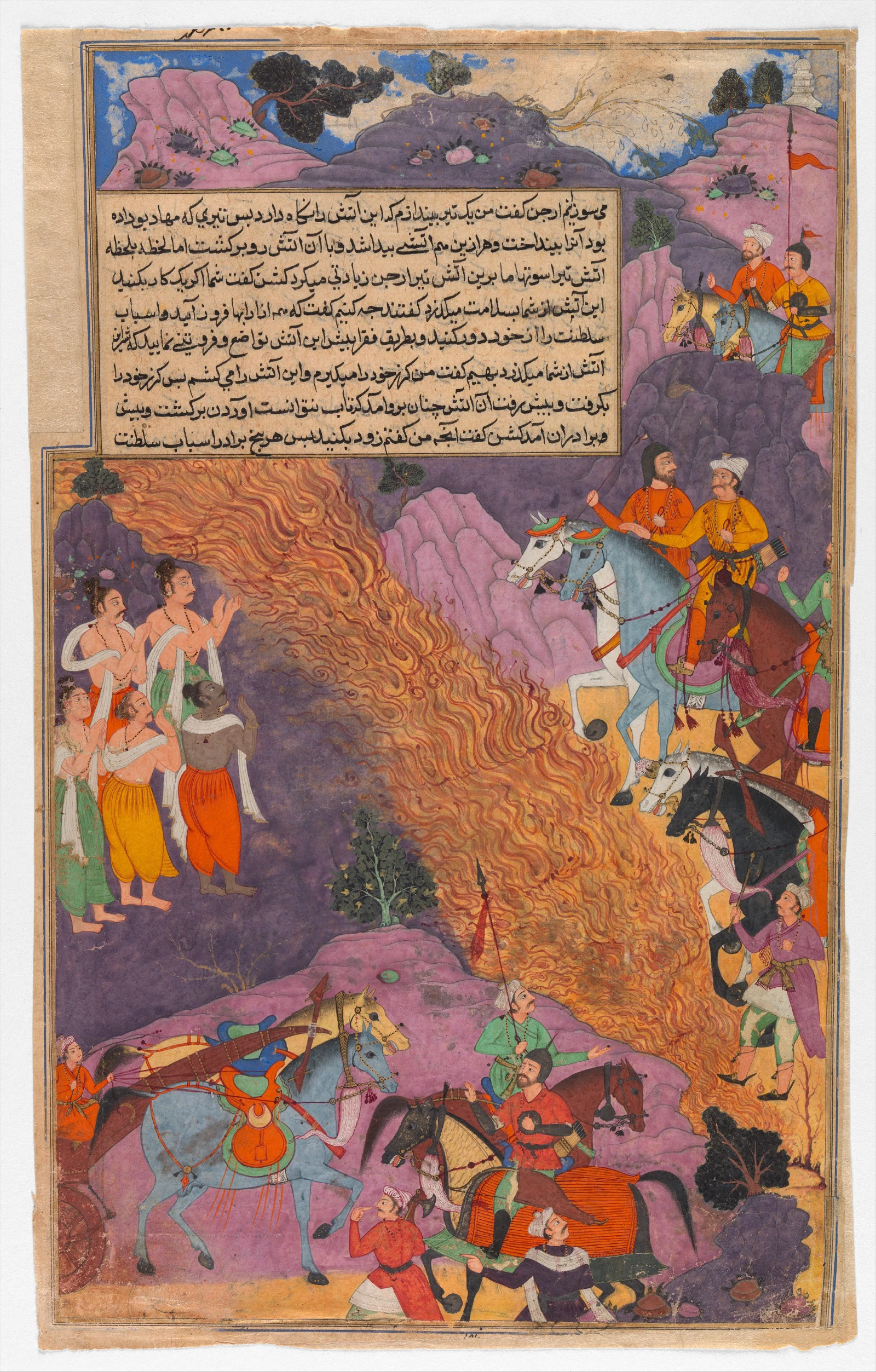
That long process of composition helps explain why the epic places historically plausible martial detail alongside weapons that summon fire, wind, or annihilation. Yet scholars cannot neatly separate the surviving text into an early chariot layer and a later astra layer. Chariots and the Kuru setting connect the epic to the late Vedic world, while divine weapons belong to its mythic register, but the tradition weaves both throughout the surviving work. Language, narrative structure, and comparisons across manuscripts can suggest relative strata, but no single contrast can date a passage by itself. The unevenness reflects more than a continuity error. It shows how the tradition repeatedly recomposed its own past.
What actually happens. Yudhishthira, the eldest Pandava and the embodiment of dharma, is invited to a dice game and loses his kingdom, his brothers, himself, and finally his wife Draupadi. She is dragged into the assembly hall and subjected to an attempted public disrobing while the elders debate whether a man who has already lost himself can still stake his wife. Thirteen years of exile follow, then negotiations fail, then war. Several decisive Kaurava deaths exploit or violate warrior norms: Bhishma is brought down behind Shikhandi, whom he refuses to fight; Drona lays down his weapons after a deliberately misleading report of his son’s death; Karna is attacked while trying to free his chariot wheel; Duryodhana is struck on the thigh in a mace duel that forbids such a blow. Not every Kaurava death follows this pattern, but Krishna advises or approves each of these turns.
The Pandavas win. Their army is also almost entirely dead: Draupadi’s five sons are murdered in their sleep, multiple warriors kill Abhimanyu after being isolated, and the fighting strength of an entire generation is gone. Yudhishthira rules an emptied kingdom without much appetite for it. Years later, Draupadi and the five brothers journey north; one by one, all but Yudhishthira fall, and he refuses to enter heaven without the dog that has followed him.
What’s it arguing about? One powerful way to read the Mahabharata is as a sustained inquiry into dharma’s insufficiency: what happens when available rules conflict, when a king devoted to righteousness gambles away his wife, and when the god on the field recommends acts that violate ordinary warrior norms. Its recurring claim that dharma is subtle is sometimes counsel for humility and sometimes an expression of despair. The stories of Karna and Ekalavya expose conflicts among merit, birth, loyalty, and social authority without offering a clean remedy. The text repeatedly raises objections against its own moral order.
On this reading, it is markedly less consoling than its reputation.
Where the Gita sits. In the Bhishma Parva, at the moment the armies are drawn up, and Arjuna refuses to fight. Eighteen chapters, traditionally counted as 700 verses, and then the war begins. The Bhagavad Gita page explains why the edition displayed here numbers 701.