
Sikhism
Sikhism was founded in the fifteenth-century Punjab by Guru Nanak. What it is, an independent revelation or a synthesis drawing on Hindu and Islamic elements, is a question worth getting right at the start, because the two answers have very different histories. The synthesis reading was popularized by colonial-era scholarship and is still widely repeated; the Sikh tradition itself, as well as most current scholarship, holds that Nanak’s teaching was a distinct revelation that emerged in a context shared with Hindu and Muslim traditions without being derived from either. Nanak’s own reported formulation, that there is neither Hindu nor Muslim, reads better as a rejection of the categories than as an attempt to average them.
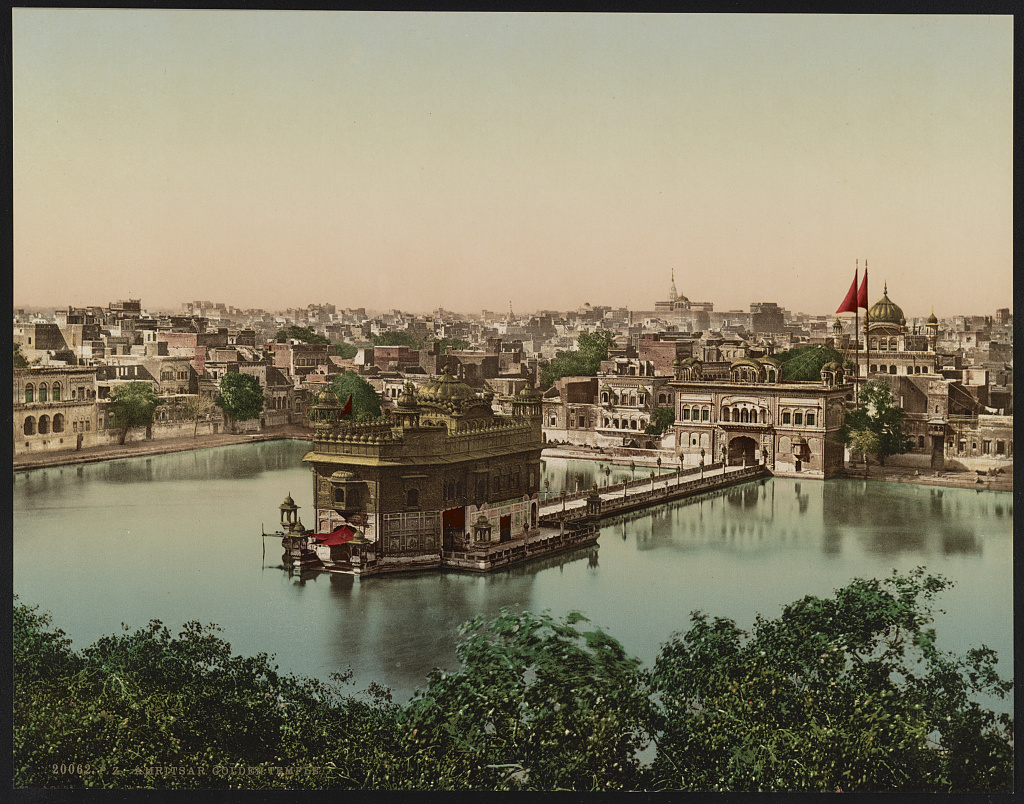
There are roughly 26 million Sikhs worldwide, the large majority in Punjab, with significant communities in the UK, Canada, the US, and East Africa. “Sikh” means disciple.
According to Sikh tradition, at the Baisakhi gathering of 1699, the tenth guru, Gobind Singh, called for volunteers willing to give their lives, took five men one by one into a tent, and emerged each time with a bloodied sword, before revealing all five alive and initiating them into the Khalsa. From this come the Five Ks worn by initiated Sikhs: uncut hair (kesh), a comb (kangha), an iron bracelet (kara), a specific undergarment (kachera), and a ceremonial sword (kirpan).
The occasion carried a deliberate social argument. The five volunteers came from different castes, and Guru Gobind Singh gave Sikh men the shared surname Singh (“lion”) and Sikh women the surname Kaur (“princess”) specifically to erase caste markers from Sikh identity. In practice, many Sikhs now use these alongside family names rather than instead of them, and caste has proved more persistent within Sikh communities than the tenth guru intended.
Sikhism has emphasized gender equality since its founding, and the Guru Granth Sahib, the scripture, treated as the living and final guru after Gobind Singh, opens with the Mul Mantar, a statement of belief in one formless, timeless, self-existent creator. It also contains hymns by Hindu and Muslim poet-saints, including Kabir and Farid, which is a fact worth sitting with in the context of the synthesis question above.
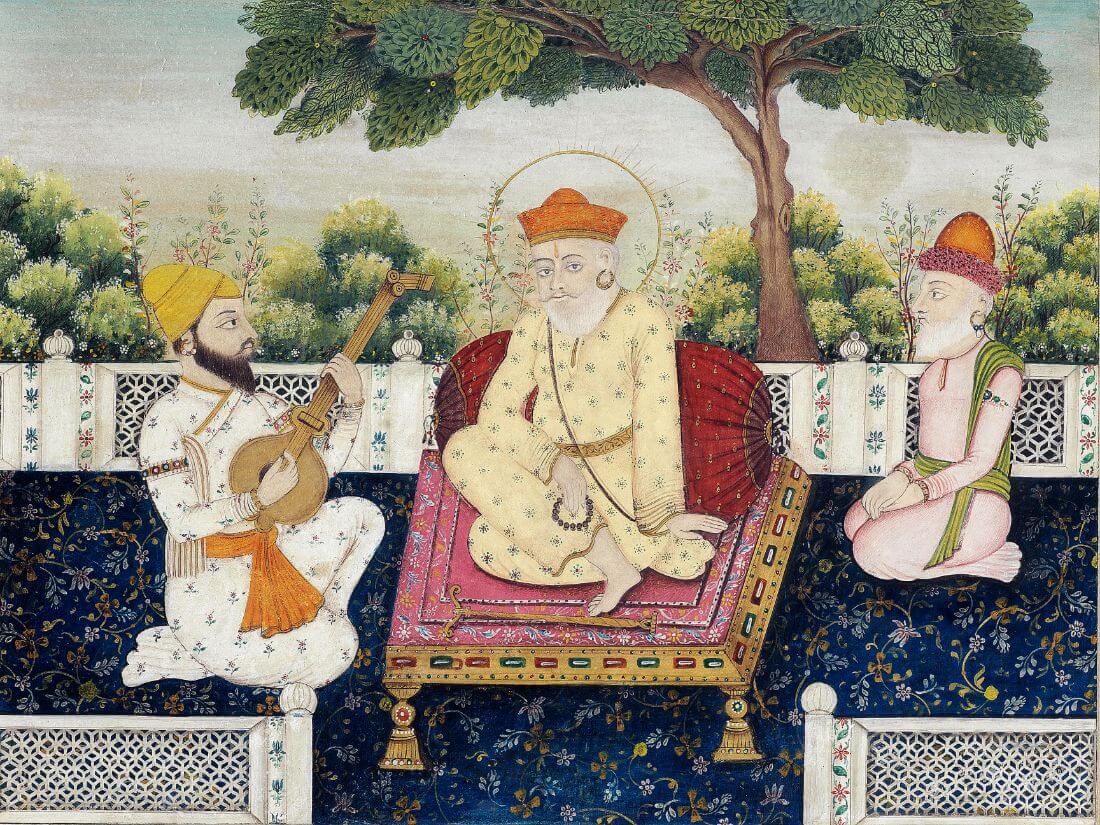
Ten Gurus, and what each added
The line of ten human Gurus runs from Nanak to Gobind Singh, and the tradition understands them as sharing one light in successive bodies rather than as ten separate teachers. Each stage added something institutional.
Nanak established the core practice: remembrance of the divine name, honest labor, and sharing with others. Angad, the second Guru, is credited with the creation of the Gurmukhi script, which gave Punjabi a writing system independent of both Devanagari and Perso-Arabic. Amar Das organized the community territorially and, by tradition, required visitors, including the emperor Akbar, to eat in the common kitchen before an audience. Ram Das founded the city that became Amritsar. Arjan compiled the Adi Granth in 1604 and built the Harmandir Sahib; he was executed under Mughal authority in 1606, the first of the martyrdoms that shaped Sikh self-understanding.
Hargobind responded by taking up two swords representing miri and piri, temporal and spiritual authority, and building the Akal Takht facing the Harmandir Sahib. That is the moment the community acquired an explicitly political dimension. Tegh Bahadur, the ninth Guru, was executed in Delhi in 1675, according to Sikh tradition, for defending the religious freedom of Kashmiri Hindus rather than of his own community. Gobind Singh founded the Khalsa in 1699 and, before he died in 1708, ended the line of human Gurus by vesting authority in the scripture, thereafter the Guru Granth Sahib, and in the collective body of the Khalsa.
The institutions
The gurdwara is open to anyone, and langar, a free meal served without regard to caste, religion, or status, is a central institution. Major gurdwaras serve it daily, while smaller congregations may do so weekly or on particular occasions. The langar is not incidental charity; it is a doctrinal statement about equality enacted by people sitting and eating together, and the same tradition of service helps explain the prominence of Sikh organizations in disaster relief in India and beyond.
Seva, voluntary service, and sangat, the congregation, complete the structure. There is no priesthood: a granthi reads and maintains the scripture but holds no sacramental authority. The Akal Takht at Amritsar functions as the highest temporal seat, and the Shiromani Gurdwara Parbandhak Committee, established in the 1920s after the Akali movement wrested control of gurdwaras from hereditary custodians, administers historic shrines and has been a central institution of Punjab politics ever since.
Empire, and then the loss of it
After Gobind Singh, Banda Singh Bahadur led an armed revolt against Mughal authority before his execution in 1716, and through the eighteenth century, Sikh confederacies fought Mughal and Afghan forces across Punjab. Ranjit Singh unified them, taking Lahore in 1799 and ruling until 1839 over an empire stretching from the Khyber to Kashmir, with a court and army that employed Muslims, Hindus, and Europeans, and a policy of religious even-handedness unusual for its time and place.
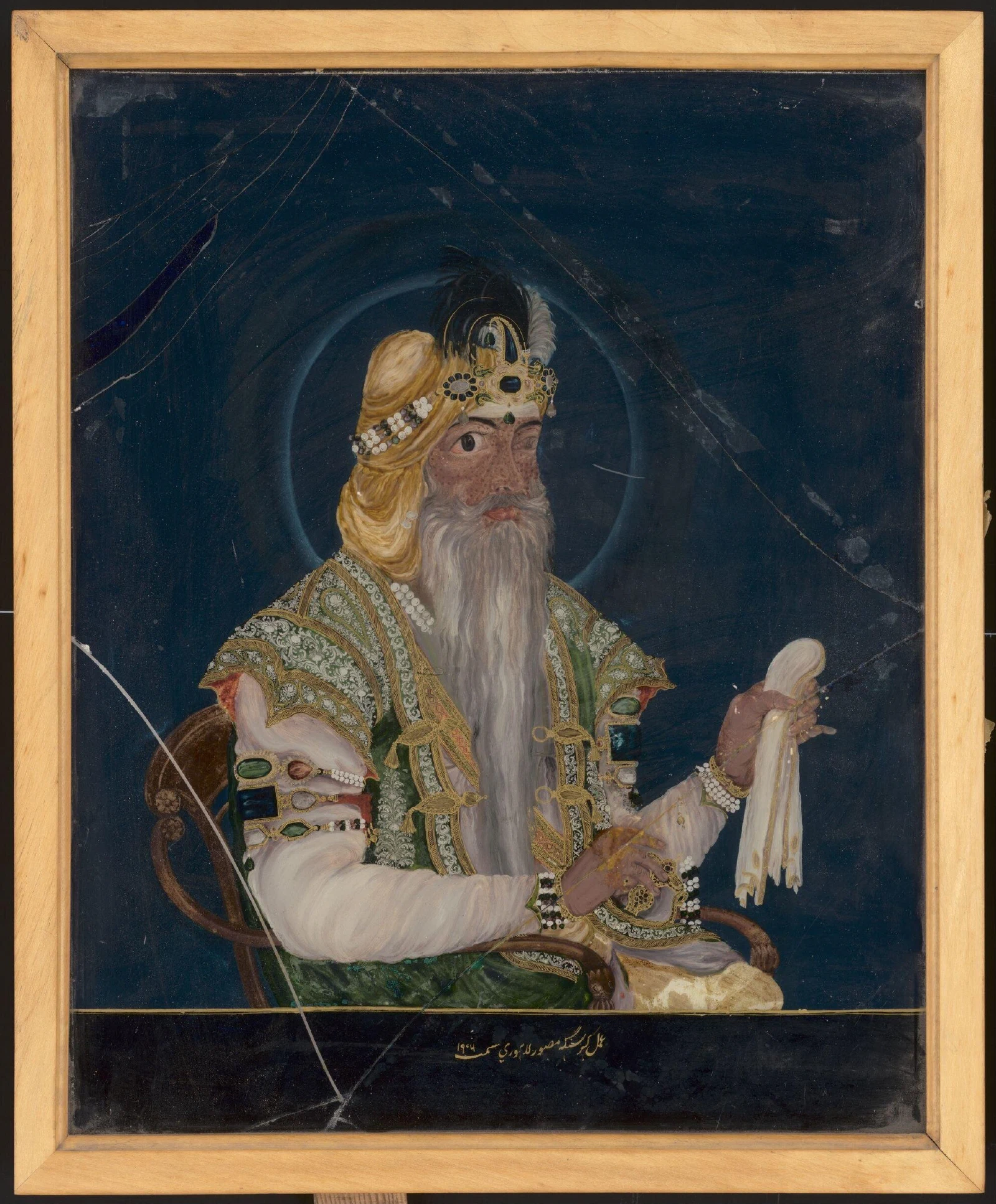
It did not survive him. Two Anglo-Sikh wars in the 1840s ended with the annexation of the Punjab in 1849 and the removal of the Koh-i-Noor diamond to Britain. The British then recruited Sikhs heavily into the Indian Army under the “martial races” theory, standardizing the appearance of the turbaned Sikh soldier and, in the process, reinforcing Khalsa identity as the normative form of Sikhism. The Singh Sabha reform movement from the 1870s pushed in the same direction from within, distinguishing Sikh practice from Hindu ritual, a boundary-drawing process Harjot Oberoi has documented in detail.
1947 and 1984
Partition fell hardest on Punjab, and on Sikhs in particular, since the community was concentrated in the province the line cut through and had no side of it that was theirs. Virtually the entire Sikh population of West Punjab moved east, leaving major shrines, including Nankana Sahib, Nanak’s birthplace, in Pakistan. The government resisted demands for a Punjabi-speaking state for two decades before conceding in 1966.
The 1980s brought the community’s deepest rupture with the Indian state. A movement for greater autonomy, articulated in the Anandpur Sahib Resolution, ran alongside a militant campaign and the rise of Jarnail Singh Bhindranwale, who fortified himself inside the Golden Temple complex. In June 1984, the Indian Army attacked the complex in Operation Blue Star, killing Bhindranwale along with many pilgrims present for a religious anniversary and severely damaging the Akal Takht. In October, Indira Gandhi was assassinated by two of her Sikh bodyguards, and organized mobs killed thousands of Sikhs in Delhi and other cities over the following days, with police standing aside and with credible evidence of participation by Congress politicians. Convictions took more than three decades and remain few.
More than a decade of insurgency and severe counter-insurgency followed in Punjab, with heavy civilian casualties and large numbers of disappearances. The demand for Khalistan retains some support in parts of the diaspora and very little inside Punjab, where the memory is mainly of what the decade cost.
Sikhism and Hinduism share deep historical and cultural threads in Punjab, along with overlapping festivals that mark different events for each community. They also differ substantially in theology, institutions, and identity. How much weight to give the shared threads versus the differences is a live question tied up with all of the above, and this page won’t try to settle it.